
The Great Wall of China Beyond Beijing: Lesser-Known Sections Worth Travelling For
The Great Wall of China is a bucket list item that people plan entire trips around. Not just foreigners, even locals want to see it. There's even a Chinese saying that roughly translates to you're not a real hero until you've stood on the Great Wall (不到长城非好汉, bù dào Chángchéng fēi hǎohàn). Tens of millions of people visit every year, and almost all of them see the same thing: the restored Ming dynasty sections near Beijing, stone battlements snaking along a ridgeline, cable cars, gift shops.No shade here. Despite the masses, that version is genuinely worth seeing, and we've written about how to do it well and skip the crowds.
But the Wall most people visit is just one dynasty's wall, in one province, restored in the 20th century. The real system spans fifteen provinces, crosses two thousand years of history, and looks completely different depending on where you find it. It runs into the Gobi Desert until it crumbles into the sand. It walks into the sea. It ends at the North Korean border. And in one case, it was built not to keep invaders out, but to cage people in.
This guide covers the lesser-known sections of the Great Wall of China worth travelling out of your way to see.
Jiayuguan, Gansu (嘉峪关长城) — The End of the World
There is nowhere in China that feels more like the edge of the world than the Jiayuguan Great Wall (嘉峪关长城). Built in 1372 at the narrowest point of the Hexi Corridor, a strip of land squeezed between the Qilian Mountains and the Gobi Desert, it was the western terminus of the Ming Great Wall and the last outpost before the Silk Road continued into Central Asia. Everything west of this point was, as far as the Ming dynasty was concerned, beyond China, beyond order, and beyond the Emperor's reach. Those exiled by imperial decree left through the western gate, most never to return. The gate earned a grim nickname: the Gate of Demons. Scholars and disgraced officials scratched their grief into the archway walls as they passed through for the final time.
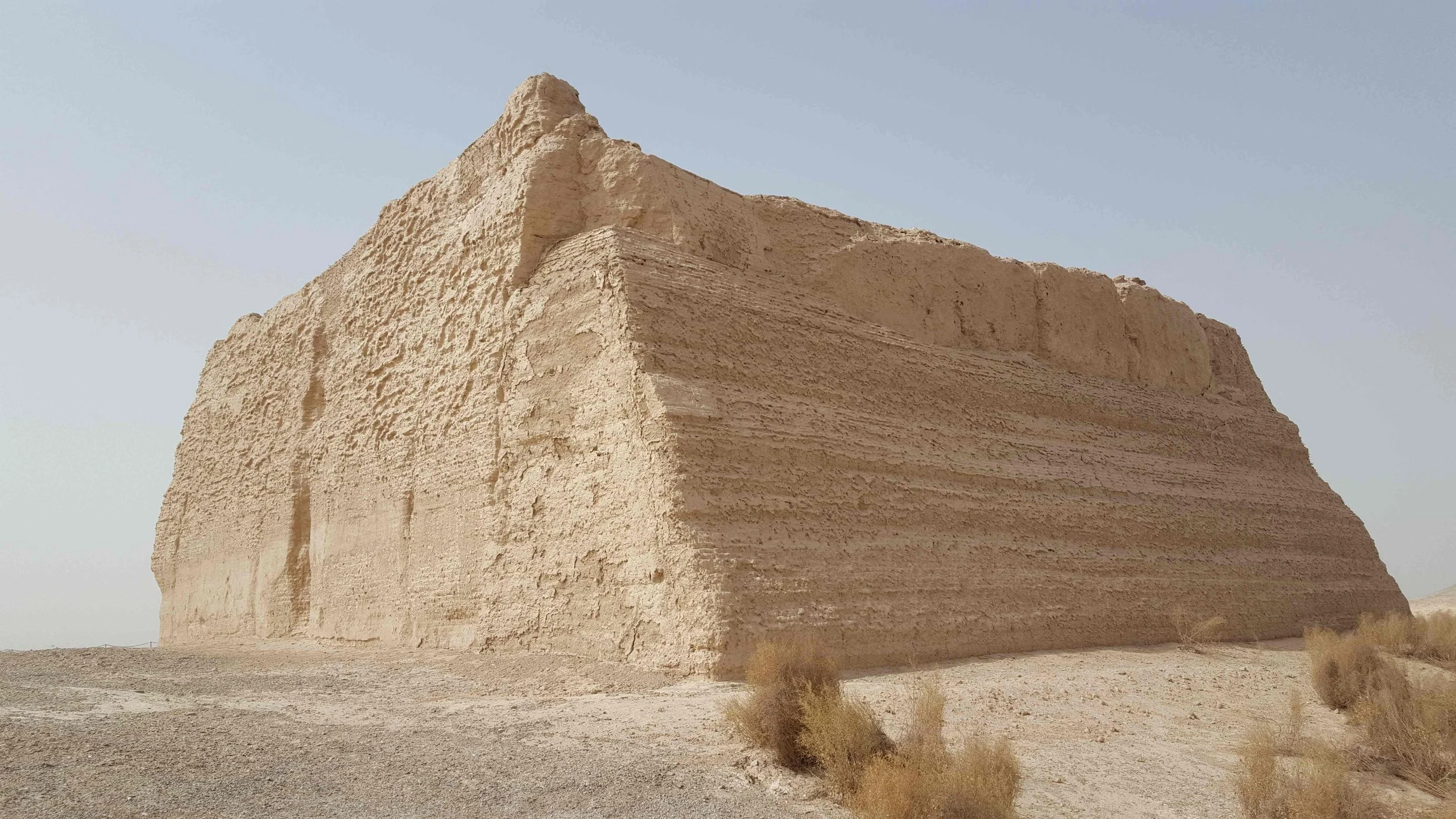
What nobody tells you before you go is that this Great Wall looks nothing like the Great Wall you're probably imagining. There are no stone battlements, no ridgeline, no cable cars. The wall here was built from rammed earth packed around a core of reeds and straw, and centuries of desert wind have worn it down to the point where you can see the straw poking through the surface. You're looking at the skeleton of the wall rather than the wall itself. You don't climb it. You walk alongside it and around the great fortress that sits alone in the middle of the desert. The Qilian Mountains rise to the south, still snow-capped. The Gobi stretches flat to the horizon in every other direction. A friend first showed me photos of this place in 2006 after he visited and I spent twelve years trying to get here. Once I did the reality lived up to what I had imagined, and it was worth the journey.
While you're there: Don't miss the Weijin Tombs just outside the city, an underground gallery of 3rd and 4th century murals depicting Silk Road daily life in vivid detail, mostly skipped by visitors rushing to the fortress. An hour east by high-speed train is Zhangye, where the Danxia Geopark's mineral-stained mountains look painted rather than eroded, red and orange and yellow rock striped across the hillsides in bands. Two hours west is Dunhuang, where the Mogao Caves hold over 45,000 square metres of Buddhist murals carved into desert cliffs from the 4th century onwards, one of the greatest concentrations of Buddhist art anywhere in the world, and one of the coolest things I’ve seen in China.
Laolongtou, Hebei (老龙头长城) — Where the Wall Meets the Sea
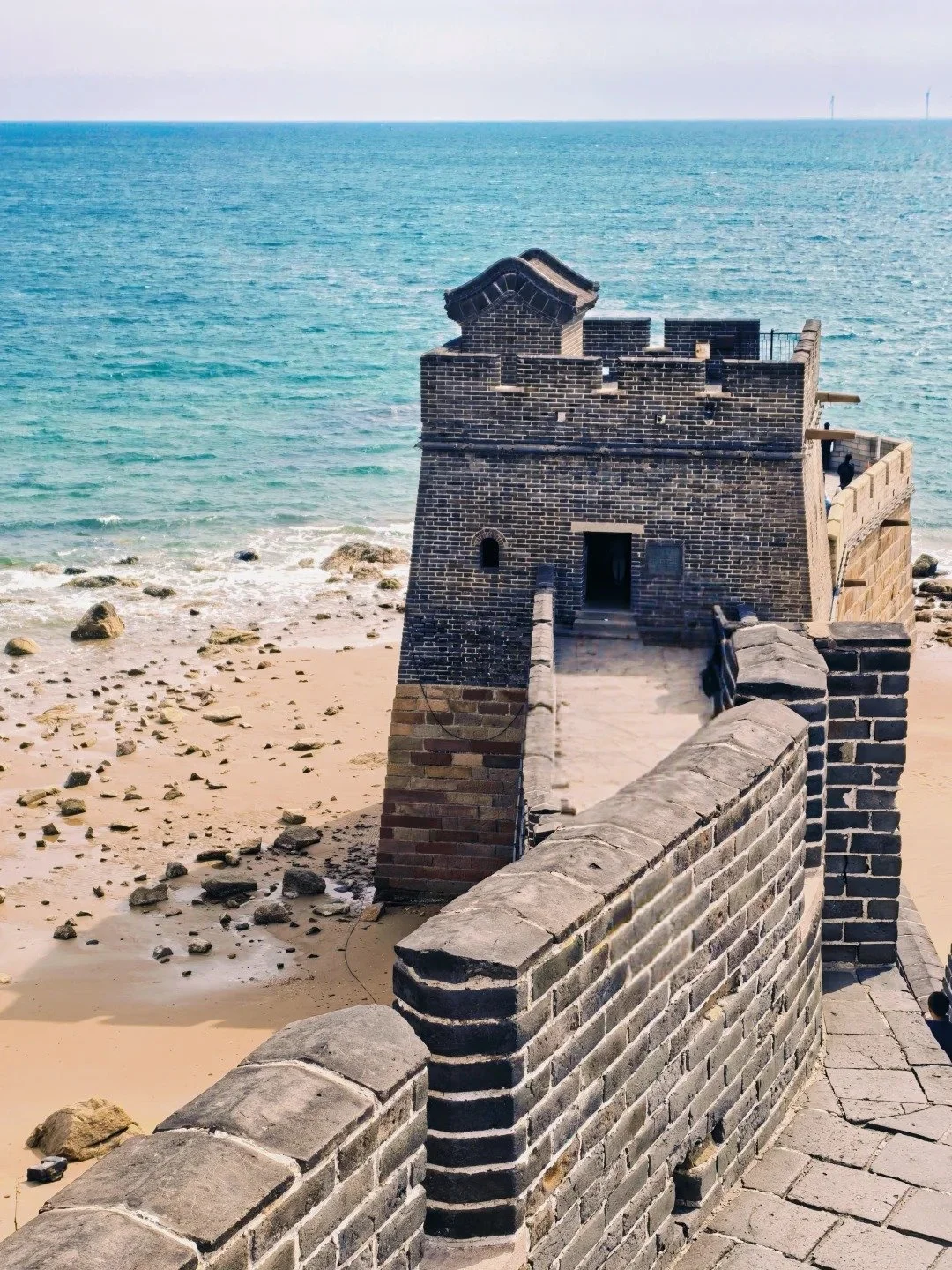
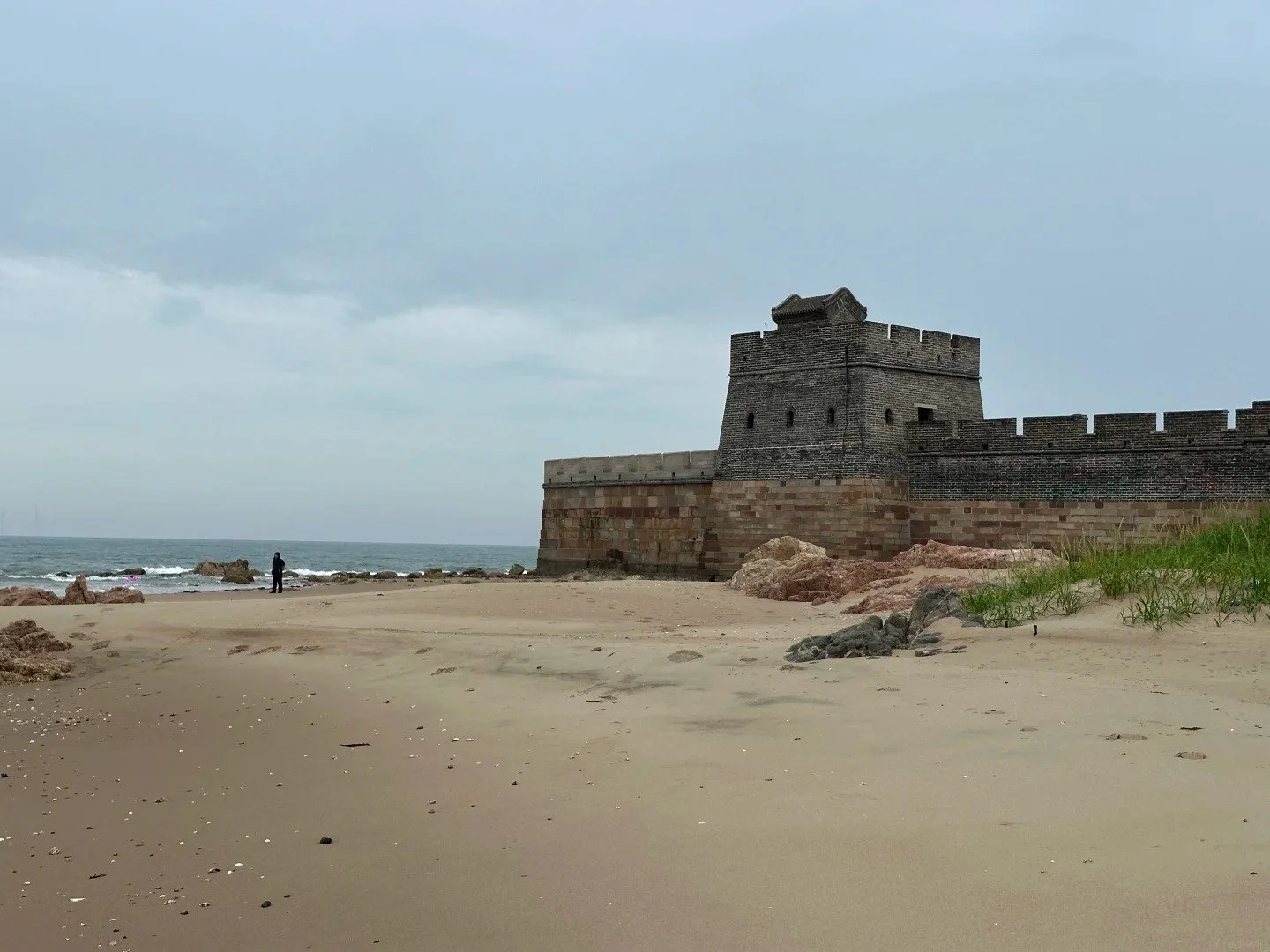
Most people picture the Great Wall snaking endlessly through mountains, battlements stretching to the horizon. What they don't picture is the wall ending. And they certainly don't picture it ending in the ocean.
On the coast of Hebei Province, about three hours from Beijing by high-speed train, that's exactly what happens. Laolongtou, which translates as Old Dragon's Head, has been the symbolic eastern terminus of the Great Wall for centuries. The whole wall was conceived as a dragon stretching across China, and this is its head, plunging into the Bohai Sea. Built in 1381, the wall extends 23 metres into the water, and at high tide the waves break directly against Ming dynasty stonework. These days it's heavily restored, but the image is genuinely arresting in a way that no amount of restoration can diminish. There are things you travel a long way to see simply because the idea of them is so strange, and a 600-year-old military fortification wading into the sea is one of them.
Pair it with Shanhaiguan Pass, a few kilometres up the road, which was for centuries considered the eastern end of the wall before archaeologists pushed that designation further east into Liaoning. Known as the First Pass Under Heaven, the gate tower and fortress here are well preserved and give a strong sense of how the wall functioned as a genuine military system rather than a scenic walk. From Shanhaiguan, the wall immediately climbs Jiaoshan, the first mountain it ascends heading west, where a mix of restored and unrestored sections make for a solid half-day hike with good views back over the coast.
Most people picture the Great Wall snaking endlessly through mountains, battlements stretching to the horizon. What they don't picture is the wall ending. And they certainly don't picture it ending in the ocean.
On the coast of Hebei Province, about three hours from Beijing by high-speed train, that's exactly what happens. Laolongtou (老龙头长城), which translates as Old Dragon's Head, has been the symbolic eastern terminus of the Great Wall for centuries. The whole wall was conceived as a dragon stretching across China, and this is its head, plunging into the Bohai Sea. Built in 1381, the wall extends 23 metres into the water, and at high tide the waves break directly against Ming dynasty stonework. These days it's heavily restored, but the image is genuinely arresting in a way that no amount of restoration can diminish. There are things you travel a long way to see simply because the idea of them is so strange, and a 600-year-old military fortification wading into the sea is one of them.
Pair it with Shanhaiguan Pass (山海关长城), a few kilometres up the road, which was for centuries considered the eastern end of the wall before archaeologists pushed that designation further east into Liaoning. Known as the First Pass Under Heaven, the gate tower and fortress here are well preserved and give a strong sense of how the wall functioned as a genuine military system rather than a scenic walk. From Shanhaiguan, the wall immediately climbs Jiaoshan (角山长城), the first mountain it ascends heading west, where a mix of restored and unrestored sections make for a solid half-day hike with good views back over the coast.
While you're there: The seafood along this stretch of Hebei coast is excellent. Worth knowing for wine lovers: Gloriville Winery is in this area, and it's one we've had our eye on for a while. We couldn't fit it into our upcoming China Wine Trail tour due to timing, but it's high on our list and we'd strongly recommend seeking it out if you're in the region. If the idea of exploring China's emerging wine regions appeals, that tour has plenty more where that came from. [internal link: China Wine Trail tour page]
Hushan, Liaoning (虎山长城) — The Wall Ends at North Korea
Most people have never heard of Dandong. It doesn't appear on the standard China itinerary, and it doesn't need to. But for anyone with even a passing fascination with North Korea, it's one of the most compelling border cities in the world, and the real reason to make the trip.
Dandong sits on the Yalu River in Liaoning Province, directly across the water from the North Korean city of Sinuiju. The city has more North Korean restaurants than anywhere outside Pyongyang, a bombed-out bridge that the US Air Force cut in half during the Korean War and left that way, and a riverfront where locals promenade in the evenings while North Korea sits quietly on the other side. I came as part of a longer tour through Dongbei, primarily to see the border.
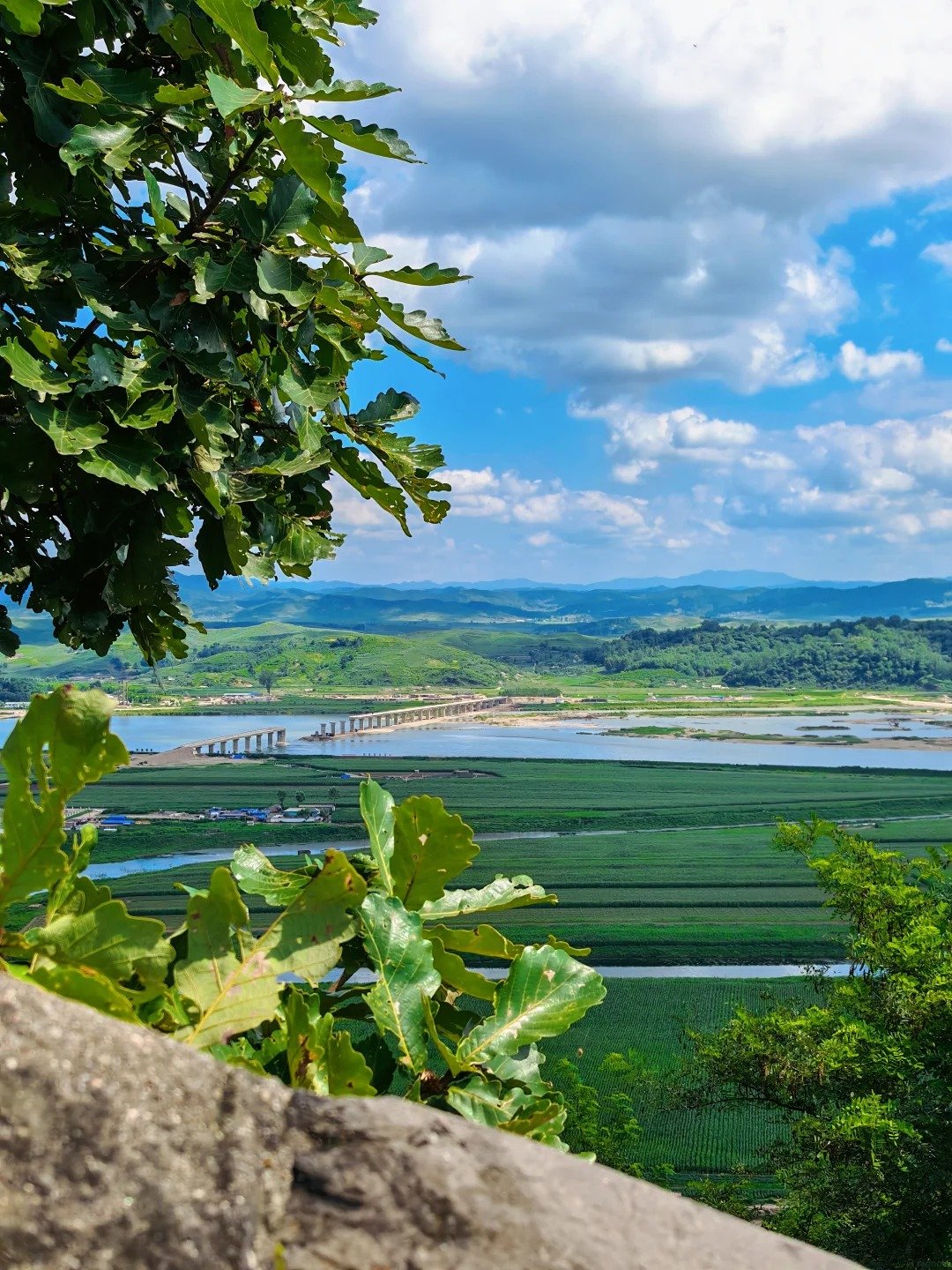
The Great Wall is here too. Hushan (虎山长城), or Tiger Mountain, was confirmed in 1989 to be the true eastern terminus of the Ming Great Wall, not Shanhaiguan as had been believed for centuries. Built in 1469 to defend against Jurchen raiders from the north, it ends right here at the Yalu River, 15 kilometres from the city. The restored section is short, about 1,200 metres, and extensively rebuilt. As a wall experience it's not the most impressive stretch you'll visit. But standing at the top, looking directly across the river into North Korea, watching fields and villages and the occasional guard post on the other side, makes the whole thing worthwhile. There is even a spot near the entrance called One Step to Cross, where the border is close enough to make the geopolitical reality feel slightly surreal.
While you're there: Walk the Yalu River waterfront and take one of the boat trips along the river, which gets you out onto the water and considerably closer to the North Korean bank than you'd think is legal. The Korean War Memorial is worth a visit for the history, told entirely from the Chinese perspective which is illuminating. The food leans heavily Korean, and the cold noodles and Korean BBQ are both excellent. The fresh seafood is some of the best in northeastern China, and one night the group and I ended up at a street barbecue stall eating grilled fish and shellfish, got talking to the people at the next table, and didn't leave for hours. That kind of evening is very Dandong.
Zhenyuan, Guizhou (苗疆边墙) — The Wall Nobody Was Expecting
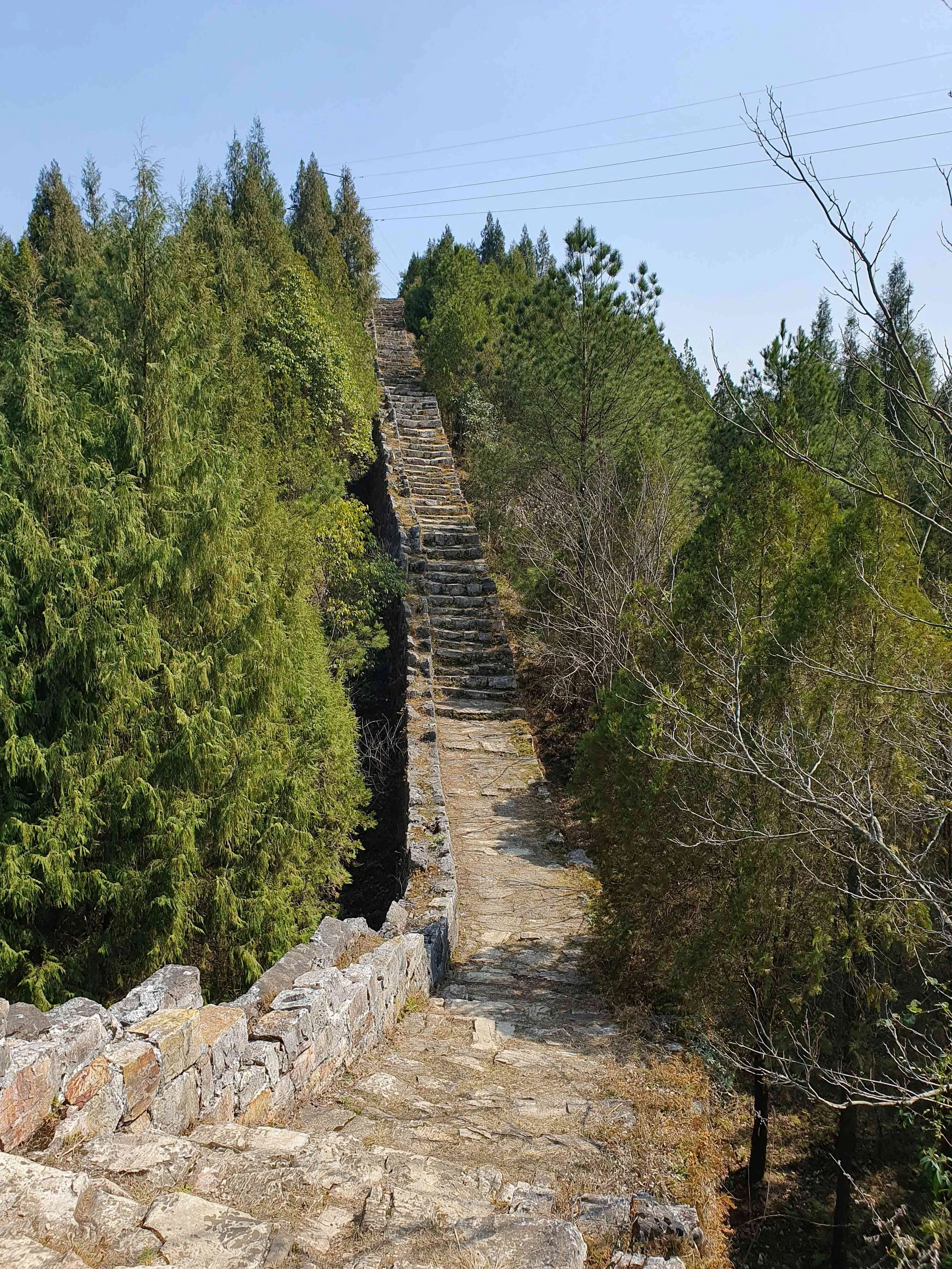
I came to Zhenyuan leading a tour of the water town. Photos of the place had caught our attention — an ancient city folded into the banks of the Wuyang River with old wooden buildings climbing the cliffs on either side. The kind of scene that makes you rearrange an itinerary. We were travelling through Guizhou at the time, spending a few nights here and there visiting Miao and Dong villages across the region, and Zhenyuan was a stop that seemed worth a few days. What we didn't know until we arrived was that there was a Great Wall here too.
Shiping Mountain rises directly above the old town, and the hike up takes an hour or two depending on your pace, climbing through a series of temples as the town and the river slowly open up below you. At the top the mountain flattens into a plateau, quiet and almost entirely empty of other visitors, and then you come to the wall. In places it's wooded on either side. In others it opens up completely, and you can walk to the edge and look straight down into the gorges below. The wall itself is modest, partially ruined, showing its age honestly in a way that the restored sections elsewhere in this article don't.
Built in the early 1500s as part of the Ming dynasty's southern frontier fortification network, this wall wasn't built to keep invaders out of China. It was built to keep people in. The Miao people had lived in these mountains long before the Han Chinese administration arrived, and the wall was one of the tools used to contain them. We'll come to that story in full in the next section, but standing up there above Zhenyuan, knowing what we now know, the view down to the town feels different.
While you're there: Before you climb the mountain, spend time at Qinglong Cave, a complex of Buddhist, Daoist and Confucian temples built directly into the cliff face above the river, sometimes called the Southern Hanging Temple. Thirty-five individual structures are embedded into 300 metres of rock, connected by walkways and stairs cut into the stone, with the Wuyang River running below. The old town itself is worth an extra day. The Wuyang River curves through in a shape locals compare to a yin-yang symbol when seen from above, with the ancient city divided across both banks. From Zhenyuan you're also well placed to continue deeper into Qiandongnan, one of the most ethnically diverse regions in China, with Miao and Dong villages scattered through the hills that are worth several days in their own right.
Fenghuang, Hunan (南方长城) — The Wall That Faced the Wrong Direction
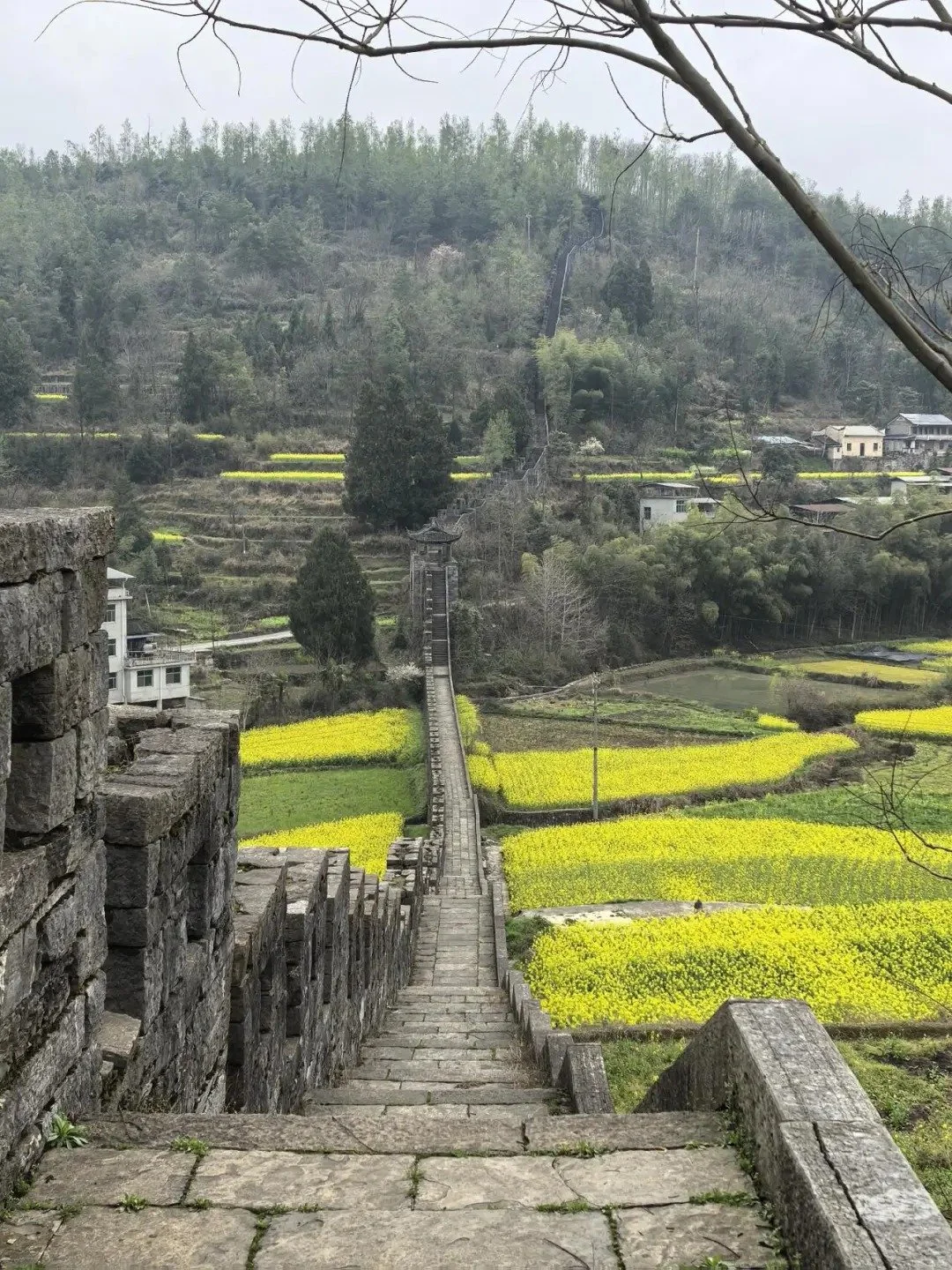
Most Great Walls were built to keep people out. This Southern Great Wall of China (南方长城) was built to keep people in.
From the 15th century onwards, the Ming dynasty constructed a network of walls, garrison towns, and beacon towers stretching roughly 190 kilometres along the Hunan-Guizhou border. The purpose was not to defend against foreign invaders. It was to contain the Miao people, who had lived in these mountains long before Han Chinese settlers and imperial administration arrived, and whose land the empire wanted. The wall divided the region into two administrative zones, with those living outside it classified as unsubmitted and subject to military campaigns launched from the garrison towns within. Fenghuang was the military headquarters for those campaigns. Today it is a Miao and Tujia majority town. The wall built to contain their ancestors sits on the hillside above their descendants. That is the thing to hold in mind as you walk through it.
If you read the Zhenyuan section above, you already know part of this story. That wall and this one are part of the same system, different sections of the same Ming frontier network running through the same mountains for the same purpose. Zhenyuan sits at the Guizhou end, quieter and far less visited, a wonderful introduction to the southern wall with almost none of the crowds. Fenghuang is the Hunan end, and the experience here is a different scale entirely.
The town sits on the Tuo River in western Hunan, old wooden stilted buildings lining both banks, their reflections broken by the current, connected by stepping stones and an ancient covered bridge. It is one of the most photogenic towns in China, which means it draws crowds of enthusiastic domestic tourists. Go early in the morning before the tour groups arrive, or stay late enough to see it after dark when the lanterns come on over the water. The Miao culture here is not incidental. The embroidery, the silver jewellery, the festivals, and the food are all a living tradition. The section of the southern wall above the town is a shorter and easier hike than the climb up Shiping Mountain in Zhenyuan, and the view back down over the old city and the river is reason enough to make it.
While you're there: The Dehang Scenic Area, a couple of hours north, is a deep gorge cut through karst mountains with Miao villages perched on the slopes, far less visited than Fenghuang itself. If you time your visit right, Miao festivals here are some of the most extraordinary in China, with the Sisters' Meal Festival in spring and the Miao New Year in autumn both worth planning a trip around.
The Wall Is Never Just One Thing
The Great Wall of China is not a single object. It is the accumulated result of different dynasties, different materials, different enemies, different politics, and two thousand years of building and rebuilding across a continent-sized country. The version near Beijing is the version that survived long enough to become the symbol. These are the versions that survived to tell a more complicated story.
What connects them is not the stone or the rammed earth or the brickwork. It's the fact that every one of these walls meant something to the people who built it and something different again to the people it was built against. Standing at Jiayuguan, you feel the weight of being at the edge of the known world. Standing above Fenghuang, you feel the weight of what a wall can mean when it faces inward.
If any of these sections have sparked something, we'd love to help you plan a trip around them. China is endlessly surprising, and the further you get from the standard itinerary, the more it rewards you.
Frequently Asked Questions
-
The Ming Great Wall runs from Hushan in Dandong, Liaoning Province in the east, to Jiayuguan in Gansu Province in the west. Hushan was confirmed as the true eastern terminus in 1989, replacing the earlier assumption that Shanhaiguan in Hebei was the end. In the west, Jiayuguan fortress marks the point where the wall meets the Gobi Desert.
-
Yes. The Great Wall system spans fifteen provinces across China, and many of the most historically significant sections are far from Beijing. Jiayuguan in Gansu, Laolongtou in Hebei, and Hushan in Liaoning are the western, symbolic eastern, and true eastern termini of the Ming Great Wall respectively. There is also a Southern Great Wall system in Hunan and Guizhou provinces, built to contain the Miao ethnic minority rather than repel northern invaders.
-
The Southern Great Wall, also called the Miao Frontier Wall (苗疆边墙), is a Ming dynasty military fortification stretching roughly 190 kilometres along the Hunan-Guizhou border. Unlike the northern Great Wall, it was built not to repel foreign invaders but to contain the Miao ethnic minority, who had resisted Han Chinese imperial expansion into their territory. The best-preserved sections are near Fenghuang in Hunan and Zhenyuan in Guizhou.
-
Jiayuguan is worth visiting for travellers interested in seeing a fundamentally different version of the Great Wall. Unlike the restored stone sections near Beijing, the wall here is made from rammed earth and straw, partially dissolved by centuries of desert wind. The fortress complex is well preserved, the surrounding Gobi Desert landscape is dramatic, and the site sits on the ancient Silk Road with other nearby attractions including the Mogao Caves in Dunhuang and the Danxia Geopark in Zhangye.
-
From the Hushan Great Wall near Dandong in Liaoning Province, visitors can look directly across the Yalu River into North Korea. The wall ends at the river, which forms the border between China and North Korea at this point. North Korean villages, fields, and watchtowers are visible from the top of the restored wall section, and from a riverside spot near the entrance known as One Step to Cross.
-
Fenghuang is one of the most visually striking ancient towns in China, with stilted wooden buildings lining the Tuo River and well-preserved Miao and Tujia cultural traditions. It draws large domestic tourist crowds, particularly on weekends and during national holidays, so visiting early in the morning or staying for the evenings is recommended. The Southern Great Wall section above the town adds a significant historical layer to the visit that most travellers are unaware of.
-
The Great Wall of China passes through fifteen provinces, autonomous regions, and municipalities, including Hebei, Beijing, Tianjin, Shanxi, Inner Mongolia, Liaoning, Jilin, Heilongjiang, Shandong, Henan, Shaanxi, Gansu, Qinghai, Ningxia, and Xinjiang. The Ming dynasty sections, which are the most visited and best preserved, run primarily through northern China from Liaoning in the east to Gansu in the west.