
Best Food Tours in China (2026)
Updated October 2026
The best food tours in China depend on trip length. For a single day, Lost Plate (Beijing, Chengdu), UnTour Food Tours (Shanghai, Beijing) and Saint Cavish Food Tours (Shanghai, Suzhou) lead the field. For multi-day trips, Off the Eaten Track, The Food Adventure Club and Boutique China (Yunnan) build every day around food, while WildChina, Intrepid Travel and Shan China Tours pair it with wider sightseeing.
Off the Eaten Track is our company, and it appears in this guide. We've said plainly what each operator does and doesn't offer, ours included.
How we chose these food tours
We included operators that run English-language food tours in China, then looked at four things: how long they have been operating, how much local access their guides have, whether food shapes the itinerary or sits alongside other sights, and how large the groups are. We haven't ranked them from best to worst. Each is grouped by what it is built for.
China food tours compared
| Operator | Best for | Where | Length | Group size | Price |
|---|---|---|---|---|---|
| Lost Plate | Sightseeing plus evening food crawls | Beijing, Chengdu | Full day | Max 10 | USD 175 to 305 |
| UnTour Food Tours | Breakfast and dinner tours focused purely on food | Shanghai, Beijing, Chengdu, Hong Kong | 3 hours | Max 10 to 12 | RMB 525 to 640 |
| Saint Cavish Food Tours | Private, in-depth tours | Shanghai, Suzhou, elsewhere on request | 4 hours (Shanghai), full day (Suzhou) | Private | On request |
| WildChina | Off-route cultural travel, including Fuchsia Dunlop's Yunnan food tour | Yunnan, multiple provinces | 10 to 12 days | Max 12 | USD 5,250 to 10,980 |
| Intrepid Travel | First-time visitors who want food alongside the major sights | Beijing, Xi'an, Chengdu, Hong Kong | 8 to 19 days | Max 12 | USD 1,595 to 6,245 |
| Shan China Tours | Private, personalised trips through the classic regions | Sichuan, Yunnan, Guizhou, Zhangjiajie, Guilin | Custom | Private and small group | On request |
| The Food Adventure Club | Food-first trips led by Amy or her team | Sichuan, Guizhou, Chongqing, Guangdong | 9 to 10 days | Max 18 | USD 2,600 to 3,400 |
| Boutique China | Home cooking, markets and community access | Yunnan | 7 to 10 days | Max 8 | USD 2,390 to 3,590 |
| Off the Eaten Track | Food-first tours in very small groups | Henan, Hebei, Ningxia, Yunnan | 13 to 15 days | Max 10 | AUD 8,500 to 11,044 |
Why eating well in China takes some help
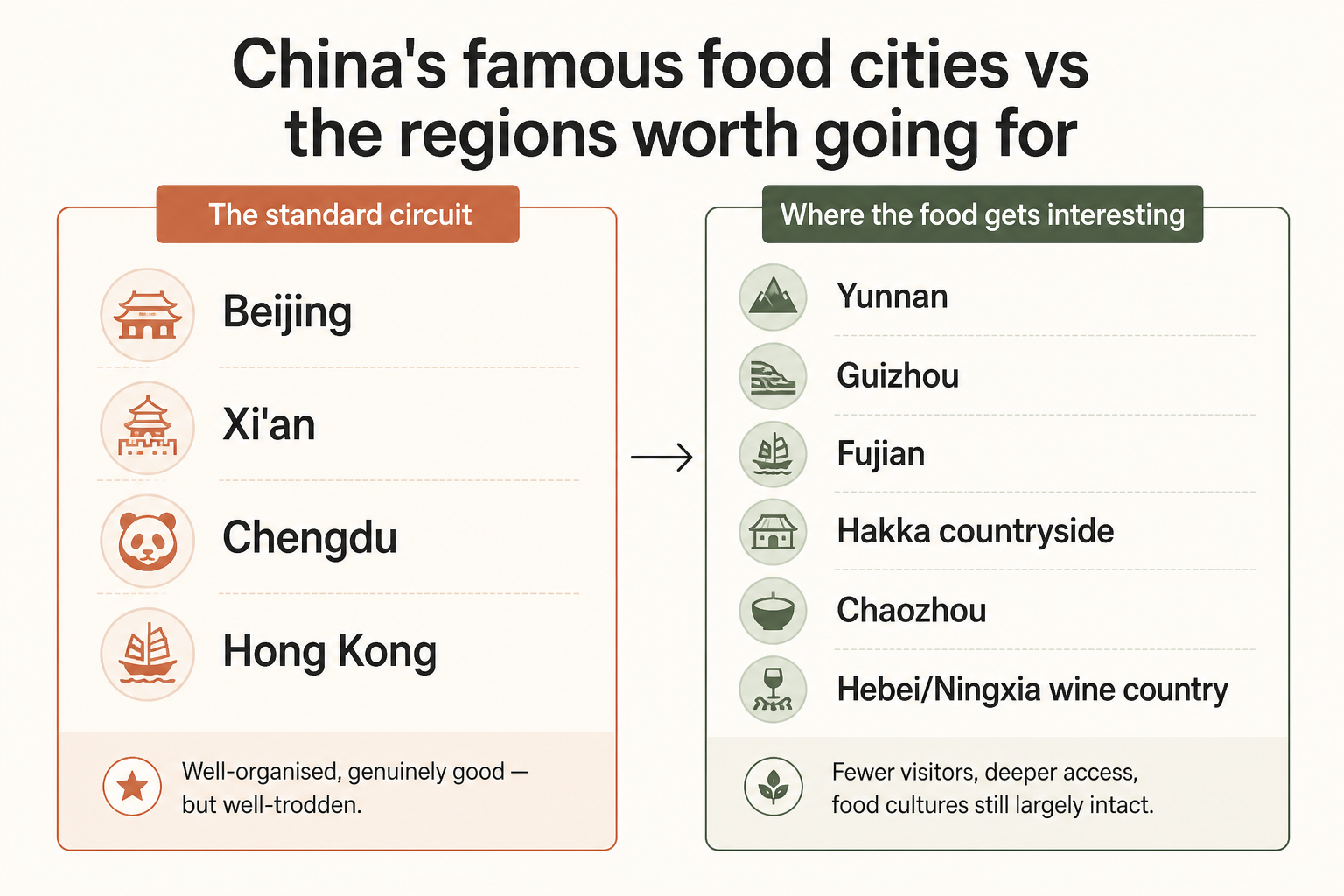
China has eight major cuisine traditions and dozens of sub-regional ones. Most Western travellers arrive with a mental map built from takeaway: Cantonese roast duck, Sichuan mapo tofu, dim sum on trolleys. But Chaozhou, Yunnan's river valleys and the Hakka countryside of Guangdong have food cultures that plenty of people in Beijing or Shanghai have never properly eaten either.
The bigger barrier is digital. A VPN restores Google and Instagram, but it doesn't help you read Dianping, where Chinese diners look up where to eat, or Xiaohongshu, where they post the places worth going to. A restaurant that has been good for 20 years often has no Google Maps listing, and the stall locals queue for at 7am has no TripAdvisor page. Payment adds another step. Most places run on WeChat Pay or Alipay, which both accept foreign cards now but still need setting up in advance. Our guide to the essential apps you need before visiting China helps you get ready before a trip.
The operators below do that navigation for you.
Best day food tours in China
Day tours suit travellers who are already in China and want one food experience to build a morning or evening around. The best ones take you somewhere the guidebooks haven't mapped, or introduce you to someone who has been eating in one city long enough to know where the real things are.
Lost Plate
Lost Plate is a food tour company that has run full-day tours in Beijing and Chengdu since 2013. In more than a decade of tours, its guides have kept dealing with the same vendors, so they know the person behind the counter by name and can get you a bowl of something that isn't on the menu.
In Beijing, the day runs from early morning to late evening. It starts with the Great Wall at Mutianyu, followed by a farmhouse lunch on the way back and an evening food crawl through the hutongs. The evening covers four or more stops in backstreets that don't appear on English-language lists, finishing at a spot serving what the neighbourhood eats. Transport, the cable car and toboggan, and all food and drink are included.
In Chengdu, the day starts at the Panda Base, then moves to a fly restaurant for lunch. That is the Sichuan term for a small, unremarkable-looking spot where locals eat every day because the food is good and the price is right. The evening runs by tuktuk through the streets for three and a half hours and finishes at a plum wine bar. Everything is included, and the dishes include dandan noodles, chaoshou wontons, mapo tofu and tea-smoked duck.
Lost Plate also runs shorter tours of a few hours in other cities, including Chongqing, Guangzhou and Shanghai.
Lost Plate has hosted more than 75,000 guests, has over 5,400 reviews, and has been featured in the Washington Post and National Geographic.
What you get: two of China's great food cities in full-day depth, plus shorter tours in Chongqing, Guangzhou and Shanghai, with guides who have spent years building relationships with vendors.
What you don't get: coverage of China's wider regional diversity. Lost Plate's full-day tours focus on Beijing and Chengdu, and its shorter tours cover a handful of other cities, so regions such as Yunnan or Fujian would need a different trip.
UnTour Food Tours
UnTour Food Tours has run food tours in Shanghai since 2010, and now also runs breakfast and dinner tours in Beijing and food tours in Chengdu and Hong Kong. Sixteen years of tours in one city shows in the detail: which stall opens at 6am and makes the best pan-fried pork buns (生煎包, shengjian bao) in the city, which hole-in-the-wall in a former factory building serves hand-pulled noodles to a room full of construction workers, and which neighbourhood still has the original Shanghainese food culture intact.
In Shanghai, the breakfast tour starts at 9am and moves through historic neighbourhoods and local vendors, where the menu is a piece of cardboard on the wall and the queue is mostly locals on their way to work. The evening tour covers more ground, moving from Shanghai's own Jiangnan cuisine to dishes from the northwest, the south and Sichuan. The city works as a meeting point for China's food cultures, and the tour makes that visible.
In Beijing, the hutong breakfast runs on Thursday and Sunday mornings. The Old Beijing dinner runs most nights except Wednesday and Saturday, moving through a hutong neighbourhood to eat traditional dishes at tables shoulder to shoulder with the people who live there.
UnTour's guides are food writers and industry professionals with strong language skills, and the company has been featured in CNN, the BBC, the New York Times, National Geographic and Travel + Leisure. For understanding what Shanghai eats, it is the obvious starting point.
What you get: depth in the cities it operates in, with guides who understand food at the level of people who write about it for a living.
What you don't get: regional China. UnTour works in Shanghai, Beijing, Chengdu and Hong Kong, so the countryside and the minority cuisine traditions need a different kind of trip.
Saint Cavish Food Tours
Saint Cavish Food Tours is a private food tour company run by Christopher St. Cavish, with tours in Shanghai and Suzhou and elsewhere in China on request. St. Cavish has lived in Shanghai since 2005. Before that he cooked in fine-dining Western kitchens for a decade, and over the past 20 years he has documented Chinese food through magazine and newspaper writing and a documentary series he hosts.
Tours are private, small and priced on request. The signature Shanghai tour, "Shanghai in a Dumpling", runs four hours across four stops, using two kinds of soup dumplings, pan-fried pork buns and noodles as a route through modern Shanghai's urban history and food culture. Fuchsia Dunlop, whose books on Chinese food are among the best written in English, put it this way: "Chris's decades of experience scouting out the best and most interesting Chinese foods and food-makers make him the perfect guide."
He also runs a Suzhou day tour, best done as a full day and built around the Yangtze River Delta's seasonal ingredients. It moves from an old-school grandma restaurant to contemporary Suzhou elegance. For anywhere else in China, you name the place and he'll tell you what it costs.
Availability in the second half of 2026 is limited while he finishes a book and shoots the third season of his video documentary series, so more lead time helps.
What you get: 20 years of expertise in Chinese food, delivered privately in the city where he has spent most of his adult life. This is the most intellectually serious food tour available in Shanghai.
What you don't get: group energy, a fixed departure calendar or published pricing. Booking starts with a conversation rather than a checkout page, and he will tell you plainly what he can do.
Best multi-day food tours in China
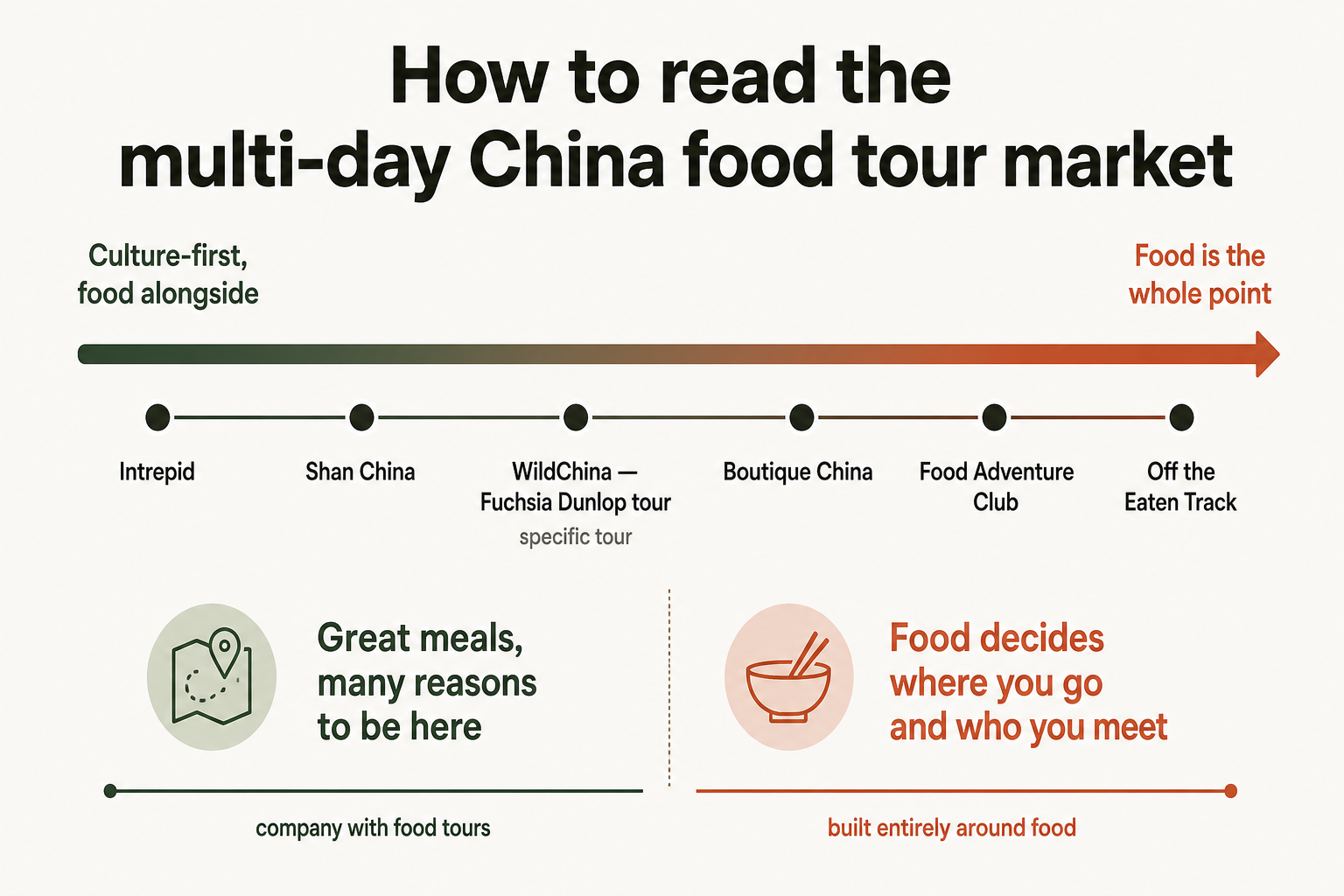
A multi-day food tour hands the whole lo gic of the journey to someone else's expertise: what gets eaten, where it comes from and what it means. Operators range from those who treat food as one lens among several, pairing good meals with the country's cultural sites, to those who build every day around eating and choose regions because the food there rewards a guide with years of local access.
Multi-day China tours that pair food with sightseeing and culture
These operators take China's food seriously and eat well wherever they go. Food isn't the organising idea of the itinerary, though. It sits alongside architecture, landscape, history and culture as one of several reasons to be somewhere.
WildChina
WildChina is a small-group and private travel company, founded in 2000 by Yunnan native Mei Zhang, that focuses on China beyond the standard tourist circuit. Its routes and regions weren't on any English-language map when the company launched. Food has always been part of that, since you eat differently in places most people don't go, but the travel comes first.
Small-group tours cap at 12 people and cover Yunnan's ancient tea horse road, off-route hiking in the GUDAO trail network and cultural immersion across multiple provinces. Awards include Condé Nast Traveler 2026, National Geographic Best Adventure Travel Company and Virtuoso Partner of the Year.
The food angle has become more explicit on some of their tours. The 2027 calendar includes a gastronomic Yunnan journey through tea-farming regions and mountain villages, led by Fuchsia Dunlop, who has probably done more than anyone to introduce China's regional cuisines to Western readers. The tour sells on her name, and deservedly so.
What you get: a culturally serious journey through parts of China most operators don't reach, with food that reflects regional knowledge. The Fuchsia Dunlop tour is a food-first trip led by one of the best food writers working on China today.
What you don't get: a trip structured entirely around the best things to eat. WildChina's strength is the breadth of its travel, from landscapes to cultural access to off-route itineraries. Food is present and good, but it isn't the organising idea.
Intrepid Travel
Intrepid Travel is one of the world's largest adventure travel companies, running structured group departures with a China food programme built for first-time visitors. Its China Real Food Adventure is a 10-day trip through Beijing, Xi'an, Chengdu and Hong Kong, with hands-on food experiences woven between the major sights: a noodle-making class in a local home in Xi'an, the Muslim Quarter food crawl, Sichuan hot pot, a cooking class at the Sichuan Cuisine Museum and dim sum in Hong Kong.
Groups cap at 12, the food experiences are hands-on rather than staged, and the logistics of four cities in 10 days are handled for you.
The trade-off is the usual one for a highlights tour. The cities are China's most visited, and the experience within them, while better than going independently, stops short of the depth that comes from years of local relationships. For a first trip to China where food matters but isn't the only reason to go, it works well.
What you get: a well-organised introduction to China's most famous food cities, with hands-on food experiences built in and the logistics taken care of.
What you don't get: coverage of China beyond Beijing, Xi'an, Chengdu and Hong Kong. The regions where regional food cultures are still largely intact and less visited aren't on this itinerary.
Shan China Tours
Shan China Tours is a private and small-group operator covering Sichuan, Yunnan, Guizhou, Zhangjiajie and Guilin, with guides who know those regions well and groups small enough to go where a coach tour can't. Every itinerary is built around the traveller rather than a template: you tell them when you want to go and what you want to see, and they build around it. That level of personalisation is unusual at their scale.
Testimonials lean towards multi-generational family travel and private groups, which suits an operator built for people who want a real guide and a flexible itinerary rather than a bus schedule.
The regions are China's more established tourist destinations. Shan China makes the standard circuit as good as it can be, at your pace and to your brief.
What you get: private, personalised travel through China's most recognisable regions, with an itinerary built around what you want rather than a fixed departure.
What you don't get: a food-first itinerary or the food regions further off the standard circuit. Food is part of the experience but doesn't shape the plan.
Multi-day China food tours built entirely around food
These operators treat food as the reason for being in China. It decides where you go, who you meet and what each day sets out to understand. The regions they work in reward that focus, because the food is regionally distinct and the access takes years to build.
The Food Adventure Club
The Food Adventure Club is a food tour company run by Amy, known online as Blondie in China, who has more than 600,000 YouTube subscribers, more than 370,000 Instagram followers and over 2 million followers on Chinese social media. Her Mandarin, honed at Tsinghua and Fudan, lets her have conversations other guides can't. She has visited more than 60 Chinese cities and built regional food knowledge that is hard to match in English-language food tours.
The Southwest China tour spends 10 days moving through Sichuan, Guizhou and Chongqing. It covers Chengdu, Leshan's snack streets, a bamboo banquet in Yibin, Guizhou's fermented and sour food traditions and Chongqing's nuclear hot pot. The Guangdong tour is nine days through the Cantonese heartland, taking in Guangzhou's yum cha trolleys, Shunde's roast goose, Chaozhou's congee hot pot and 21-step gongfu tea ceremony, and a Hakka countryside homestay.
The guides she has assembled include Harry Li, a Wall Street Journal contributor who grew up in Tibetan areas of Sichuan; Shanshan Mei, a food journalist and editor-in-chief of Flavorful Planet; and Yujia He, who translated Fuchsia Dunlop's Shark's Fin and Sichuan Pepper into Chinese.
Three points are worth knowing before booking. The maximum group size is 18, which is closer to a standard group tour than the boutique format the branding suggests. Not every departure is hosted by Amy, because Foodie Crew-hosted tours run with trained guides in her place. And the tours run in partnership with Intrepid Travel, which handles the logistics. That brings scale and operational reliability, though it means operating within a larger commercial structure than a fully independent boutique operator.
What you get: itineraries built on deep regional knowledge, in regions where the food rewards are exceptional.
What you don't get: a small group, guaranteed time with Amy or the independence of a fully boutique operator. The knowledge behind these tours is real, but the format is closer to a large group tour than it first appears.
Boutique China
Boutique China, in partnership with Little Chinese Everywhere, runs small-group tours in Yunnan built around home cooking, markets and community access. The itineraries cover northwest Yunnan's Tibetan highlands, the Hani rice terrace culture of Honghe and the Dai food culture and rainforests of tropical west Yunnan. Tours run seven to 10 days, and groups are capped at eight.
Yunnan is China's most biodiverse province and has more distinct ethnic minority food traditions than any other region in the country. What people eat here, and why, reflects the landscape in ways that differ from anywhere else in China.
Boutique China is a Yunnan specialist, so a trip through Sichuan, Guizhou or the Pearl River Delta needs a different operator.
What you get: access to Yunnan's food cultures in a small group, at a price point that is accessible for the level of organisation involved.
What you don't get: coverage of China beyond Yunnan. For a broader sweep of the country, you'll need a different operator.
Off the Eaten Track
Off the Eaten Track is a boutique tour company, founded by Michael Minsky and Beth Brash, that runs very small food-first tours in China. Michael and Beth spent years living in and travelling through China, learning the food and building the relationships behind the itineraries. No two tours are exactly the same, because routes and offerings change every year. Private tours are also available.
There are three China tours in 2027. China's Heartland runs for 13 days in May, through the province where Buddhism arrived in China and kung fu was born. It moves from Kaifeng, the suppoesd birthplace of xiaolongbao, and the Jun ware kilns of Shenhou to Shaolin Temple and the Song Mountains, then to Luoyang, where century-old restaurants still serve the 24-course imperial soup banquet known as the Luoyang water banquet .
China's Wine Trail runs for 15 days in August, going from vineyards in Hebei near the Great Wall to Ningxia's desert plateau and its Hui lamb dishes, then to the herb-forward cooking of Yunnan's minority communities, following a Chinese wine industry that has quietly become one of the most interesting in the world.
China's Wild Southwest runs for 13 days from October to November, through Guizhou's Ming dynasty garrison villages, Asia's largest waterfall, the karst peaks of Wanfenglin and the sacred mountain of Fanjingshan, experiencing the unique flavours of this incredible region along the way. It ends in the Miao heartland for Miao New Year.
What you get: food-first travel in regions chosen for their food, in small groups or privately, with relationships with local producers and cooks and an itinerary built entirely around understanding what you're eating.
What you don't get: a highlights tour of China's most famous cities, or a trip designed around monuments with meals alongside. Off the Eaten Track suits travellers who come to China for the food and want it to lead them somewhere new.
How to choose a food tour in China
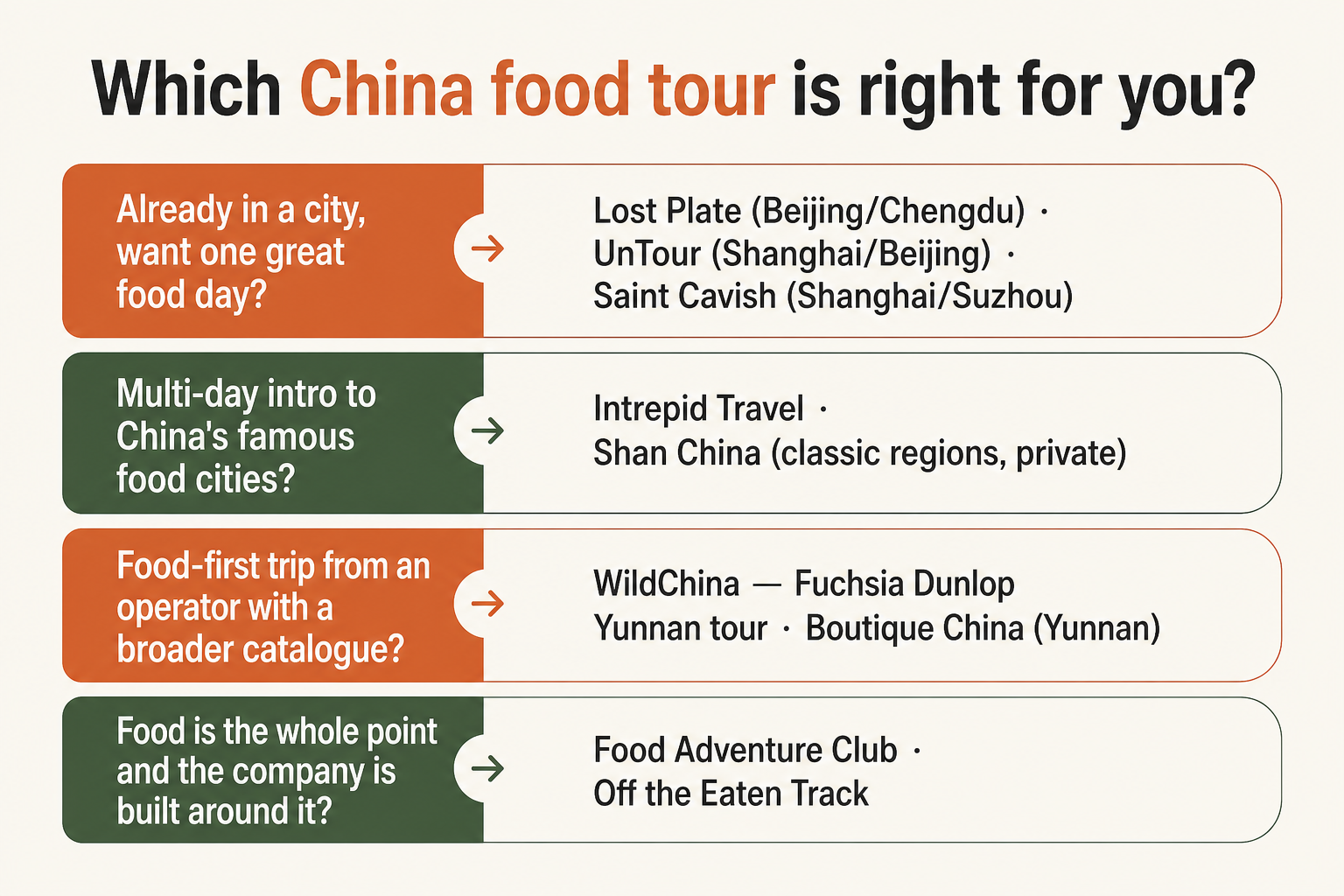
The choice comes down to how much of China you want and how deep you want to go.
If you're already in a city and want one great food day: Lost Plate in Beijing or Chengdu, UnTour Food Tours in Shanghai or Beijing, or Saint Cavish Food Tours in Shanghai or Suzhou. All three have spent years in their cities, and all three will take you somewhere you wouldn't find on your own.
If you want a multi-day introduction to China's most famous food cities: Intrepid Travel covers Beijing, Xi'an, Chengdu and Hong Kong with hands-on food experiences built in. It suits a first trip to China where food is important but not the only reason you're going.
If you want a food-first trip from an operator with a broader catalogue: WildChina's Fuchsia Dunlop Yunnan tour is a food-first experience led by one of the best food writers working on China today. Boutique China puts food and community access at the centre of every Yunnan itinerary. Both operators run other kinds of trips too, but these ones are built around eating.
If food is the organising idea of the whole trip: The Food Adventure Club for the Southwest (Sichuan, Guizhou, Chongqing) or Guangdong, where Amy's knowledge of regional Chinese food is hard to match in the English-language tour world. Off the Eaten Track for regions chosen for their food, with food determining every day of the itinerary.
If you want the classic regions done privately, at your pace: Shan China Tours builds every itinerary around what you want rather than a fixed departure.
Before or after a tour, our Chongqing travel guide and Xiamen travel guide cover two of China's most underrated food cities in more depth.
Frequently Asked Questions
-
No. Every operator in this guide provides English-speaking guides. Speaking Mandarin only matters for independent travel, where restaurant discovery apps such as Dianping and the menus at local restaurants are mostly in Chinese. A guide handles both, along with the conversations with vendors.
-
Intrepid's China Real Food Adventure suits first-time visitors who want food alongside the major sights. It runs 10 days through Beijing, Xi'an, Chengdu and Hong Kong with hands-on food experiences throughout. Travellers whose main reason for visiting is food can consider The Food Adventure Club's Southwest or Guangdong tours, or Off the Eaten Track's itineraries.
-
Day food tours typically cost USD 175 to 305 for Lost Plate's full-day tours and RMB 525 to 640 for UnTour's three-hour tours. Multi-day tours in this guide range from USD 1,595 (Intrepid Travel) to USD 10,980 (WildChina). The Food Adventure Club costs USD 2,600 to 3,400, Boutique China USD 2,390 to 3,590 and Off the Eaten Track AUD 8,500 to 11,044. Saint Cavish Food Tours and Shan China Tours price on request. Costs depend on length, region, group size and inclusions.
-
Shanghai, Beijing and Chengdu have the most established day food tours. Lost Plate, UnTour Food Tours and Saint Cavish Food Tours all run tours in Shanghai. Lost Plate and UnTour also operate in Beijing and Chengdu, Lost Plate in Chongqing and Guangzhou, and Saint Cavish Food Tours in Suzhou. Multi-day tours reach regions such as Yunnan, Sichuan and Guangdong.
-
Lost Plate has run tours since 2013, with full-day tours in Beijing and Chengdu and shorter tours in Chongqing, Guangzhou and Shanghai. UnTour has run tours since 2010 in Shanghai, Beijing, Chengdu and Hong Kong. Lost Plate combines sightseeing, such as the Great Wall and the Panda Base, with evening food crawls, while UnTour's three-hour tours are more purely food-focused. Both operate in Shanghai, Beijing and Chengdu.
-
No. Amy (Blondie in China) leads some departures herself at a higher price point, and trained guides from her Foodie Crew lead the others. The itineraries draw on her food knowledge either way. Check which type of departure you are booking.
-
Spring (March to May) and autumn (September to November) suit most of China, with mild temperatures, manageable crowds and good seasonal produce. Golden Week, the first week of October, brings peak domestic tourism and crowded sights. Summer is hot and wet in southern China, including Yunnan and Guangdong. Winter in Beijing is cold but suits lamb hot pot and street food.
-
Group sizes range from private tours to a maximum of 18. Saint Cavish Food Tours and Shan China Tours are private. Boutique China caps groups at eight, Lost Plate and Off the Eaten Track at 10, UnTour at 10 to 12, and WildChina and Intrepid Travel at 12. The Food Adventure Club goes up to 18, which is closer to a standard group tour.
-
Yes. Multi-day tours often need booking months ahead, because The Food Adventure Club, Boutique China and Off the Eaten Track run limited departures with fixed group sizes and popular seasons fill early. Day tours from Lost Plate and UnTour usually have more availability, though the best dates and private options book up. Saint Cavish Food Tours has limited availability in the second half of 2026. As a rule, the more specialist the operator, the more lead time you need.
-
Food tours are generally a lower-risk way to eat street food in China. Guides choose busy vendors with high turnover, and they can explain allergies and dietary needs to vendors in Chinese. Tell the operator about any allergies when you book.
-
Most operators can accommodate common restrictions with advance notice, and vegetarian and gluten-free requests are generally manageable. Shellfish or pork allergies are harder in regions where both are central to the cuisine, such as Guangdong and Fujian. Tell the operator when you enquire and ask for a direct answer on what they can and can't do.