
Chongqing Travel Guide: China’s Most Surprising City
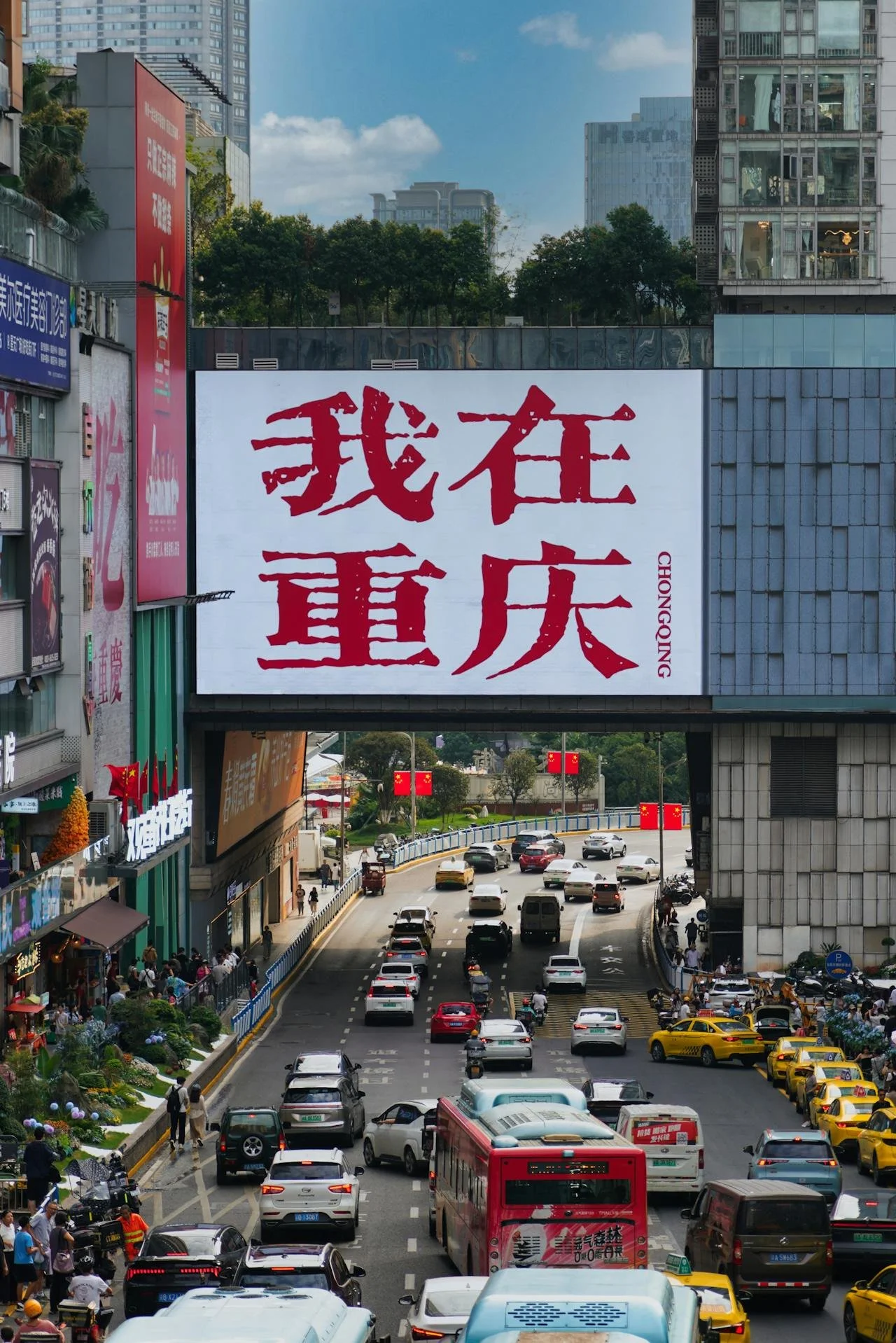
Many years ago I went to Chongqing for the first time to visit a friend. No research, no itinerary, no expectations. What I got was one of the most surprising cities I’ve ever visited. A place so strange, alive and delicious that I’ve been recommending it to anyone who’ll listen ever since, why is why I put together this Chongqing travel guide.
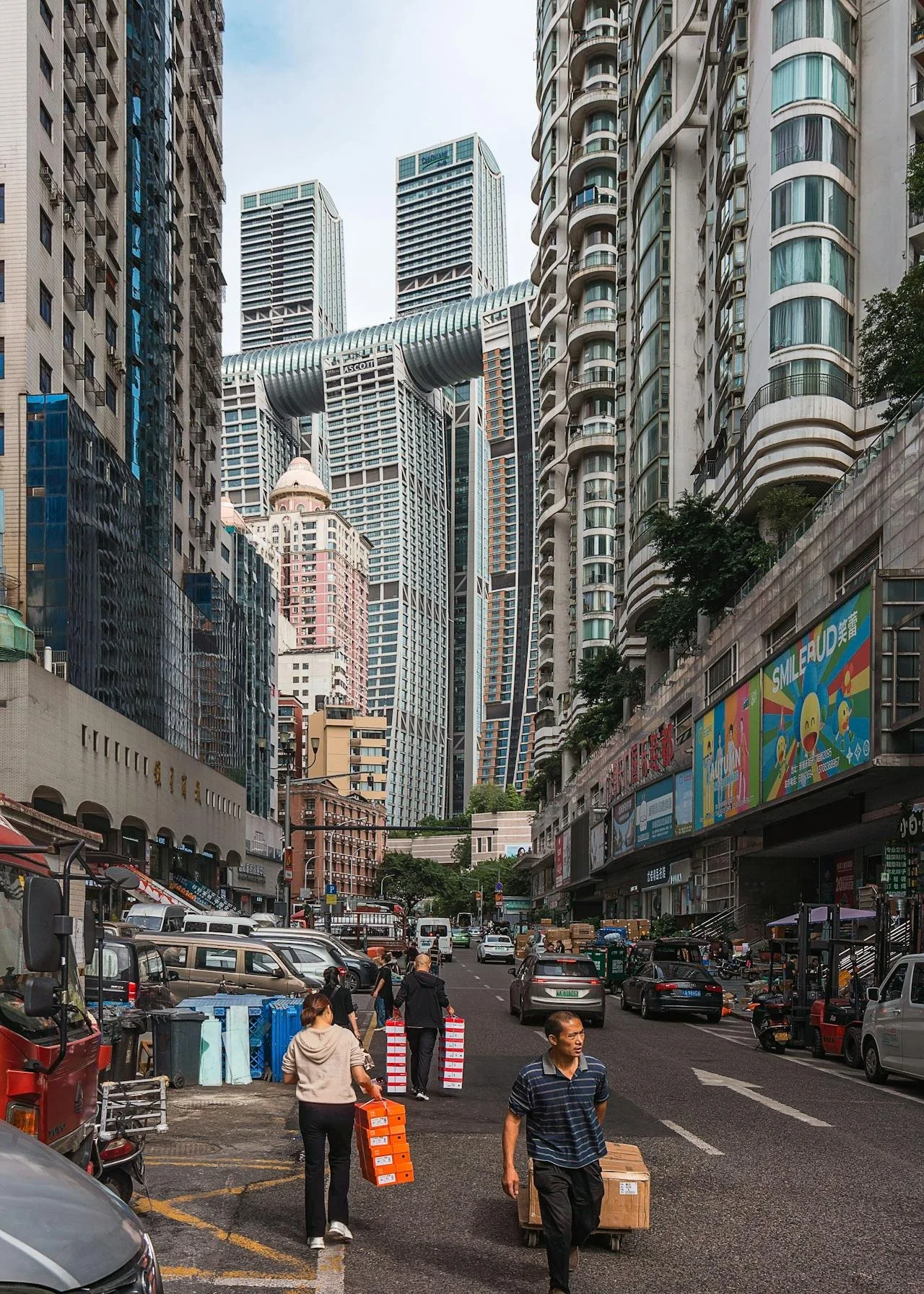
Chongqing is unlike anywhere else in China, which is saying something in a country that never stops surprising you. The city doesn’t sprawl outward the way most cities do, it stacks – highways thread through the upper floors of residential buildings, elevators replace staircases to get between neighbourhoods, the metro disappears into apartment blocks and comes out the other side. What looks like the ground floor from one street is the 20th floor from the next. It’s the kind of city that makes you feel like the laws of urban planning simply don’t apply here.
Then there’s the food. Chongqing cuisine is one of the boldest in China. Built on málà (麻辣), the tongue-numbing combination of dried chilli and Sichuan peppercorn that is equal parts pleasure and pain. The city claims over 30,000 hot pot restaurants alone. Street food is everywhere and it is extraordinary. This is a city that takes eating seriously, and it shows in every meal.
The internet has been catching on to Chongqing lately, and for once, the hype is justified. But this guide won’t be about viral moments. It’s about what makes the city worth going back to: the food, the chaos, and the character.
How to Get to Chongqing
Chongqing is well connected to the rest of China by both air and high speed rail. Chongqing Jiangbei International Airport is one of China’s eight major aviation hubs, with direct flights from most major Chinese cities as well as international routes to destinations across Asia. If you’re coming from overseas, you’ll most likely connect through Beijing, Shanghai, or Guangzhou.
By rail, Chongqing sits at the centre of a web of high speed connections making train travel easy. From Chengdu, it’s a quick hour and a half on the bullet train, making the two cities an easy and popular combination. From Xi’an it’s around five hours, from Beijing seven to nine hours, and from Shanghai around ten to eleven hours. Most long distance trains arrive at Chongqing North or Chongqing West stations, both well connected to the city by metro.
Where to Stay
Chongqing is genuinely good value for accommodation, especially compared to China’s coastal cities. For most visitors, the Jiefangbei and Yuzhong area is the best base. It’s central, walkable to the main sights, and well connected by metro for everything else.
Crystal Orange Hotel Chongqing Jiefangbei Hongyadong ¥¥ — Orange Hotel is one of China’s best mid-budget chains, and this branch puts you right in the thick of it, steps from Hongyadong, Raffles City, and the Chaotianmen metro station. Rooms are clean, well-designed, and well-serviced with a decent breakfast buffet and the kind of thoughtful touches that Chinese hotel brands do very well. River view rooms are worth the small upgrade.
Hyatt Regency Metropolitan Chongqing ¥¥¥ — Sitting in the absolute heart of Jiefangbei, directly connected to Metropolitan Oriental Plaza and 200 metres from the metro, this is as well located as it gets in Chongqing. Two restaurants, a rooftop garden with koi ponds and city views, and a pool, all at prices that would be unthinkable for a Hyatt Regency in most other major cities.
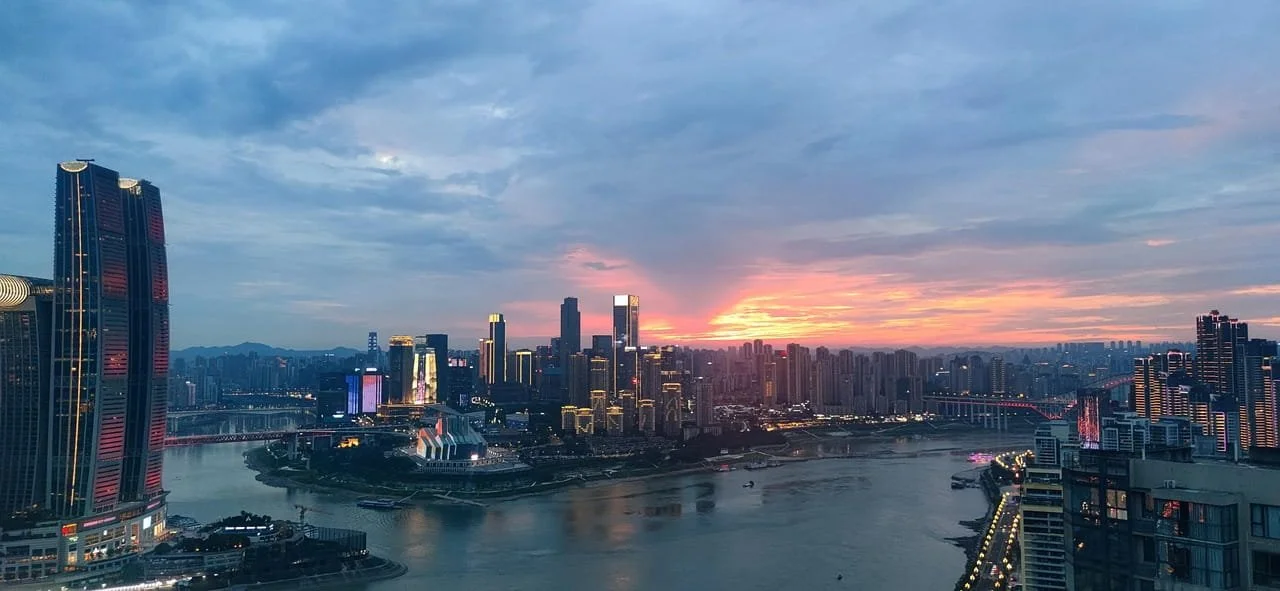
Niccolo Chongqing ¥¥¥¥ — Occupying floors 52 to 62 of the IFS tower in Jiangbeizui, the Niccolo is consistently rated the best hotel in the city. Panoramic views of the confluence of the Yangtze and Jialing Rivers, a 20-metre sky pool, and Bar 62 on the top floor where you can watch the city light up below you with a cocktail in hand. The service matches the setting. If you’re going to splurge anywhere in Chongqing, splurge here.
What to Eat
You could eat in Chongqing for a week and barely scratch the surface. The city runs on a food culture that starts at breakfast and doesn't really stop, with street stalls, hole-in-the-wall spots, and restaurants on every corner all doing something worth trying. For street food, your first stop should be Bayi Road (八一路好吃街), a lively food street near Jiefangbei where stalls and small restaurants running the full spectrum of Chongqing snacks sit side by side. You'll find yourself back there more than once. Here are the dishes we think you have to eat, and where to find them.
Hot Pot (火锅)
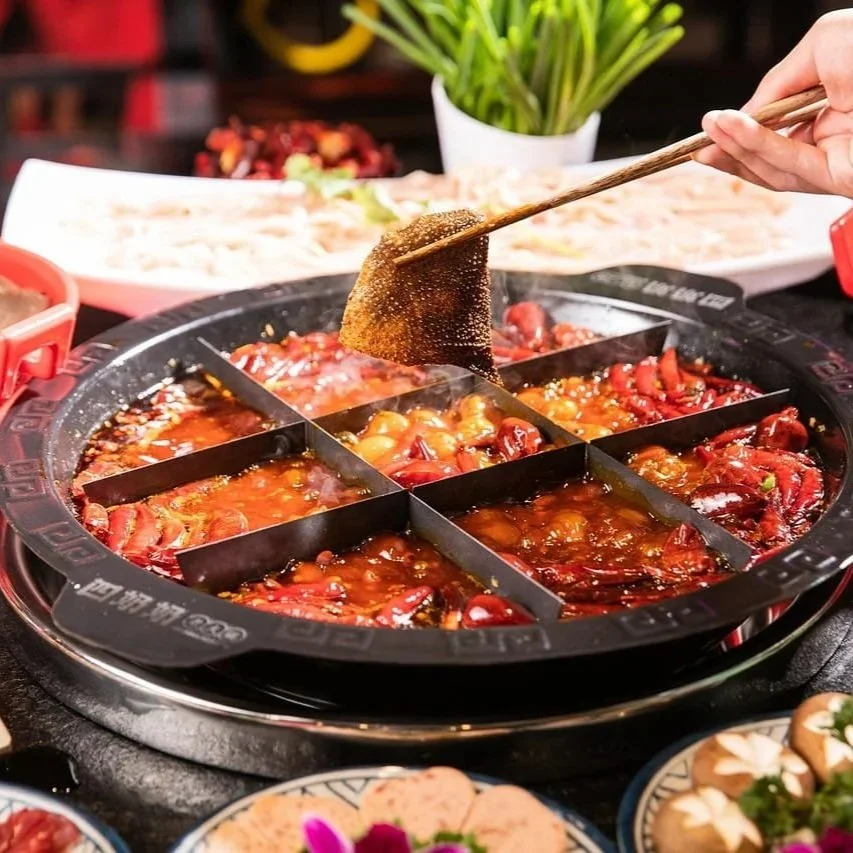
Ask anyone what Chongqing is famous for and this is the answer, every time. Chongqing hot pot is its own thing, so don't confuse it with the milder versions you might have had elsewhere. The base here is beef tallow, which makes the broth richer and oilier, carrying the heat deeper into everything you cook. The classic format is the nine-grid pot (九宫格), where different sections run at different temperatures and spice concentrations, so you can manage what goes where. If you think you can handle it, go full red — that's the real Chongqing experience, and yes, your lips will go numb. If you're not there yet, the yin-yang pot splits the broth down the middle, one side fiery, one side clear, and you can always ask for the spicy side mild (微辣 wēi là) to ease in. Either way, there's a reason this city has over 30,000 hot pot restaurants and locals eat it multiple times a week. For something neighbourhood and unpretentious, Yang Ma’er Hot Pot (洋马儿火锅 yáng mǎ er huǒguō) is a residential building hot pot that locals swear by, with simple ingredients that are fresh and genuinely flavourful, and branches near both Ciqikou and Jiefangbei. For something more considered, Yanshe Hot Pot (滟设火锅料理 yàn shè huǒguō liàolǐ) has held a Black Pearl one-diamond rating for six consecutive years. Each diner gets their own individual pot, ingredients are sourced from New Zealand, Canada, and the East China Sea alongside Sichuan's best local produce, and the whole thing sits on the Nanbin Road waterfront where the two rivers meet.
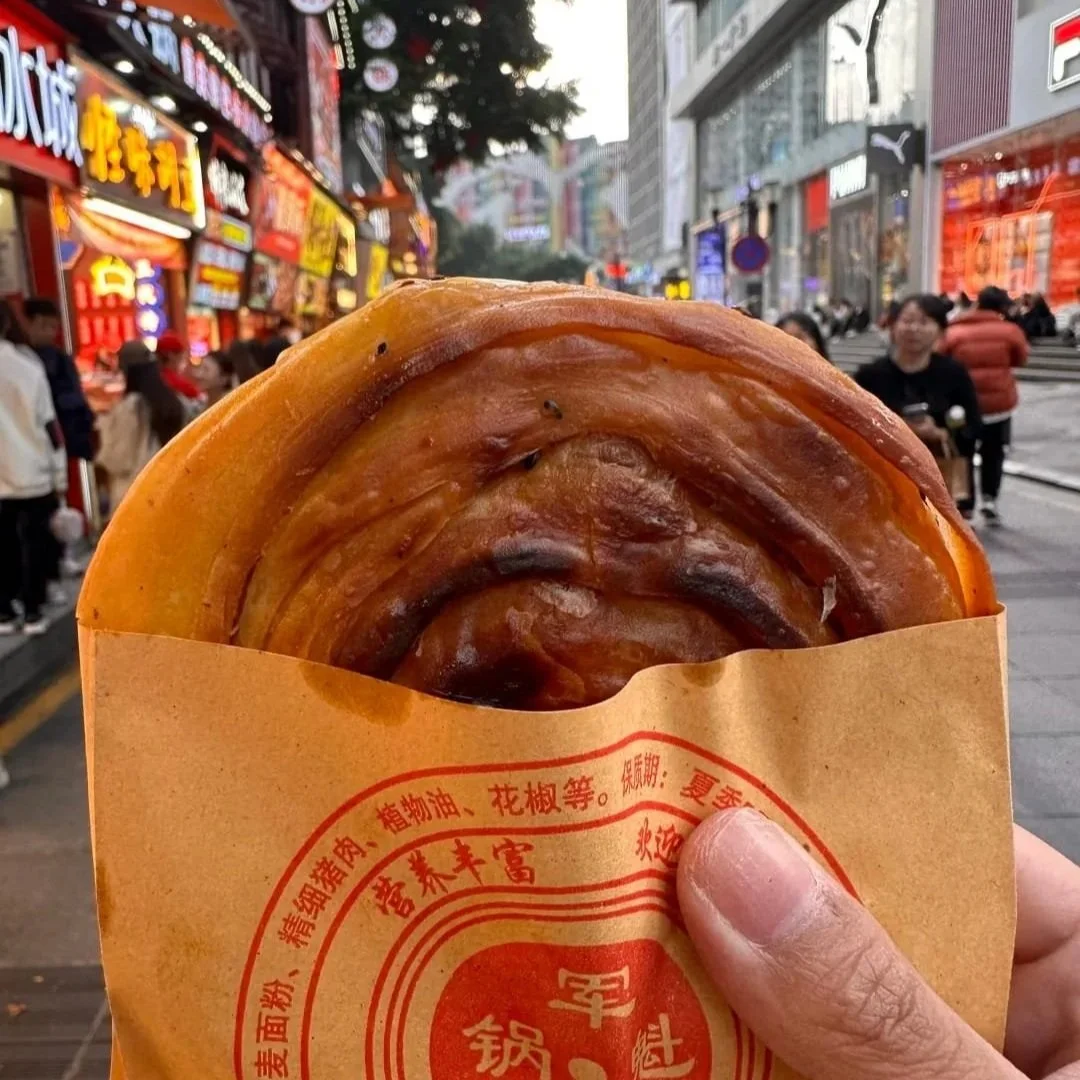
Guokui (锅盔)
Think of guokui as the love child of a Neapolitan pizza and a dumpling, and you're partway there. This crispy, fire-baked flatbread is stuffed with any number of fillings. Spiced minced pork is the classic, but the range of options here goes far wider than anywhere else in China, which is exactly what makes Chongqing's version so good. The exterior shatters when you bite in, giving way to a soft, fragrant interior that's still piping hot. Jingzhou Guokui (荆州锅盔 Jīngzhōu guōkuī) in the Daoping area is the one worth seeking out. It’s a tiny shopfront selling them for 6 yuan a piece, and the 梅菜扣肉 braised pork with preserved vegetables (梅菜扣肉 méicài kòuròu) filling is as good as guokui gets. Closer to the city centre, Liang Ji Fang Guokui (良记方锅盔 Liáng jì fāng guōkuī) near Times Street (时代天街 shídài tiānjiē) does a generous version where you can load in cold side dishes alongside the filling for 7 or 8 yuan. Eat it immediately, standing up, on the street. That's lunch sorted.
Xiaomian (小面)
These are the noodles Chongqing runs on. Cheap, fast, and ferociously flavoured, Xiaomian — literally meaning "small noodles" — are the everyday breakfast of this city, eaten three or four times a week by locals who will all have their favourite stall the way others have their favourite coffee shop. Thin wheat noodles arrive in a spicy broth built from more than ten aromatics and herbs, topped with pickled vegetables, minced pork, roasted peanuts, and a slick of chilli oil. The noodles might be small, but there's nothing small about the flavour. Shibati Dengdeng Noodles (十八梯邓凳面 shíbātī dèng dèng miàn) near Shibati is consistently rated among the best in the city. Order the pea and minced pork noodles (豌杂面 wān zá miàn ), and while you're at it they also do a solid wonton (抄手chāoshǒu). Afu Ban Deng Noodles (阿福板凳面 Ā fú bǎndèng miàn) is a well-regarded local chain with multiple branches around Jiefangbei and the city centre, all consistently good.
Suan La Fen (酸辣粉)
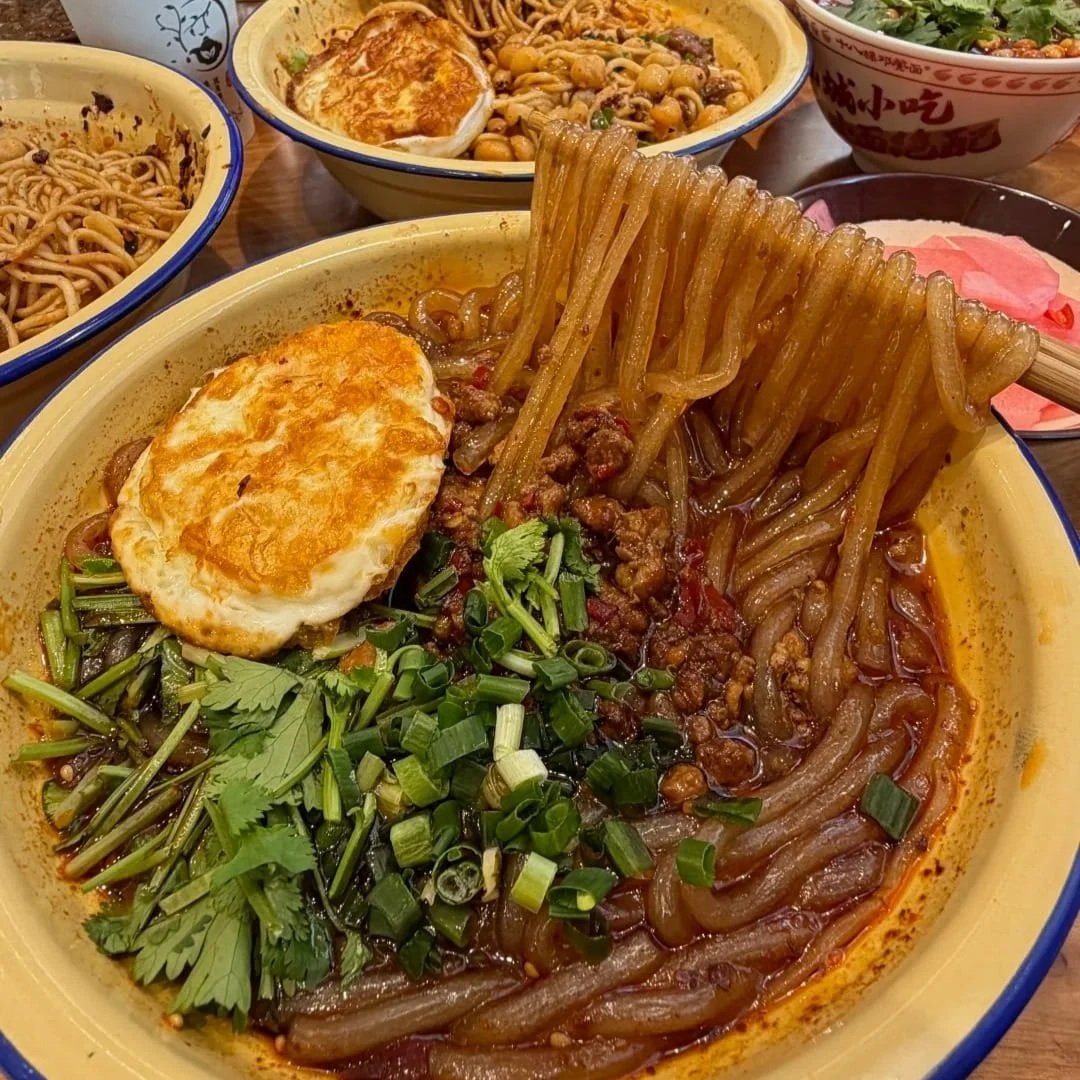
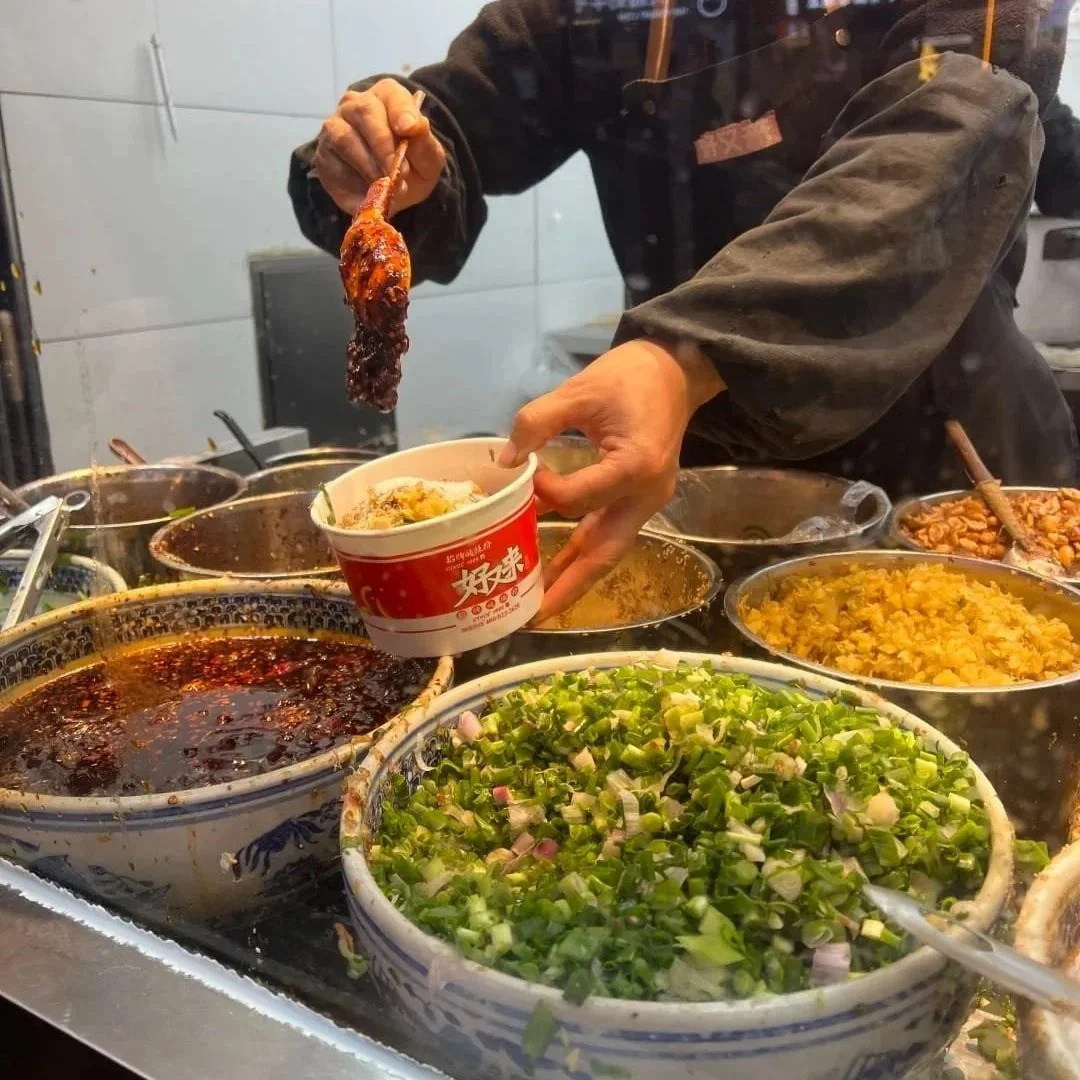
Hot and sour glass noodles are one of those dishes that hits every tastebud at once. Tangy vinegar, fiery chilli oil, deep garlic umami, the numbing buzz of Sichuan peppercorn, all soaked up by chewy, elastic sweet potato noodles, then topped with crunchy peanuts and fresh herbs. It's the kind of bowl that wakes you up from the first mouthful. On Bayi Road, Hao You Lai (好又来酸辣粉 hǎo yòu lái suān là fěn) is the one everyone queues for, and for good reason. For a second option, Lai De Kuai (莱得快 lái dé kuài) near Shibati does a particularly good minced pork and mixed sauce version (杂酱酸辣粉 Zá jiàng suān là fěn) that locals rate highly.
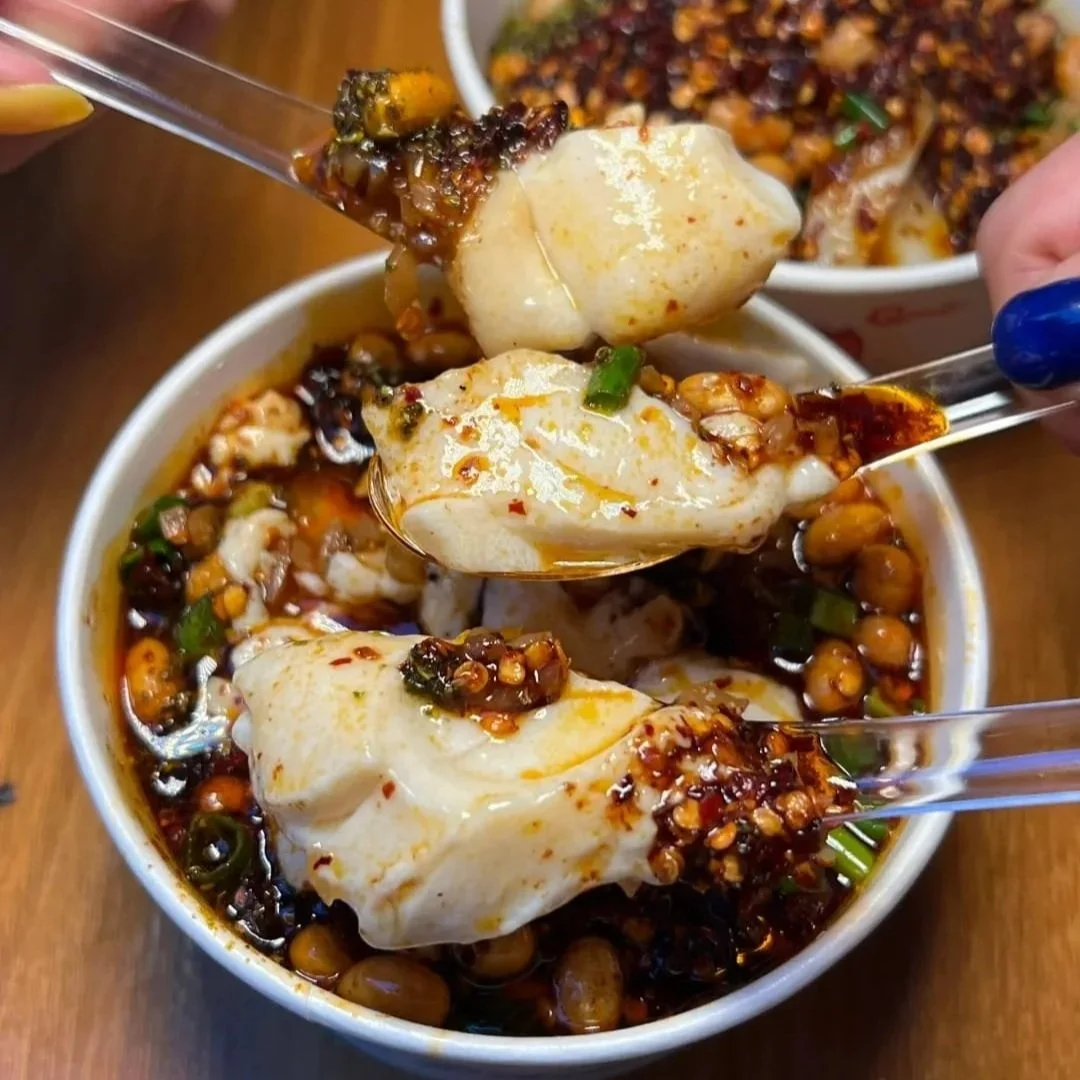
Doufunao (豆腐脑)
If you've only ever had sweet tofu pudding, Chongqing's version is going to rearrange your expectations. Here, silken tofu is served savoury, draped in chilli oil, soy sauce, minced pork, and enough garlic to make your presence known, then eaten spooned over rice. The first time I had it was a revelation and now I'll find any excuse to eat it. I've strong-armed more than a few friends into trying it. It's the kind of dish that sounds too simple until you're halfway through the bowl and already planning your next one. Part of what makes doufunao special in Chongqing is that some of the best versions come from roving cart vendors, made by people who have been working the same neighbourhood route for ten or twenty years. They can't be found on any map, but instead are located entirely by word of mouth or happy accident. If you want a guaranteed sit-down option, Haiguan Hun Tofu Pudding (海关荤豆花 hǎiguān hūn dòuhuā) in Guanyinqiao is a 20-year institution that grinds its tofu fresh daily. You'll also find stalls along Bayi Road.
Mao Xue Wang (毛血旺)
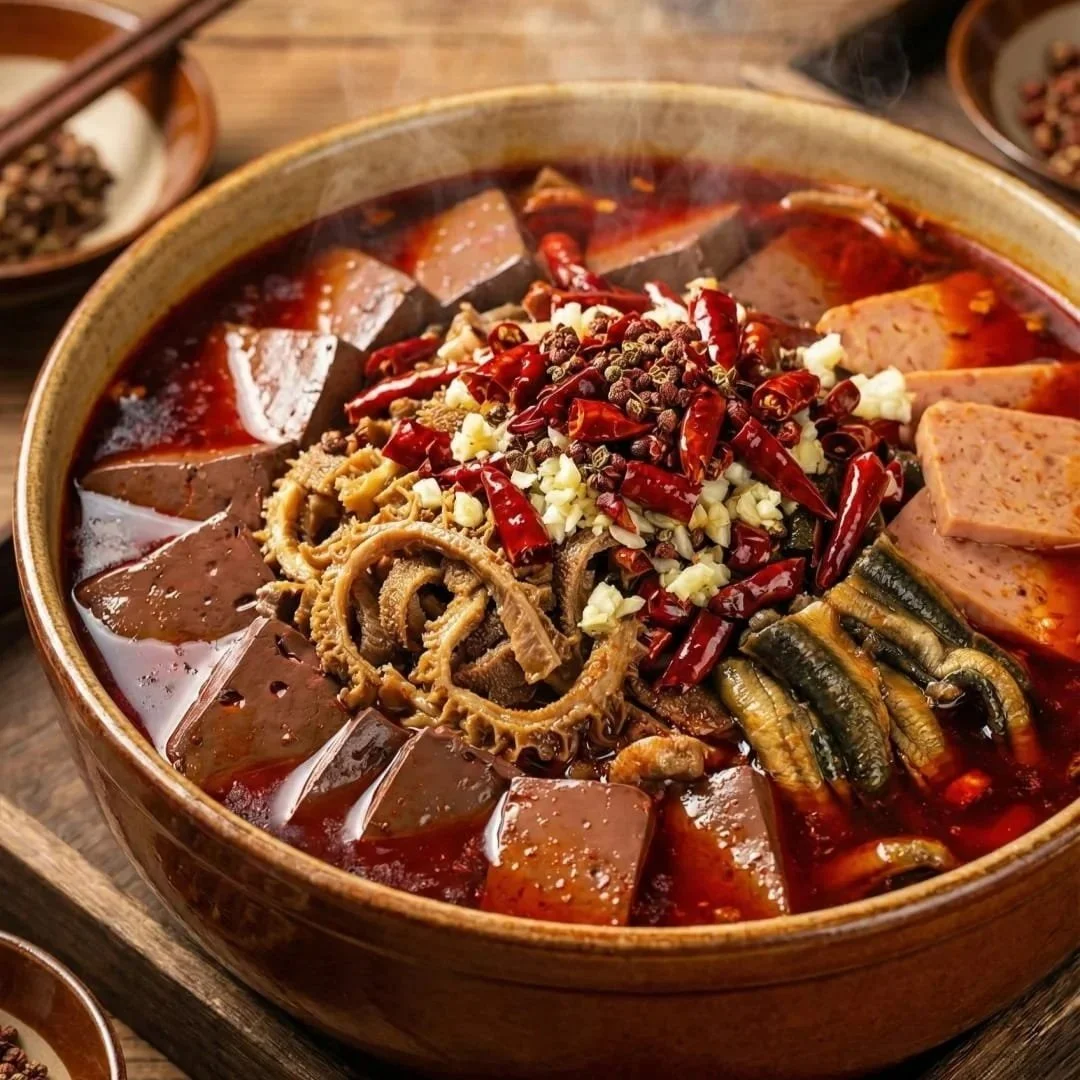
This is Chongqing's more challenging offering. Mao Xue Wang is duck blood, tripe, tofu skin, ox aorta, and whatever else the kitchen feels like throwing in, all simmered together in a thick, deeply spiced chilli broth until the whole thing becomes one fiery bowl of deliciousness. Locals call it a "small hot pot", which is accurate. It's been on Chongqing tables since the 1940s and it's not going anywhere. Sister Yu’s Mao Xue Wang (余姐毛血旺 yú jiě máo xuè wàng) on Wuyi Road near Jiefangbei is the name that comes up most consistently among locals, and Yi Xue Wang (邑血旺 yì xuè wàng) is a reliable second option with plenty of branches. Check Dianping or Baidu Maps for whichever branch is most convenient to where you're based. Even if offal isn't usually your thing, consider this your invitation to try something genuinely different.
Lazi Ji (辣子鸡)
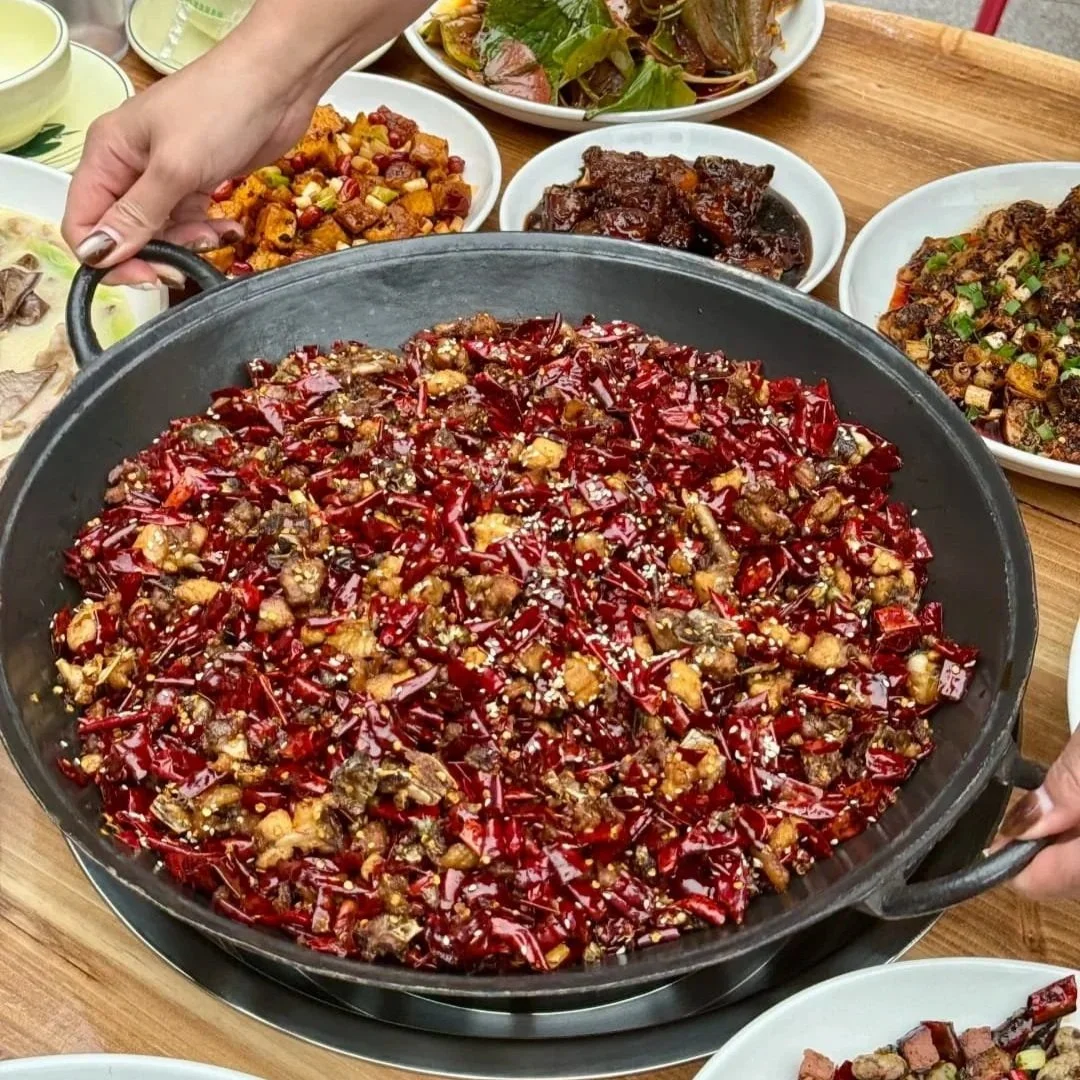
This is one of my favourite dishes anywhere in China, and Chongqing does it better than anywhere else. Deep-fried chicken pieces buried under a mountain of dried chillies and Sichuan peppercorn, the dish arrives looking more like a chilli exhibition than a meal and that's the whole point. You dig through the pile with your chopsticks, hunting for the chicken hidden within. Crispy on the outside, tender inside, perfumed with that smoky, numbing heat that's soaked in from every side. Mai Qi Mei Lazi Ji (马七妹辣子鸡 mǎ qī mèi làzǐ jī) is a strong city-centre option. For more of an excursion, Hua Qing Yuan Lazi Ji (华清源辣子鸡 huá qīng yuán làzǐ jī) sits at the foot of Gele Mountain near the wartime heritage sites of Baigongguan and Zhazidong. They take whole birds weighed and killed to order, and the leftover chillies can be vacuum-packed and taken home to grind into powder for noodles. Also worth knowing: Fan Jianghu Cuisine (饭江湖·江湖菜 fàn jiānghú·jiānghú cài) does an excellent lazi ji alongside a broader menu of Chongqing jianghu classics, in a beautifully restored heritage setting near Chaotianmen. For anyone who loves chilli, there are few more satisfying sights than a plate stacked this high. Best eaten with cold beer and good company.
Wanzhou Grilled Fish (万州烤鱼)
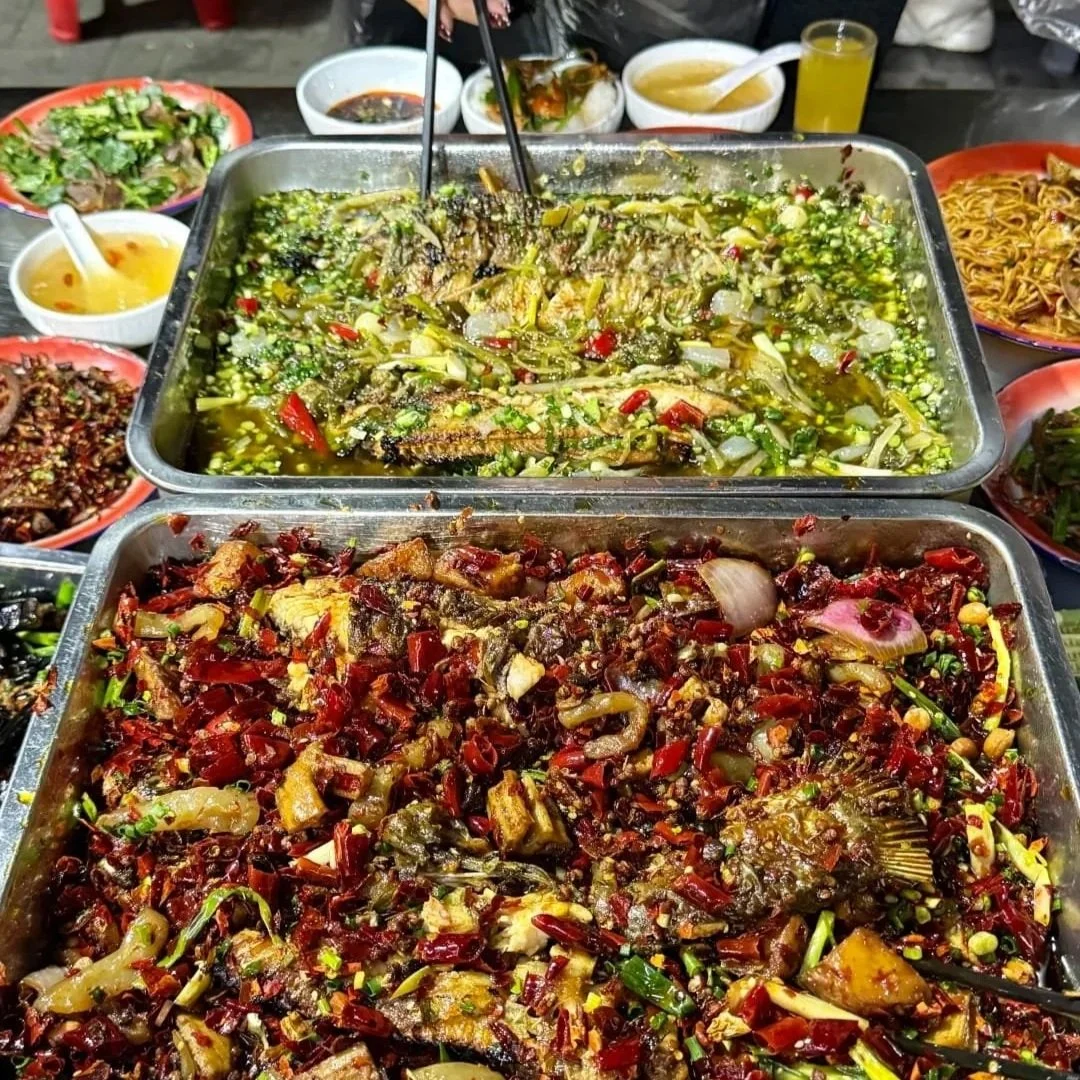
Whole grilled fish turns a meal into an event, and I'll seek it out wherever I am across China. The concept is consistent: fish grilled over open flame until the skin is crisp and charred at the edges, then placed into a giant tray of spiced broth surrounded by bean sprouts, lotus root, tofu skin, and whatever other ingredients you want to add. Everything simmers together, the fish soaking up the surrounding flavours while the vegetables do the same in reverse. It arrives at the table still bubbling, theatrical and fragrant, and feeds at least two people easily. What changes city to city is the flavour profile, and Chongqing's version is exactly what you'd expect from this place: bold, deeply spiced, and unapologetically málà. Kaojiang Spicy Grilled Fish (烤匠麻辣烤鱼 kǎo jiàng málà kǎo yú) has been queuing people out the door for twelve years and is rated the best grilled fish in the city. Make sure to order it with their handmade black bean tofu on the side. Sister Chen’s Grilled Fish (沈姐烤鱼 shěn jiě kǎo yú) has been going for 24 years, holds a Chongqing intangible cultural heritage designation, and grills every fish to order over charcoal. The signature Explosive Grilled Fish (爆辣烤鱼 Bào là kǎo yú) comes with handmade black bean tofu and braised fatty intestine (better than it sounds). It’s one fish with two flavour profiles, and open until 3am.
What to Do
A City That Defies Logic
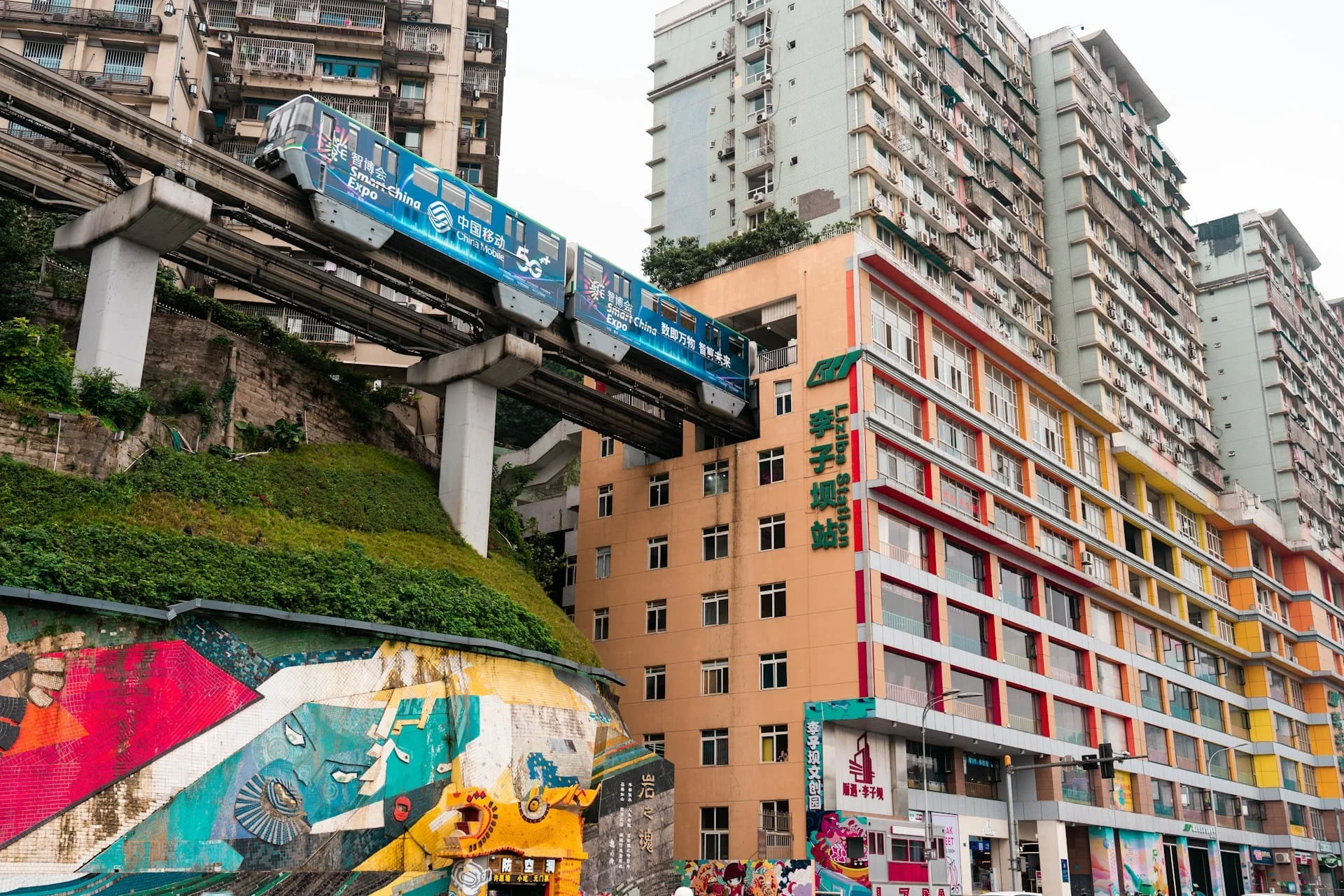
Most cities make sense when you look at them on a map. Chongqing does not. Built across a mountainous peninsula where the Yangtze and Jialing Rivers meet, this is a place where the ground floor of one street is the twentieth floor of the next, where highways thread through the upper storeys of residential buildings, and where getting from A to B sometimes involves an elevator, a staircase, a bridge, and a metro — in that order. Three places in particular capture this beautifully, and together they make for one of the most disorienting and exhilarating afternoons you’ll spend in any city in the world.
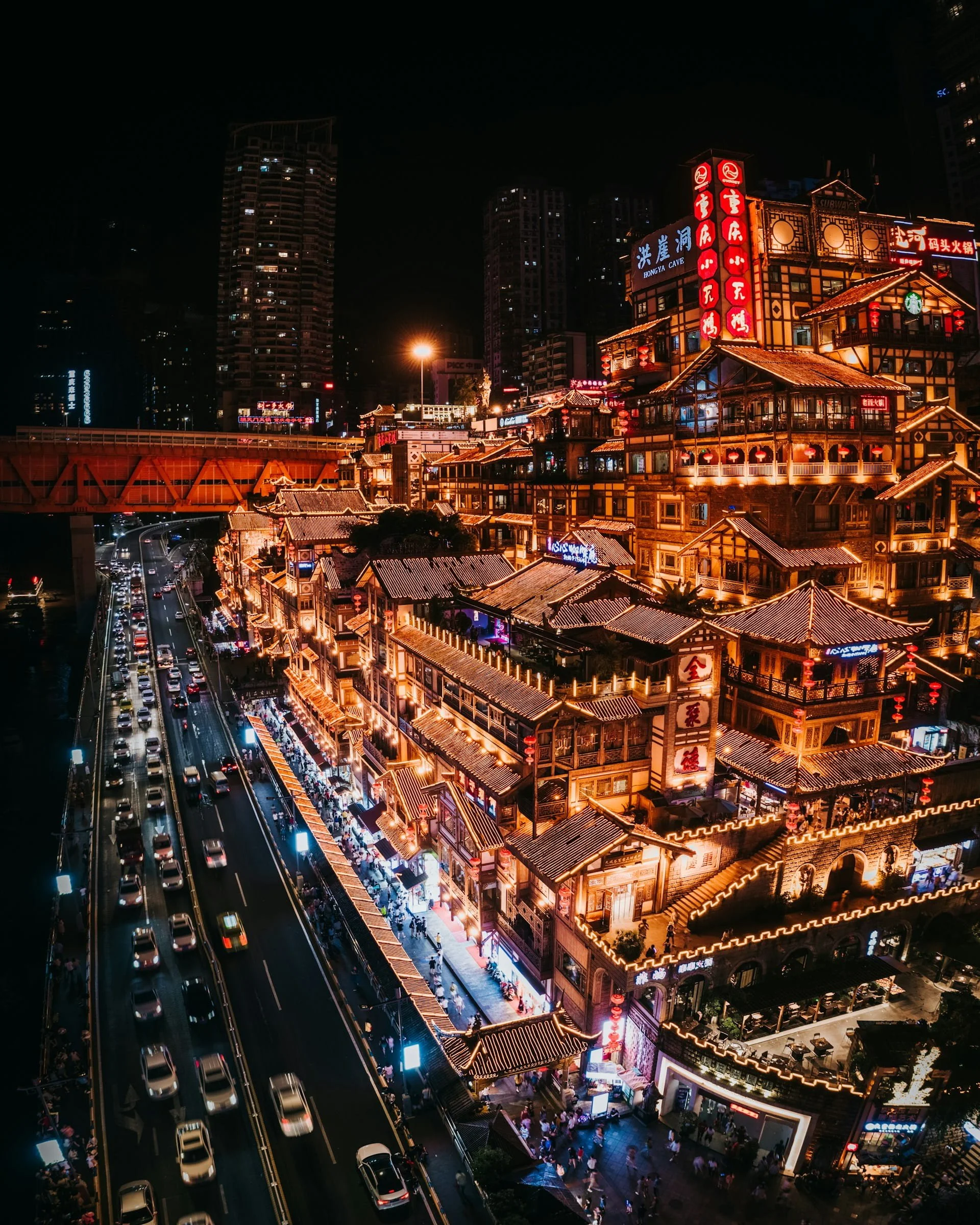
Liziba Station (李子坍站) is where Line 2 of the metro runs straight through the sixth to eighth floors of an occupied residential building. The train disappears into the building on one side and comes out the other and people still live there! You can ride it through yourself, or watch from the street below as it happens. Either way, it takes a moment to fully process. Hongyadong (洪崖洞) is best seen at night, when eleven storeys of traditional stilted architecture stacked against the cliff face light up above the Jialing River in a blaze of warm gold. It’s the kind of scene that looks like it belongs in a film and somehow doesn’t feel real even when you’re standing in front of it. Skip the tourist shops inside and walk across to the opposite bank for the full view. Shibati (十八梯) and the surrounding mountain staircase streets are the city in its most human form. The steep stone steps connect the upper and lower city, with elderly residents on stoops, laundry strung between windows, and old men playing cards in the afternoon. Wander down without a plan and let the city’s vertical logic reveal itself slowly.
Eling Park (鹅岭公园)
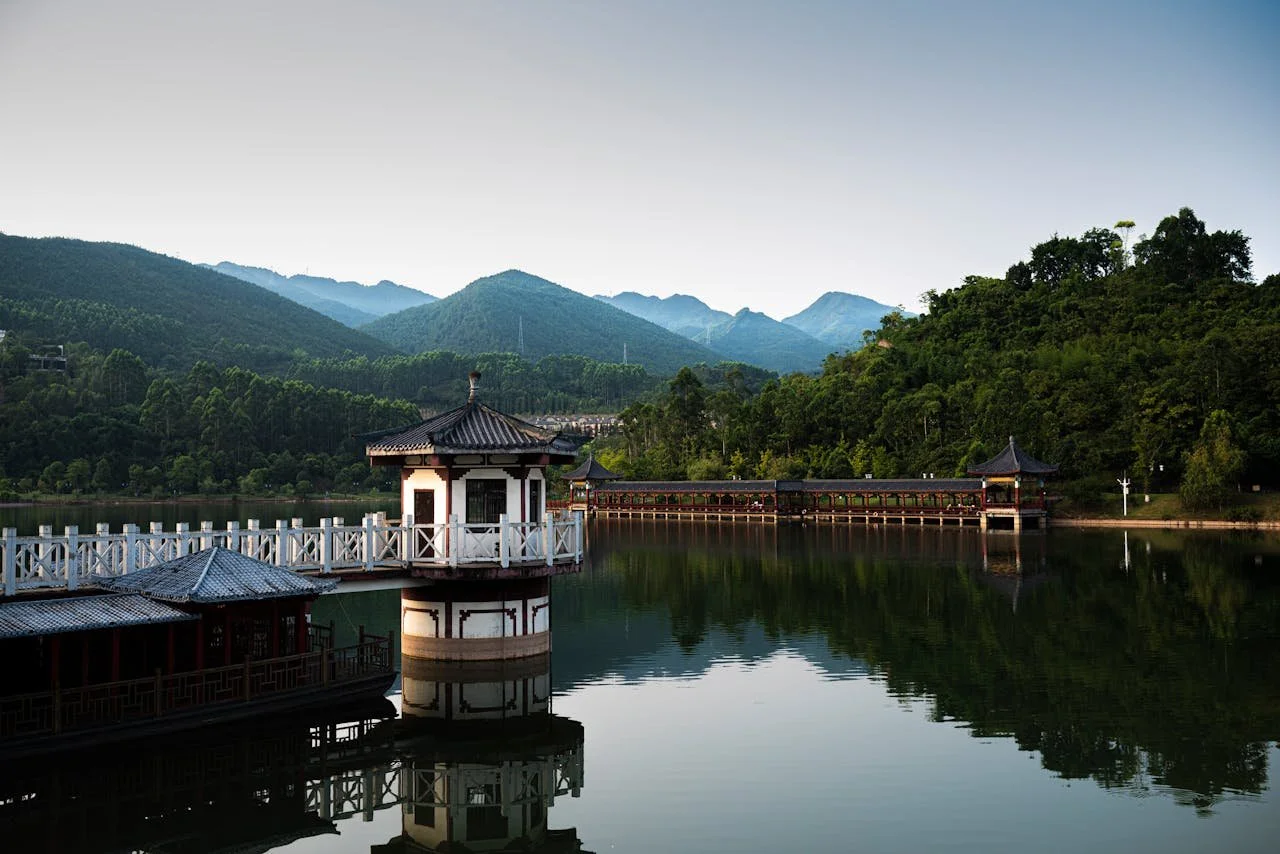
Eling Park sits at the highest point of the Yuzhong Peninsula, a quiet hillside garden with views across the confluence of the Yangtze and Jialing Rivers that the rest of the city is too busy to stop and appreciate. Originally a private garden built by a salt merchant in 1909, it became a public park in 1958 and has been a refuge from the city’s relentless energy ever since. Come in the morning when elderly locals are doing tai chi, playing chess, and going about the kind of unhurried daily life that exists just below the surface of every Chinese city. As we wrote about in our Shanghai guide, there’s a whole education in sitting quietly in a Chinese park and watching people live. Eling is one of the best places in Chongqing to do exactly that. Just below the park, Eling Erchang (鹅岭二厂) — a former printing factory turned creative arts district — is worth a wander for its independent shops and design studios during the day, and its rooftop craft beer and city views at night.
Ciqikou Ancient Town (磁器口古镇)
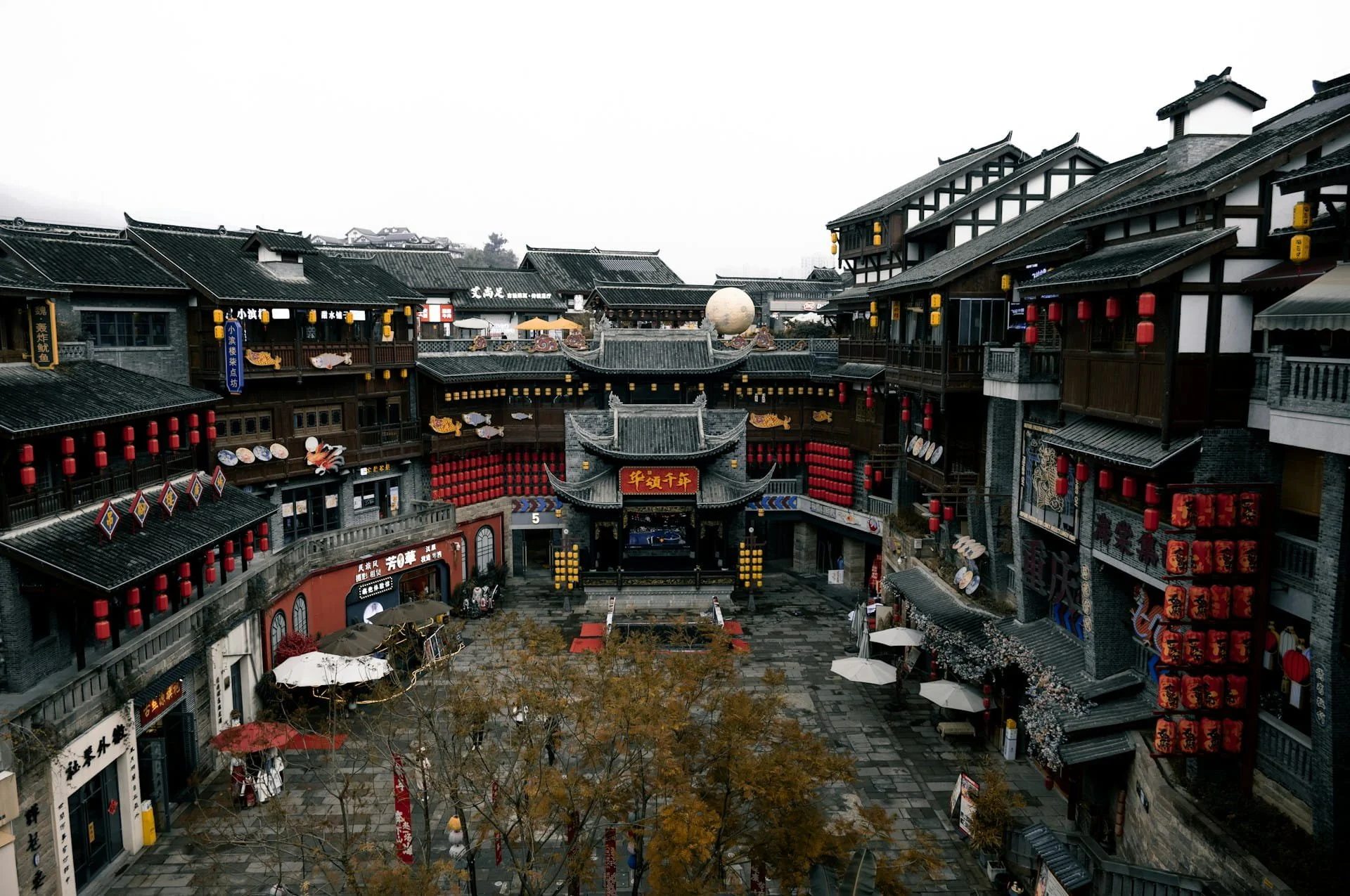
A thousand years ago, Ciqikou was a busy commercial port on the Jialing River, famous throughout the region for its porcelain. The boats are long gone, but the Ming and Qing dynasty architecture remains, with its narrow cobblestone lanes, wooden shopfronts, teahouses where old men nurse cups of tea for hours, and the occasional Sichuan opera performance drifting out from somewhere in the back. It gets crowded, especially on weekends, but the back alleys are quieter and more rewarding than the main strip. Come in the morning, grab a bowl of xiaomian, and let yourself get lost for a few hours. It’s also one of the best places in the city to pick up souvenirs, more on that in the shopping section.
Chongqing China Three Gorges Museum (三峡博物馆)
If you want to understand why Chongqing is the way it is, with its topography, the culture, and the relationship with the Yangtze River that has defined this region for millennia, then the Three Gorges Museum is where to start. Built around the history of the Ba-Yu civilisation, the ancient culture that predates modern Chongqing by thousands of years and from which the city draws much of its distinct identity. The collection spans bronze-age artefacts, Han dynasty sculpture, and an entire floor dedicated to the Three Gorges and the communities that were submerged when the dam was built. It’s not a must for everyone, but for those who like context with their travel, it’s an excellent way to spend a few hours. The People’s Assembly Hall next door, modelled on the Temple of Heaven in Beijing, is worth a look while you’re there.
Dazu Rock Carvings (大足石刻)
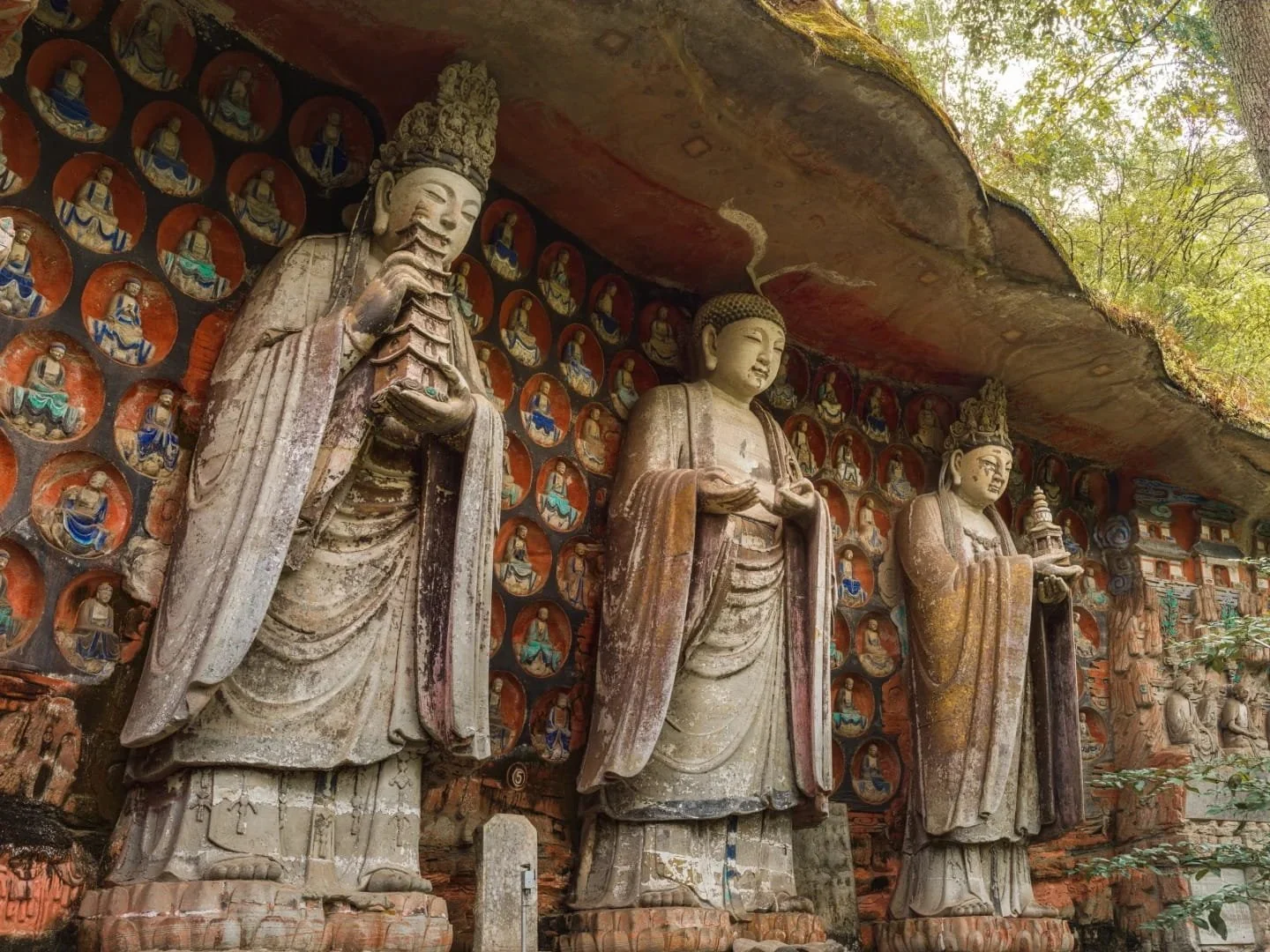
About ninety minutes outside the city, Dazu is one of the most remarkable and undervisited UNESCO World Heritage Sites in China. Over 50,000 Buddhist, Taoist, and Confucian sculptures carved into cliffsides between the seventh and thirteenth centuries, at a time when the great grotto art of northern China was already in decline. What makes Dazu different from the famous northern grottoes is how personal and secular it feels. These were depictions of everyday Tang and Song dynasty life, moral lessons carved in stone for ordinary people who couldn’t read. The centrepiece at Baodingshan is a 31-metre reclining Buddha that has been lying in peaceful repose for over 800 years. Plan for a full day and hire a guide if you can, because the stories behind individual carvings are what elevate this from impressive to unforgettable.
Where to Shop
Ciqikou Ancient Town (磁器口古镇)
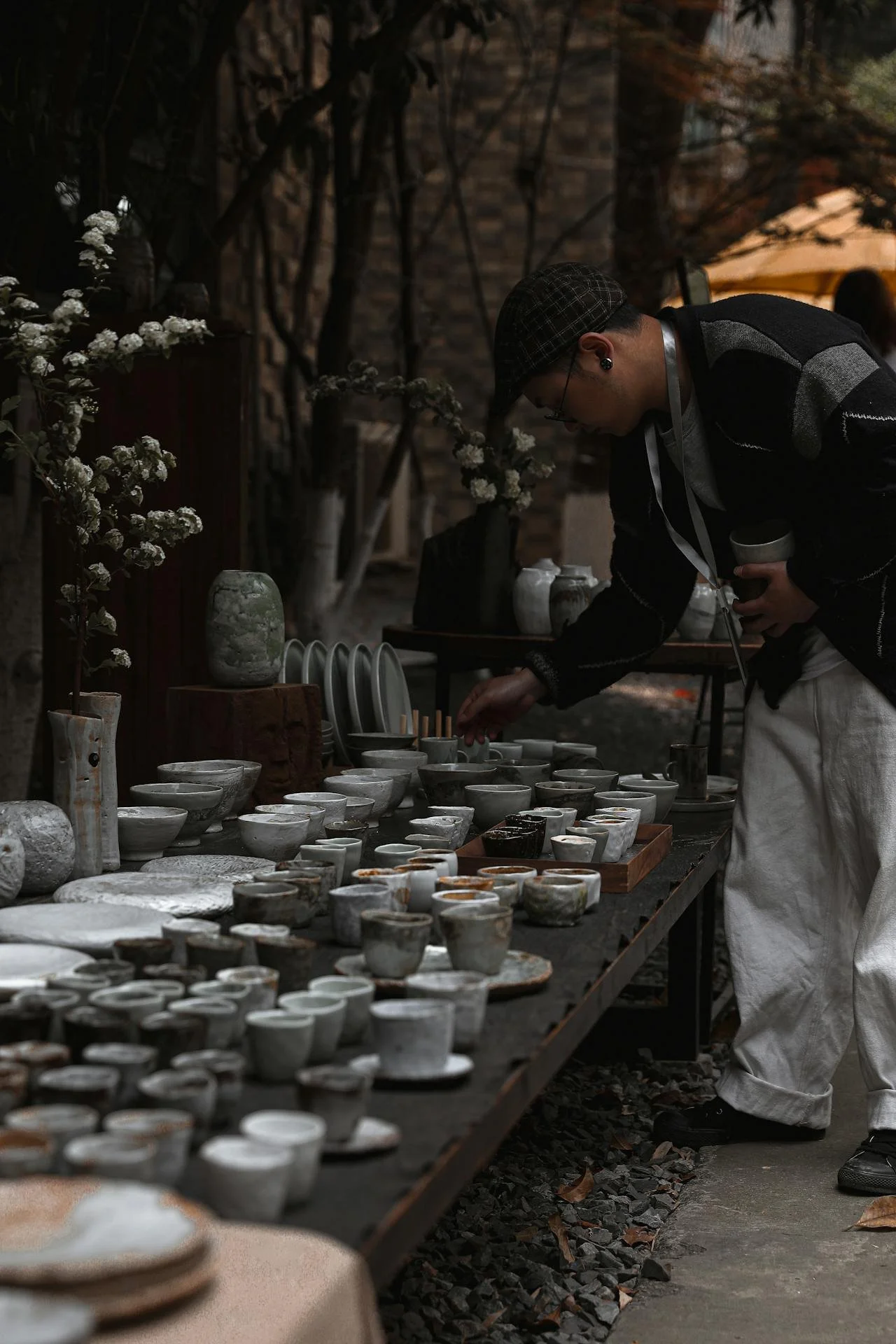
You’ll already be here for the wandering and the food, but Ciqikou is also one of the best places in Chongqing to pick up something worth taking home. The town has been associated with porcelain and craft since its days as a river trading port, and that tradition hasn’t entirely disappeared. Look past the tourist-facing trinkets on the main strip and you’ll find ceramics, handmade goods, traditional embroidery, and local snacks worth stocking up on. The mahua (麻花), deep-fried dough twists that come in plenty of flavours, are the classic Ciqikou souvenir, and the back streets have vendors making them fresh. Sichuan opera masks, handmade paper products, and locally produced teas are also worth looking out for.
Beicang Creative District (北仓文创街区)
A former textile warehouse from the 1960s, Beicang has been reimagined as one of Chongqing’s most interesting creative hubs, and unlike a lot of these kinds of projects, it hasn’t lost its soul in the process. The original industrial bones are still visible throughout, the surrounding alleys are covered in murals, and the mix of independent design shops, art studios, and small galleries makes it genuinely worth browsing rather than just photographing. Pick up locally designed prints, handmade homewares, and one-off pieces from the small makers who have set up here. It’s also home to a 24-hour library where you can swap a book for a coffee. If you’re here in the evening, the bar scene kicks in too, I’ll touch on that further in the Where to Play section.
Eling Erchang (鹅岭二厂)
You’ll pass through Eling Erchang when you visit Eling Park, and it’s worth slowing down during the day to explore the creative district properly. What was once a printing factory responsible for generations of Chongqing’s school textbooks has been converted into a cluster of independent design shops, local makers, and small galleries that feel genuinely curated rather than thrown together. The shops here lean toward the design-forward end of things: locally made ceramics, art prints, small-batch goods, and the kind of thoughtful gifts that don’t feel like typical souvenirs. Come during the day for the shopping, then move up to the rooftop for some drinks once the light drops.
Bookshops
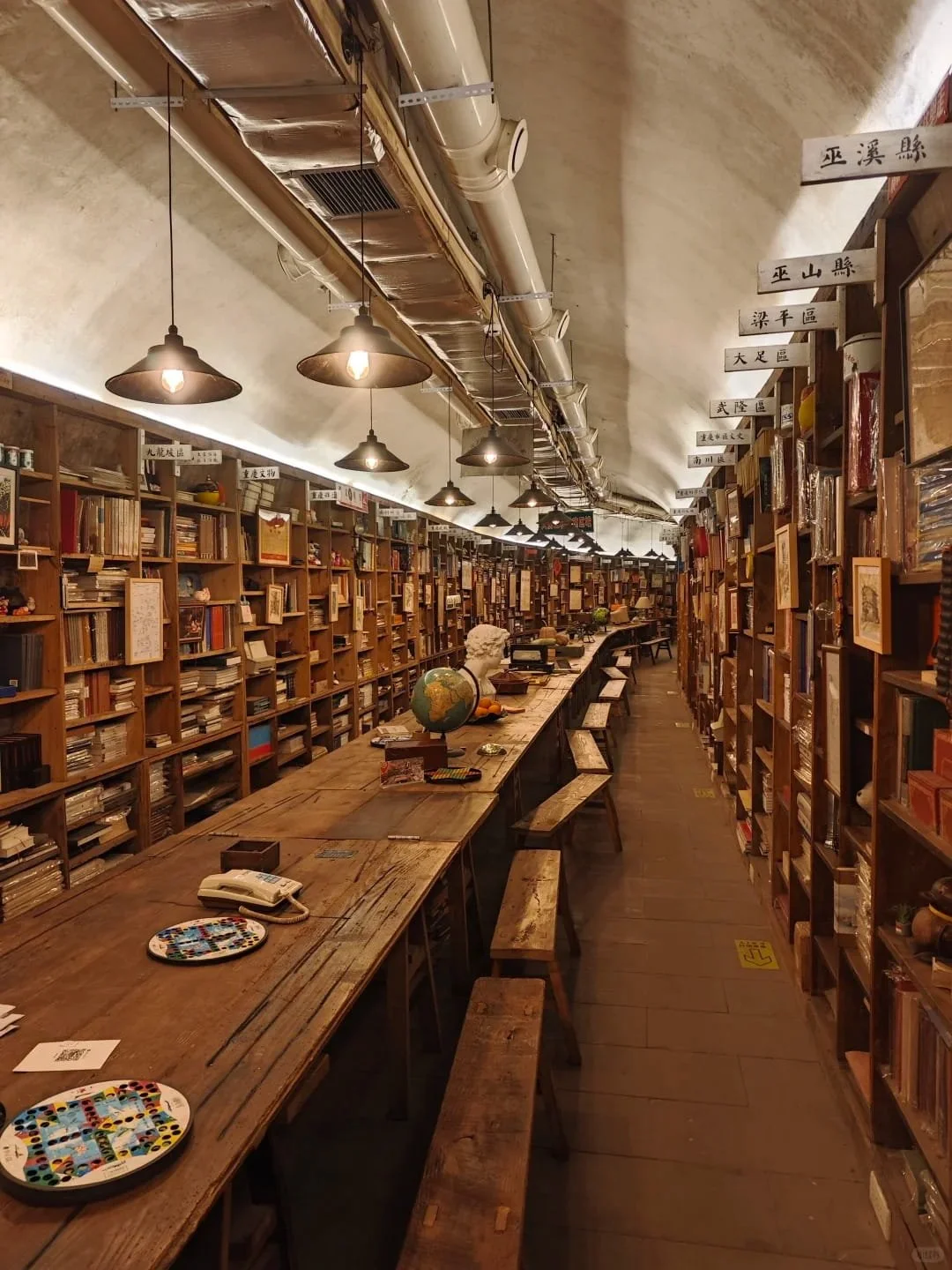
China does bookshops better than almost anywhere else in the world, and if you haven’t been to one yet, Chongqing is a good place to start. Bookshops here are part gallery, part lifestyle store, and part café. They sell everything from locally made crafts and art prints to ceramics, stationery, and design objects alongside a carefully curated selection of books. Fangso (方所) in Chongqing is a great example of the form. It’s a sprawling 2,400 square metre space that mixes books with Japanese ceramics, handmade crafts, and a café, set in a beautiful basement space. We’ve written about similar bookshops in our Xiamen guide if you want a sense of what to expect.
But my favourite is Jungo Bookshop (军哥书屋) and finding it is part of the experience. It’s tucked inside a former WWII air-raid shelter in the Huangjueping neighbourhood near Sichuan Fine Arts Institute, the kind of place you’d walk past a hundred times without knowing it was there. The owner, Gou Jun, has spent years collecting old maps of Chongqing’s neighbourhoods, and has turned them into a series of postcards and prints that capture the city as it used to be, showcasing streets that no longer exist, buildings long since demolished, and a Chongqing that only lives on paper now. Those prints have become some of the most sought-after locally made souvenirs in the city, and they’re only available here. The shop also sells handmade bags, bookmarks, stamps, and other small goods, all with the same quietly obsessive attention to local history.
Hot Pot Base (火锅底料)
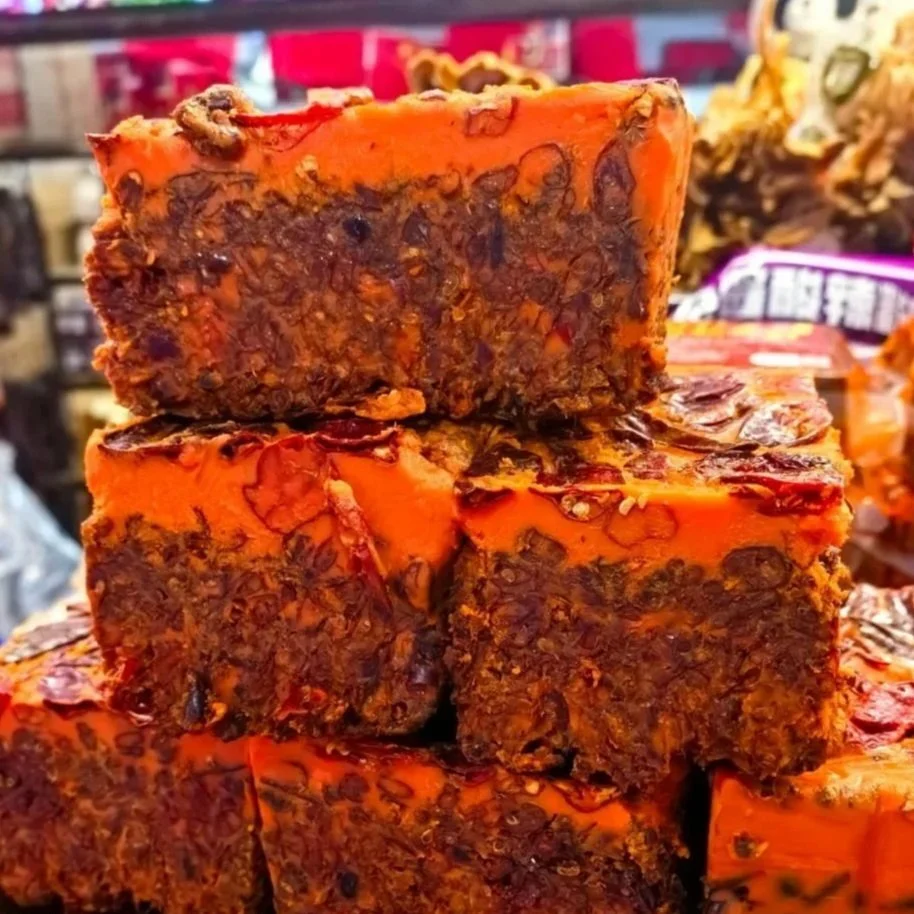
Taking Chongqing’s flavours home is easier than you think. Hot pot base is a spiced, aromatic brick of chilli, Sichuan peppercorn, and beef tallow that forms the foundation of every great Chongqing hot pot. Handmade versions are widely available across the city, and it travels well. You’ll find shops making it fresh in Ciqikou, where vendors hand-pack it in front of you in various spice levels and flavour profiles. It’s one of those genuinely useful souvenirs that will actually get put to good use. One brick makes enough broth for a full hot pot at home, and also instantly transport you straight back to Chongqing.
Where to Play
Jiujie (九街)
Jiujie — officially "Bùyè Jiǔ Jiē", the street that never sleeps — is the beating heart of Chongqing's nightlife. Located in the Guanyinqiao area of Jiangbei District, this is where the city's young, fashionable, and thoroughly committed-to-a-good-time crowd converges after dark. What makes it interesting is how your night unfolds across the night in stages. Early evening you might come for craft beer bars and quieter spots, so you’ll want to head to the Ziwei Road strip running off Jiujie to find Dameng (大梦) and Grass Taproom (野草) - find out more in the craft beer section below. By nine head to the cocktail bars that rival some of the best in Shanghai. Flavor Lounge and its sister venue Flavor Tiki are the two names to know: Flavor Lounge is the classics-focused option, with veteran bartender and owner Jimmy taking the canon seriously; Flavor Tiki is the wilder sibling, a full tiki bar with theatrical tropical cocktails. For something more intimate, Soma is a small bar on Jiujie proper where the house soma cocktail packs a punch and is worth lingering over to spend time with the bartenders who are genuinely good company. Folk music venues fill up around ten, with bands doing originals to packed rooms. Then from eleven onwards the big clubs take over and run until dawn. Whatever kind of night you're after, Jiujie has a version of it. Do your research on Dianping before you go, book ahead on weekends, and don't arrive before nine unless you want to be the first one there.
Chongqing’s Craft Beer Scene
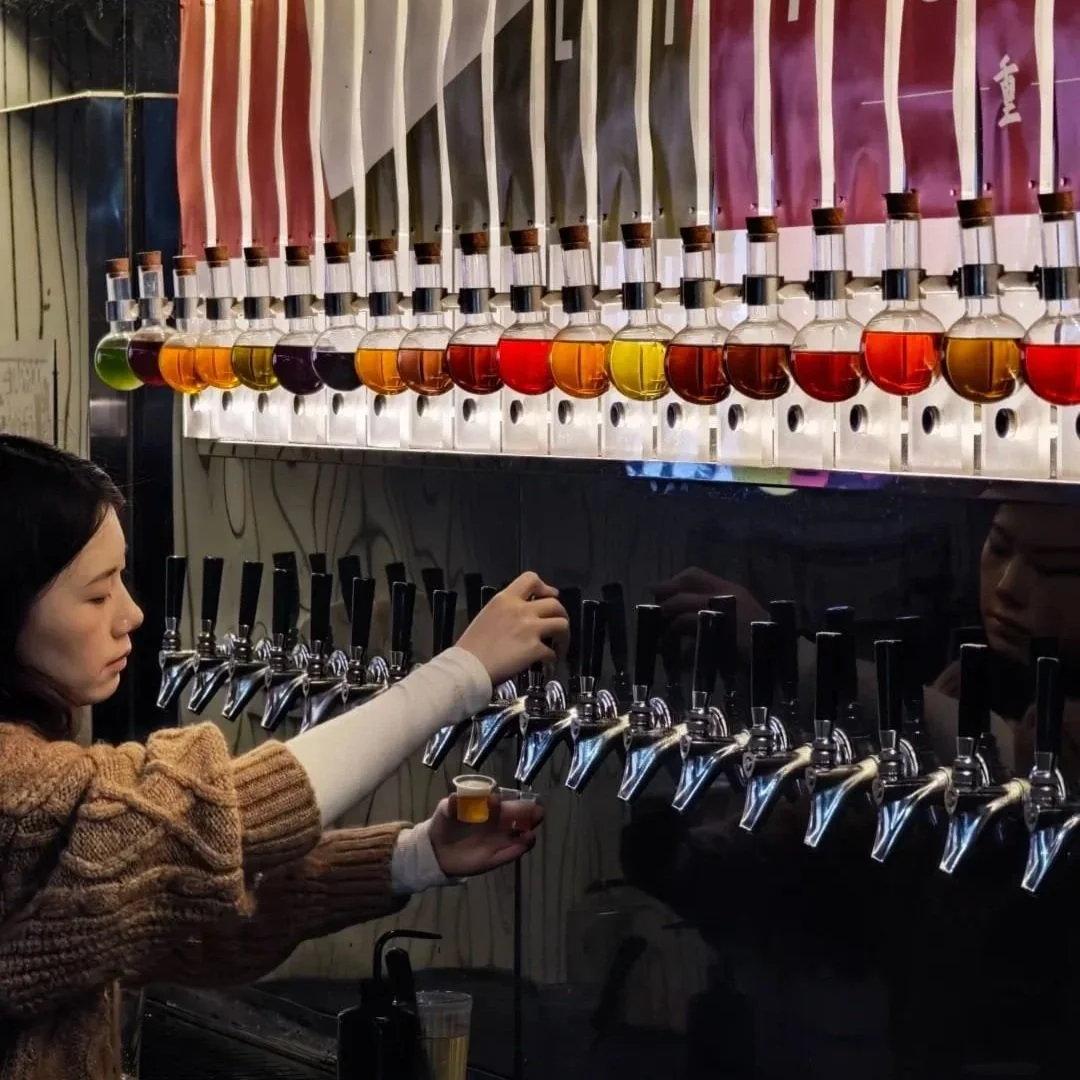
Chongqing has quietly built one of the most interesting craft beer cultures in China, and it deserves more attention than it gets. Start with BackFuture Brewery (半刻酿造 Bànkè Niàngzào), a Chongqing-born operation making saisons and fruit sour ales, with 14 house taps and a space designed so thoughtfully that each booth feels like a different corner of someone’s home. Caver Bar (凯弗 kǎi fú) is exactly what it sounds like, a craft beer bar built inside a WWII air-raid shelter near Liziba Station, with 26 taps and cocktails, rustic stone walls, and the kind of setting that could only exist in this city. Dameng Dining Room (大梦饮食间 Dàmèng Yǐnshí jiān) pairs craft beer with Chongqing chuanchuan skewers at a bar counter. Grass Taproom (野草 Yěcǎo) is a community spot hidden in a courtyard. It’s hard to find, has bottles everywhere, a cat and a dog, and the owner’s art on the walls. And then there’s PoPo, run by a 70-year-old grandmother, serving bottles only, the standard accompaniment is a bowl of sunflower seeds. No taps, no cocktail menu, no fuss. Just Popo.
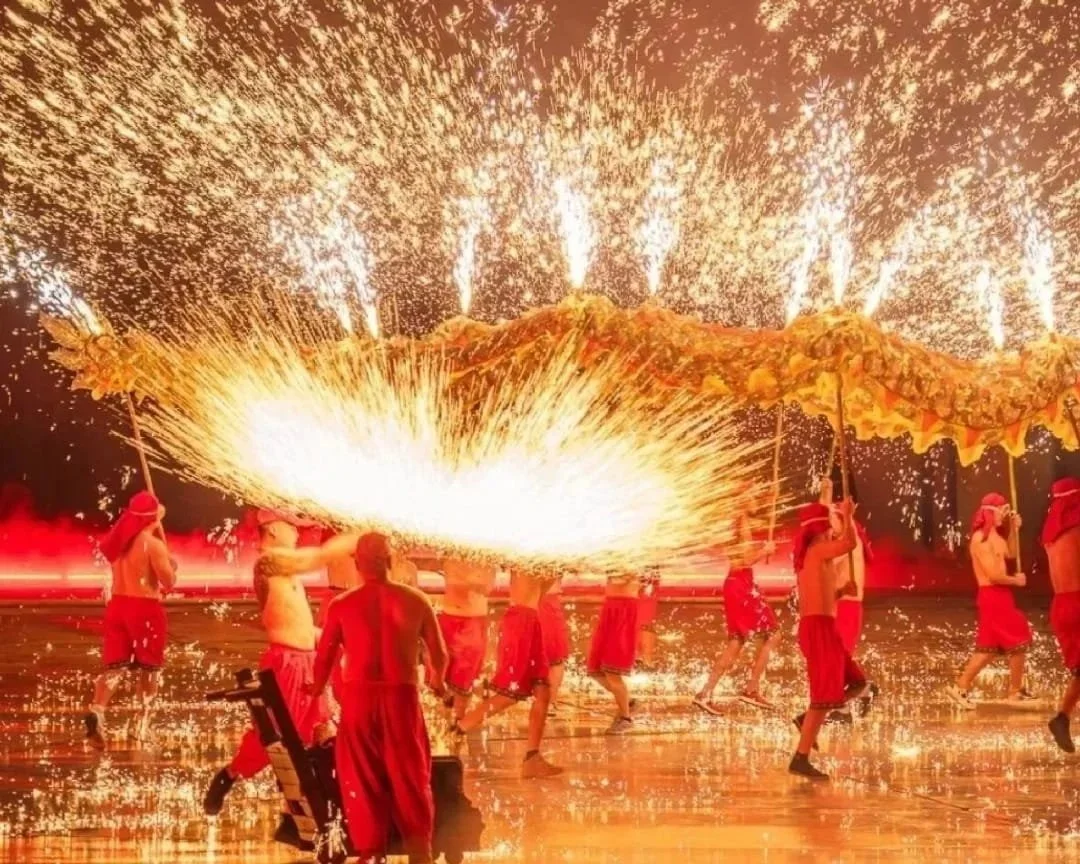
Datiehua Iron Flower Show (大铁花)
I’ve been to a lot of these traditional Chinese folk performance shows over the years, and they always sound like they might be a bit corny. They never are. The Datiehua is one of the most visually spectacular things you can see in China. Molten iron heated to over 1,600 degrees is flung into the air by performers, exploding into cascading showers of sparks that rain down like a golden firework display. It’s been performed in China for centuries and is recognised as a National Intangible Cultural Heritage. The show runs nightly near Hong’en Temple, weather permitting. The scale and skill on display is genuinely mind-blowing, and it costs almost nothing. Go.
Shaokao Street BBQ (烧烤)
Some of the best nights I’ve had in China have been when the sun goes down, the plastic chairs go out onto the pavement, the smoky grills fire up, and Chongqing settles in for the real second half of the evening. Skewers of meat, vegetables, and tofu, dusted with cumin, dried chilli, and Sichuan peppercorn, come off the grill in steady waves. You eat them with room temperature local beer, sitting on a crate, on a street corner, with whoever you’ve ended up next to. The conversation gets louder, the order list gets longer, and somehow it’s 2am. Head down any back alley around Jiujie or Nanbin Road after dark and follow your nose.
Two Rivers Night Cruise (两江夜游)
If you want a quieter evening, the Two Rivers Night Cruise is one of the best ways to see Chongqing. The city is built on a peninsula between the Yangtze and Jialing Rivers, and from the water at night you get the full picture: skyscrapers stacked up hillsides, bridges lit up in gold, Hongyadong glowing against the cliffs, the point where the muddy brown Yangtze meets the clearer green Jialing. It’s not a party boat, it’s a chance to sit back, watch the city do its thing from a distance, and appreciate just how strange and beautiful this place is. Book ahead during peak season and wait until at least 8pm when everything is fully lit up.
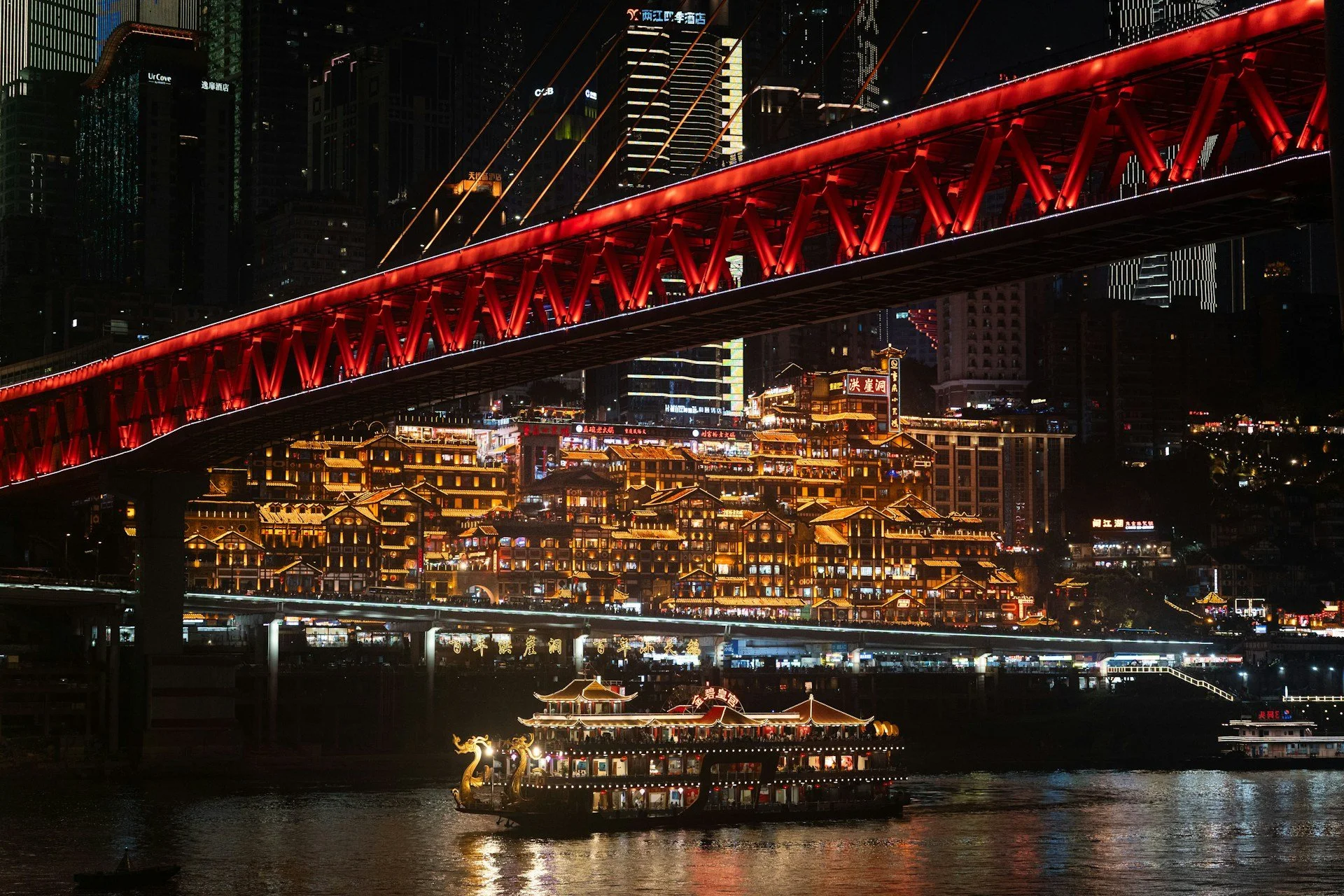
Chongqing is having a moment right now, and for once the attention is completely deserved. The topography is unlike anything you’ve seen, the nightlife is genuinely world-class, and the craft beer scene is quietly becoming one of the best in China. But it’s the food that will really do you in. You’ll be thinking about your next bowl of xiaomian before you’ve even finished the first. You’ll find yourself craving the ritual of digging through a mountain of dried chillies for your lazi ji, or the theatrical arrival of a grilled fish still bubbling in its tray. The hot pot will ruin you for hot pot everywhere else. And if you’re lucky enough to try the doufunao at a street stall on a cold morning, spooned over rice with chilli oil pooling at the bottom of the bowl, you’ll understand immediately why people who’ve been to Chongqing can’t stop talking about it.
Go soon. The secret is already getting out.
Frequently Asked Questions
-
Yes — Chongqing is one of the most distinctive cities in China, combining a dramatic mountain geography with outstanding food and a lively nightlife scene. Its unusual urban landscape, where metro trains pass through buildings and highways thread through residential blocks, makes it unlike anywhere else in the country. Three to four days is enough to cover the highlights comfortably.
-
Spring (March to May) and autumn (September to October) offer the most comfortable conditions, with temperatures between 15–28°C and manageable humidity. Chongqing summers are extremely hot — temperatures regularly exceed 40°C — so July and August are best avoided for outdoor sightseeing. Avoid Chinese public holidays, particularly National Day (1–7 October) and Chinese New Year, when crowds and prices peak.
-
Chongqing is known for its dramatic vertical cityscape, where metro lines pass through occupied apartment buildings, highways thread through upper floors of residential blocks, and the ground floor of one street can be the twentieth floor of the next. It is also known for its food, particularly Chongqing hot pot — made with a beef tallow broth and significantly spicier than other Chinese hot pot styles — along with xiaomian noodles, lazi ji, and one of the most interesting street food scenes in China.
-
High-speed trains run frequently between Chengdu and Chongqing, with the journey taking approximately 1.5 hours. Trains depart from both Chengdu East and Chengdu South stations, arriving at Chongqing North or Chongqing West. The two cities are commonly visited together as a Southwest China combination trip.
-
Three to four days is enough to see the main city highlights — the vertical urban landscape, key neighbourhoods like Shibati and Ciqikou, the Three Gorges Museum, and plenty of the food. Adding a full-day trip to Dazu Rock Carvings, about 90 minutes outside the city, is worthwhile if time allows and would suit a four to five day itinerary.
-
Chongqing hot pot uses a beef tallow-based broth heavily spiced with dried chilli and Sichuan peppercorn, producing a richer, oilier, and significantly spicier result than hot pot styles found elsewhere in China. The classic format is the nine-grid pot (九宫格), where different sections cook at different temperatures. The Sichuan peppercorn creates a numbing sensation (麻, má) alongside the chilli heat (辣, là), which is the hallmark of Chongqing's food culture.
-
The essential dishes in Chongqing are hot pot (火锅), xiaomian noodles (小面), suan la fen hot and sour glass noodles (酸辣粉), lazi ji crispy chilli chicken (辣子鸡), and guokui stuffed flatbread (锅盔). Mao xue wang (毛血旺), a spiced broth of duck blood and offal, is the more adventurous local speciality. Most of these are inexpensive and widely available across the city, with Bayi Road (八一路好吃街) a reliable starting point for street food.
-
Check current visa requirements before you travel, as China's visa-free policies have expanded significantly in recent years