
Fukuoka Travel Guide
Fukuoka might be one of Japan's best food cities, along with being the gateway to Kyushu, one of the country's most rewarding regions. If you've done the big-city loop and want to know where serious Japan eaters actually go, this Fukuoka travel guide is one of the answers.
It helps to know that Fukuoka was originally two cities. On the west side sat Fukuoka, the old castle town of the feudal lords. On the east, Hakata, the merchant quarter where traders, fishermen, and craftspeople built a culture of their own. The two merged in 1889, but Hakata never really let go of its identity. If you want to understand this city, start by understanding that the merchants won. The airport is Fukuoka Airport. The Shinkansen station is Hakata Station. The ramen is Hakata ramen. The biggest festival in the city is the Hakata Gion Yamakasa.
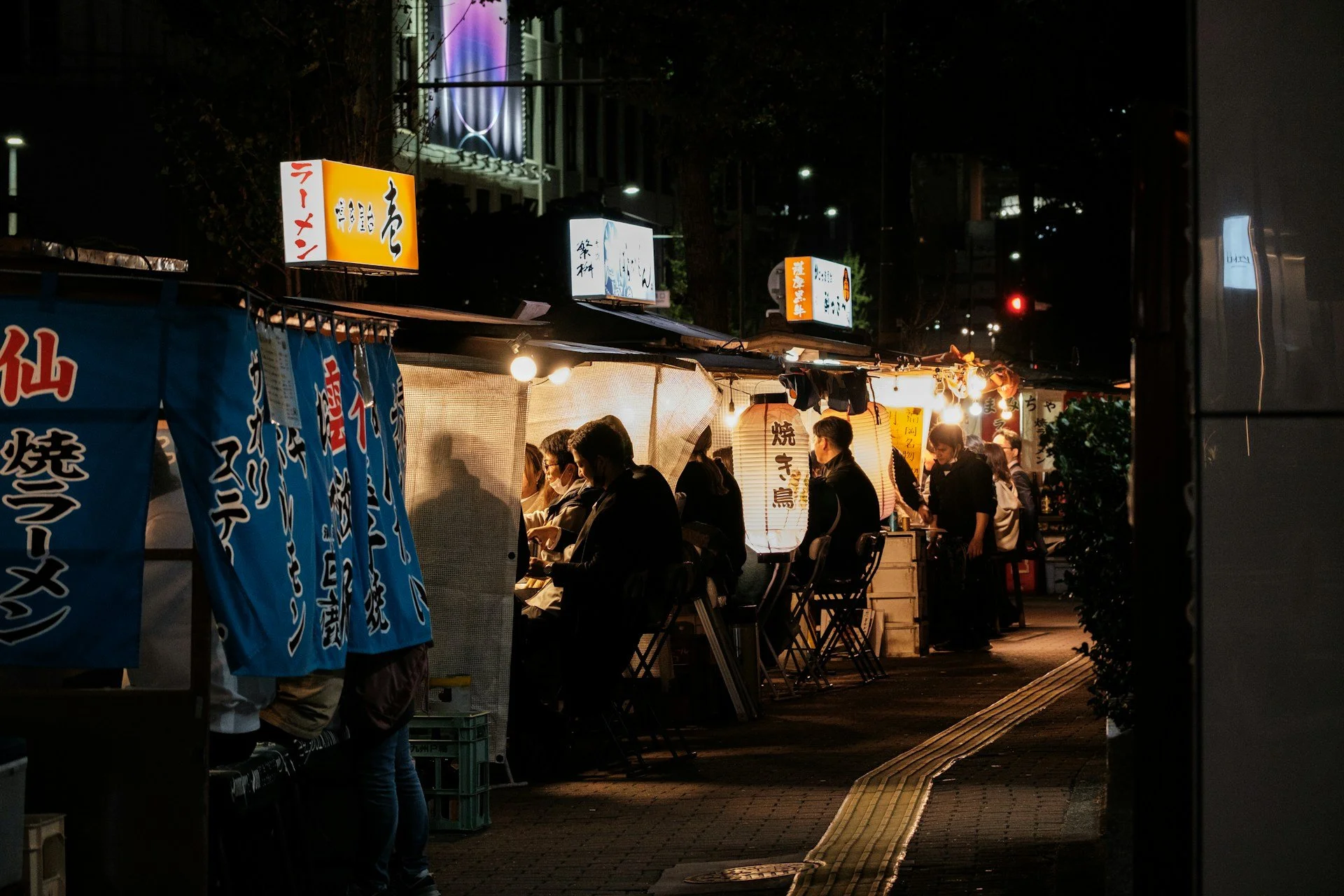
That merchant DNA runs through everything here. Fukuoka has always been Japan's gateway to the rest of Asia, geographically closer to Seoul and Shanghai than it is to Tokyo, and that openness shows up in the food, the pace, and the general attitude. People eat late and eat well. They drink outdoors. They take their local dishes very seriously and they'll tell you exactly why theirs are better than what you'll find anywhere else in Japan.
The food city comparison that makes the most sense to us is Nagoya. Both cities are largely bypassed by visitors who just rush through the Golden Triangle on the Shinkansen. But while Nagoya's food identity runs through hatcho miso and centuries of samurai patronage, Fukuoka's is louder, more informal, and built for eating shoulder-to-shoulder with strangers. If you've been skipping both, that's a mistake our Fukuoka travel guide is here to help you correct.
Getting to Fukuoka
Fukuoka is easier to get to than most people expect. Hakata Station is the western terminus of the Tokaido-Sanyo Shinkansen, which means almost every bullet train heading west from Tokyo ends here. Journey times are roughly 5 hours from Tokyo, 2.5 hours from Osaka, and 45 minutes from Hiroshima.
Fukuoka Airport is one of the most convenient in Japan. It's two subway stops from Hakata Station, about six minutes door to door. International flights connect directly from Seoul, Hong Kong, Shanghai, Taipei, and other Asian cities, making Fukuoka a strong entry or exit point if you're building a wider regional trip. There's also a high-speed ferry from Busan in South Korea (around 3 hours) for anyone combining the two countries.
Once you're in the city, the subway covers most of what you need and everything between Hakata and Tenjin is walkable.
Where to Stay
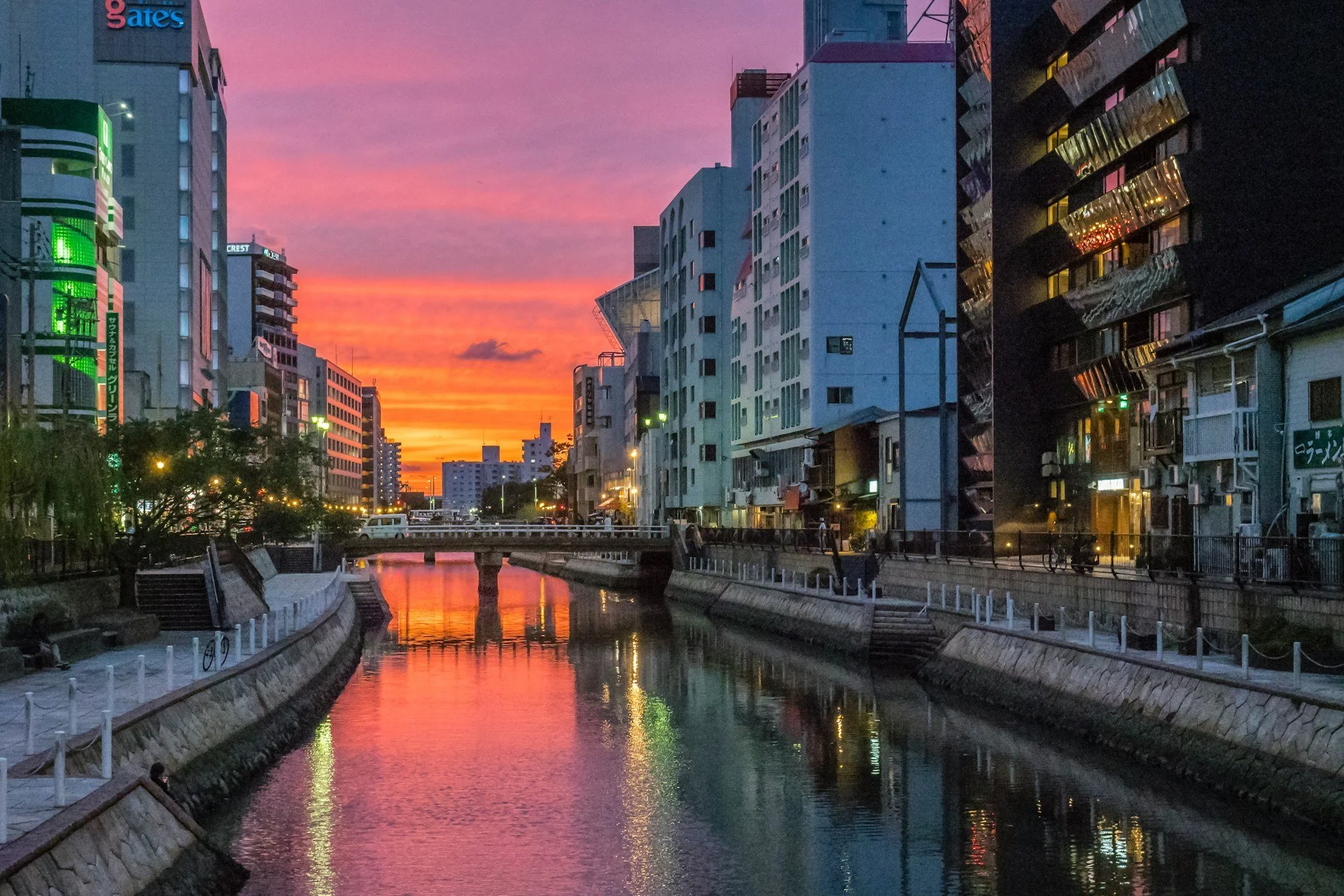
When choosing a hotel in Fukuoka, staying around Hakata Station makes sense if you're using the city as a base for day trips or arriving late by Shinkansen. Tenjin puts you closer to the eating and drinking action. The Yakuin area, just south of Tenjin, is quieter and more neighbourhood-feeling, which suits people who plan to spend their evenings at local restaurants rather than tourist spots.
Dormy Inn Hakata Gion ¥¥ — A reliable business hotel that punches above its price point, with a natural hot spring bath on-site. Centrally located near Hakata Station.
Hotel Il Palazzo ¥¥¥ — A boutique hotel designed by Italian architect Aldo Rossi, with a subterranean entrance corridor lit in blue that leads you by lift to the main lobby in the basement. All-day buffet included. Recommended by our friends at The Layer.
ONE Fukuoka Hotel ¥¥¥¥ — A 41-room, 5-star hotel that opened in 2025, directly connected to Tenjin Station via the basement. Rooftop open-air bath and sauna, library lounge with complimentary food and drinks, and a free minibar replenished daily. Views across the mid-rise rooftops of Tenjin and out to Hakata Bay.
What to Eat
Fukuoka takes food seriously, in a way that’s extremely personal. Ask someone from here about their city and within five minutes you'll be talking about what to eat. People have opinions about the local dishes, argue over them, and will happily redirect your entire evening around them.
Hakata Ramen
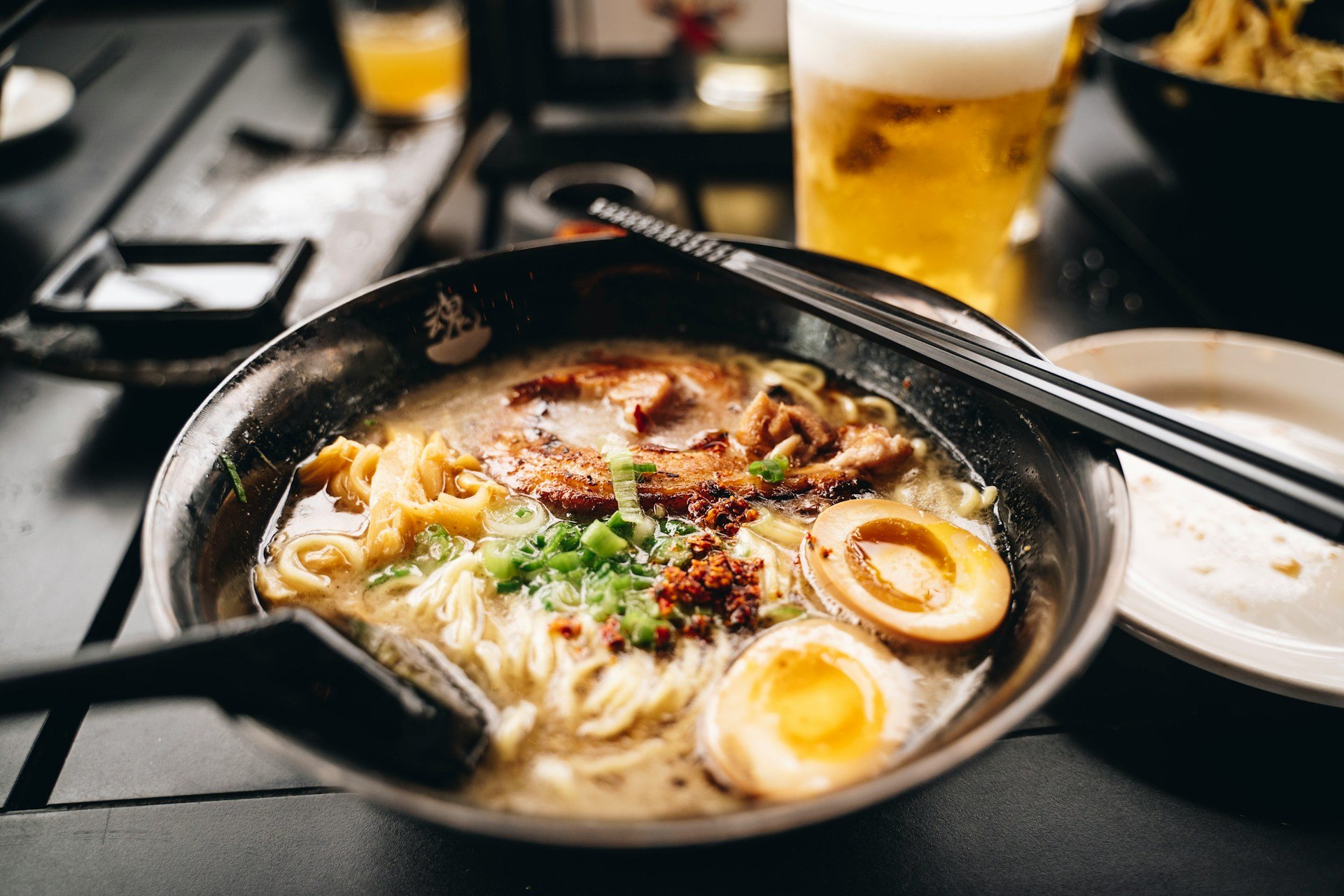
Tonkotsu ramen was born in Fukuoka, and the Hakata version is boiled at high heat for hours until pork marrow dissolves completely into the liquid, turning it white, creamy, and deeply savoury. The noodles are thin and straight. Locals order barikata (very firm) and when the noodles run out, call for kaedama, a fresh serve dropped straight into the remaining broth. It's a whole system.
Shin Shin (博多らーめん ShinShin) in Tenjin is where a lot of locals point first. The broth is slightly lighter than the ultra-rich Nagahama style but has genuine depth. For something more intense, Hakata Issou (一双) near Hakata Station does what they call a "pork bone cappuccino" — triple-pot method, domestic pork bones only, a frothy, almost shockingly rich bowl.
Mizutaki
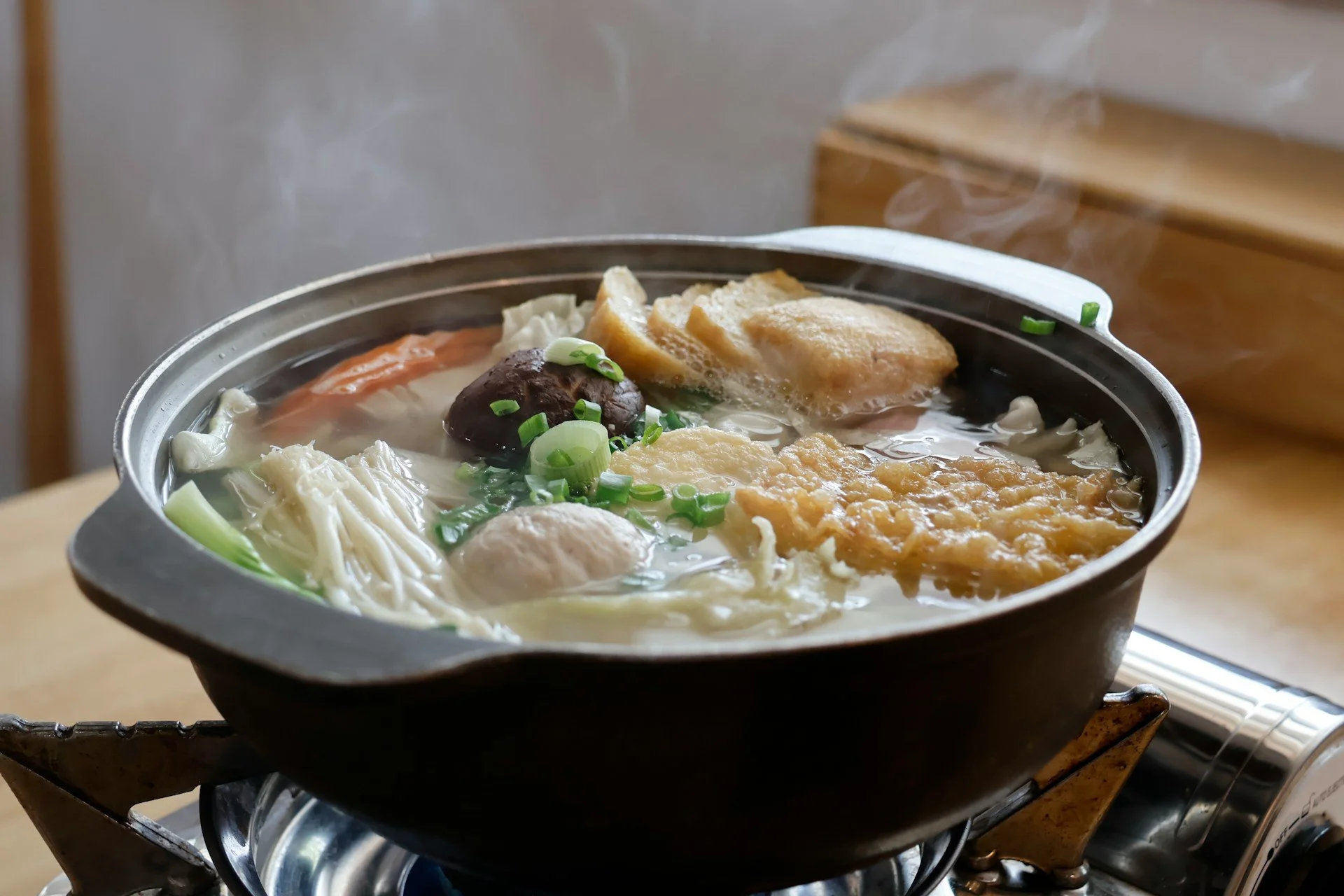
Fukuoka's chicken hot pot, and one of the dishes that surprises people most. Unlike most hot pots, mizutaki starts with a milky broth made from chicken bones simmered for hours, and you cook tender jidori chicken pieces tableside before dipping them in a ponzu-based sauce with spring onion. The broth itself is served first, as a soup, before anything else touches the pot. That first bowl is usually the moment people understand what the fuss is about.
Hakata Hanamidori (博多 はなみどり) has been doing this since 1949 and is one of the most celebrated mizutaki specialists in the city. Mizutaki Nagano (水たき 長野) is a century-old restaurant that takes a more traditional approach.
Motsunabe
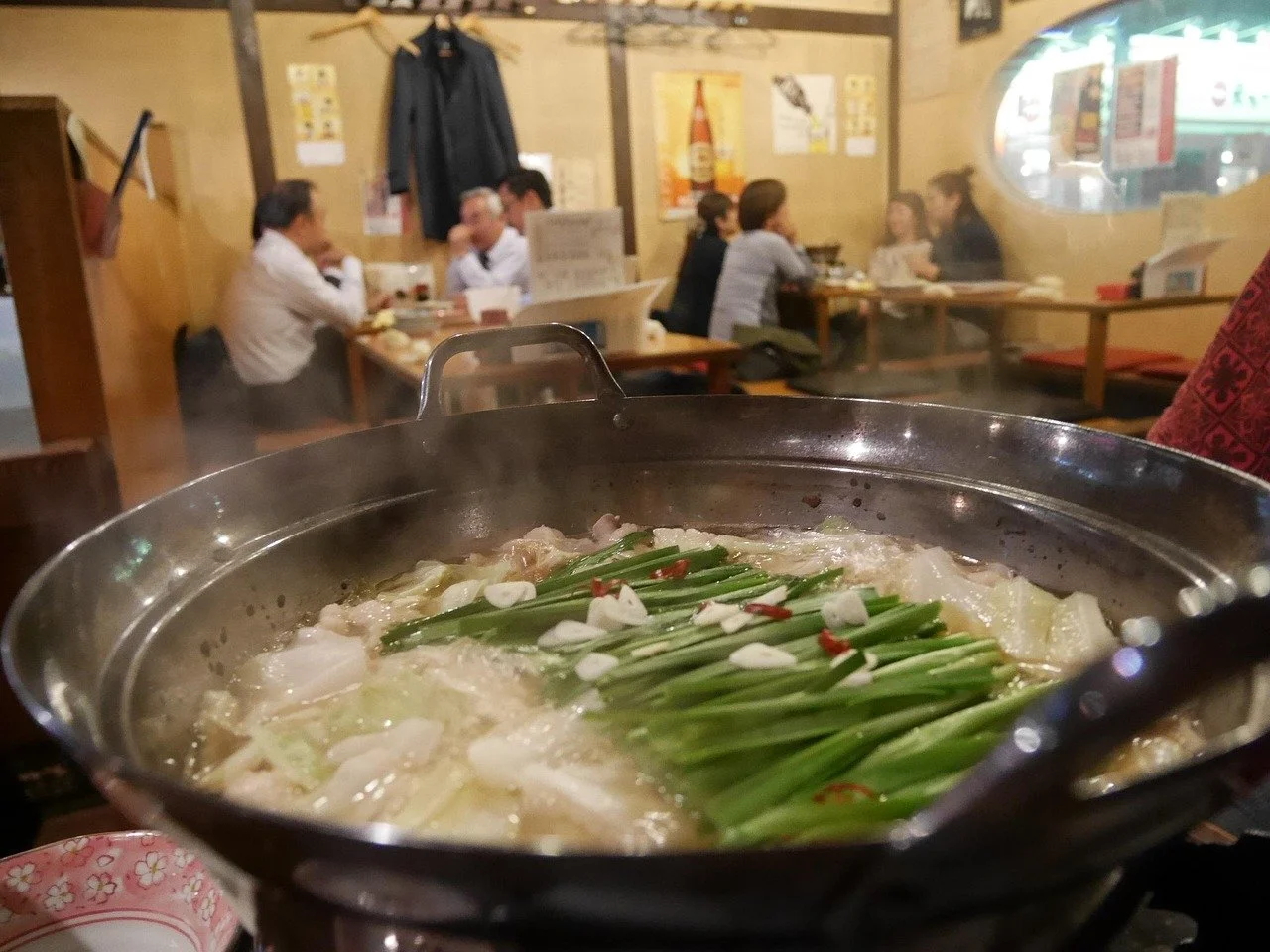
Beef or pork offal hot pot, cooked in a light soy or miso broth with chilli, garlic, cabbage, and a generous pile of Chinese chives. It's collagen-rich and warming and built to be eaten alongside several drinks. Motsunabe has spread across Japan in recent decades, but Fukuoka is where it started, and the local versions reflect that, particularly those using ago (flying fish) dashi as a base, which gives the broth a cleaner, more delicate backbone than the standard soy version.
Hagakure (はがくれ) near Nakasu-Kawabata is worth singling out: the chef trained in France and the broth uses flying fish dashi. For a more traditional take, Oyama (博多もつ鍋おおやま) uses young-cattle small intestine only and a house miso blend they've been refining for years.
Modern Izakaya
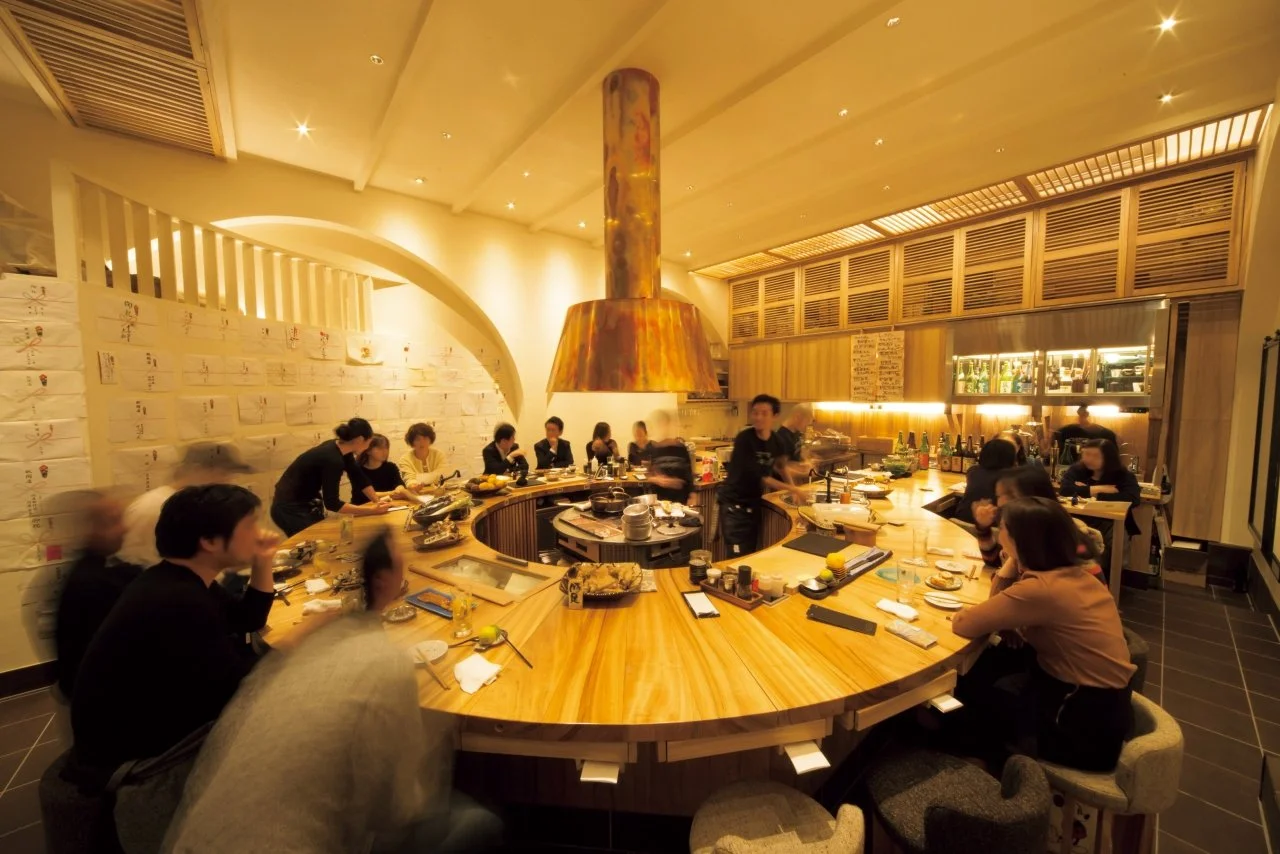
Fukuoka is a city that's serious about its classics, but it's also producing some of the most interesting modern Japanese cooking in Kyushu right now. The Yakuin and Imazumi neighbourhoods, a short walk south of Tenjin, are where a lot of that scene lives, in the form of counter restaurants, seasonal menus, and chefs doing creative things with local ingredients.
Koyama Parking (めしや コヤマパーキング) is our pick. The entrance is through a revolving door, the seating is counter-only around an open kitchen, and the menu changes with what's good that week. Reservations are required. Robata Hyakushiki (炉端 百式)is the parent restaurant, more focused on open-fire robata cooking, and a solid backup if Koyama Parking is full.
Oden Yasube 名代おでん 安兵衛
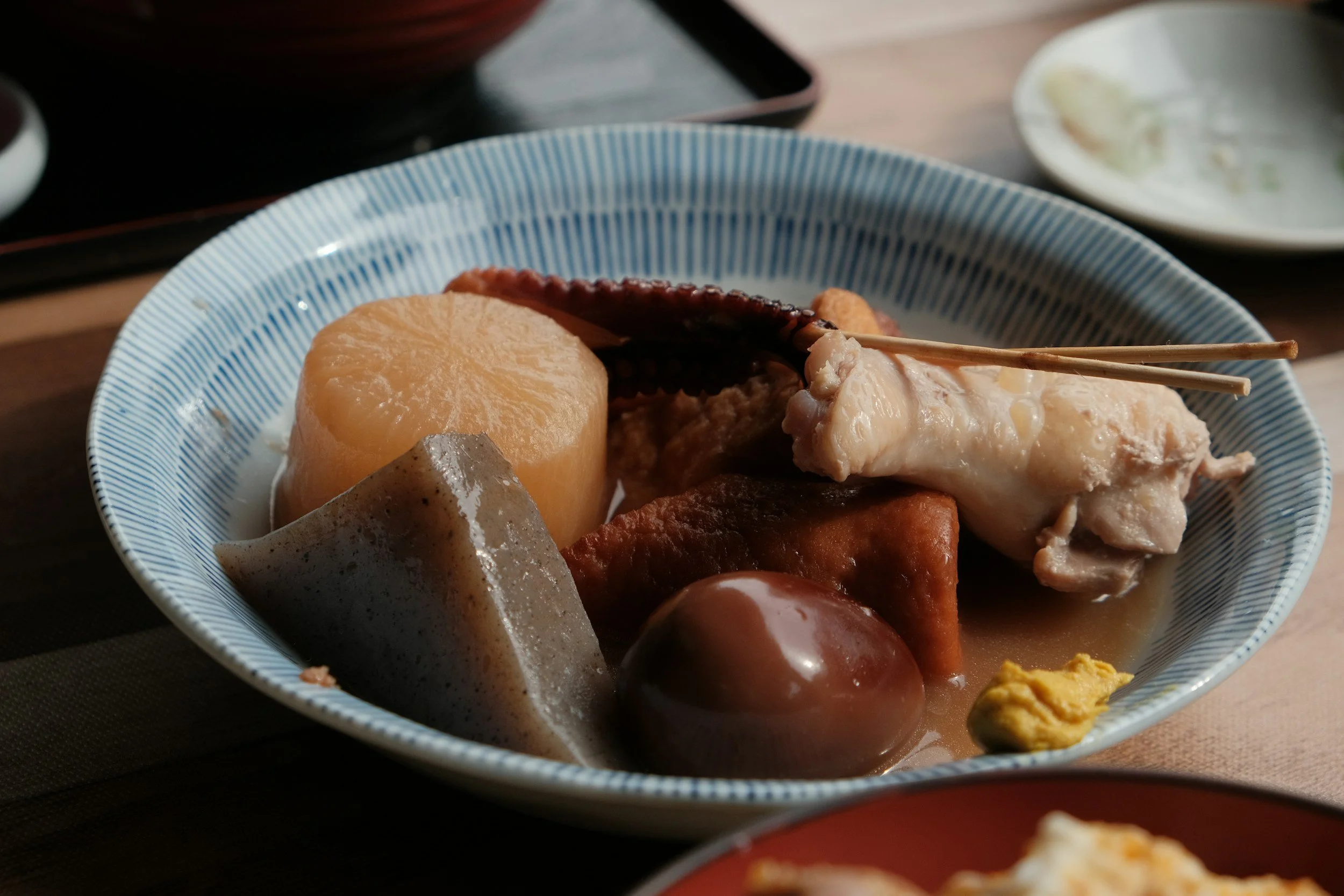
Oden is a slow-cooked pot of ingredients in dashi broth — daikon, fish cakes, tofu, boiled egg, konnyaku — that often puts people off when they first see it, but give it a chance and it will become one of your favourite Japanese dishes, especially in winter. Yasube in Tenjin is a tiny counter spot with only a handful of seats and zero English, with an environment just as homely and heartwarming as their oden. When we went, the place was full, but some customer scooted over, invited us to join their table, and we spent hours over oden and beer with new friends. The food is great. The experience of being there is better.
What to Do
Fukuoka is a great city for wandering. It's compact enough that you can move between neighbourhoods without much planning, and there's enough variety that a few days here never feels thin. Here's what to prioritise.
Yatai
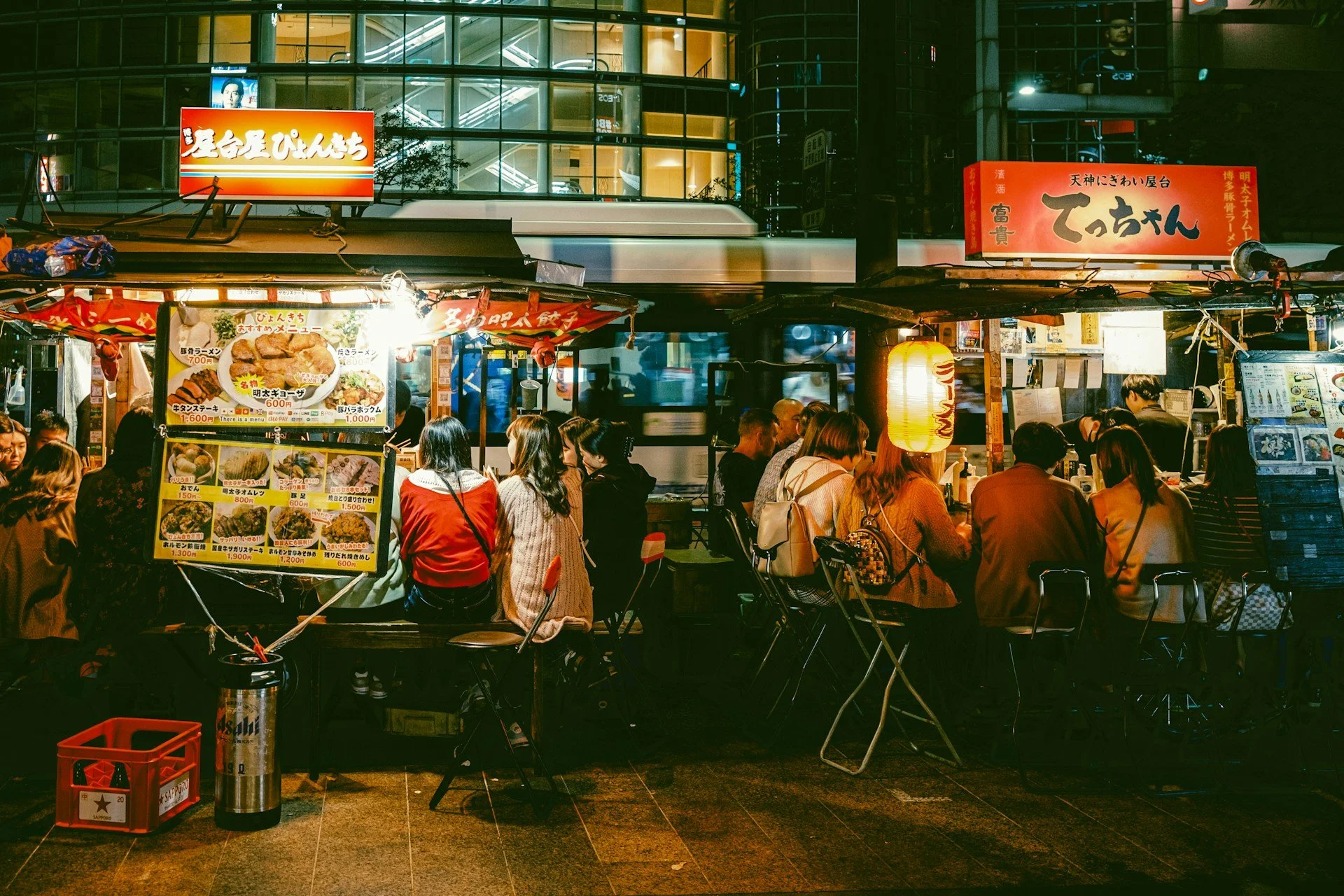
Fukuoka is the only major city in Japan where the yatai culture has survived at scale. Around 100 open-air food stalls set up each evening, mostly along the Naka River in Nakasu and around Tenjin, each holding eight to ten people shoulder-to-shoulder on stools. You're sharing a counter with strangers, eating whatever the owner specialises in. The classics are tonkotsu ramen, oden, yakitori, and gyoza, but Fukuoka's yatai also gave the world yaki ramen, stir-fried noodles cooked on an iron plate until slightly charred and chewy. The whole thing packs up by midnight.
Kokinchan (小金ちゃん) on Watanabe-dori in Tenjin is widely credited as the birthplace of yaki ramen and is still the best place to eat it. Tomochan (ともちゃん) on Showa-dori is the more well-rounded option: ramen, yakitori, gyoza, beef sagari, oden, a warm owner, and queues even in the rain. We've also put 屋台KENZO in this section because even though it's now a proper restaurant it started out as a yatai and still carries the spirit of it, earning it a Dirty Michelin nod.
Kushida Shrine and Hakata Old Town
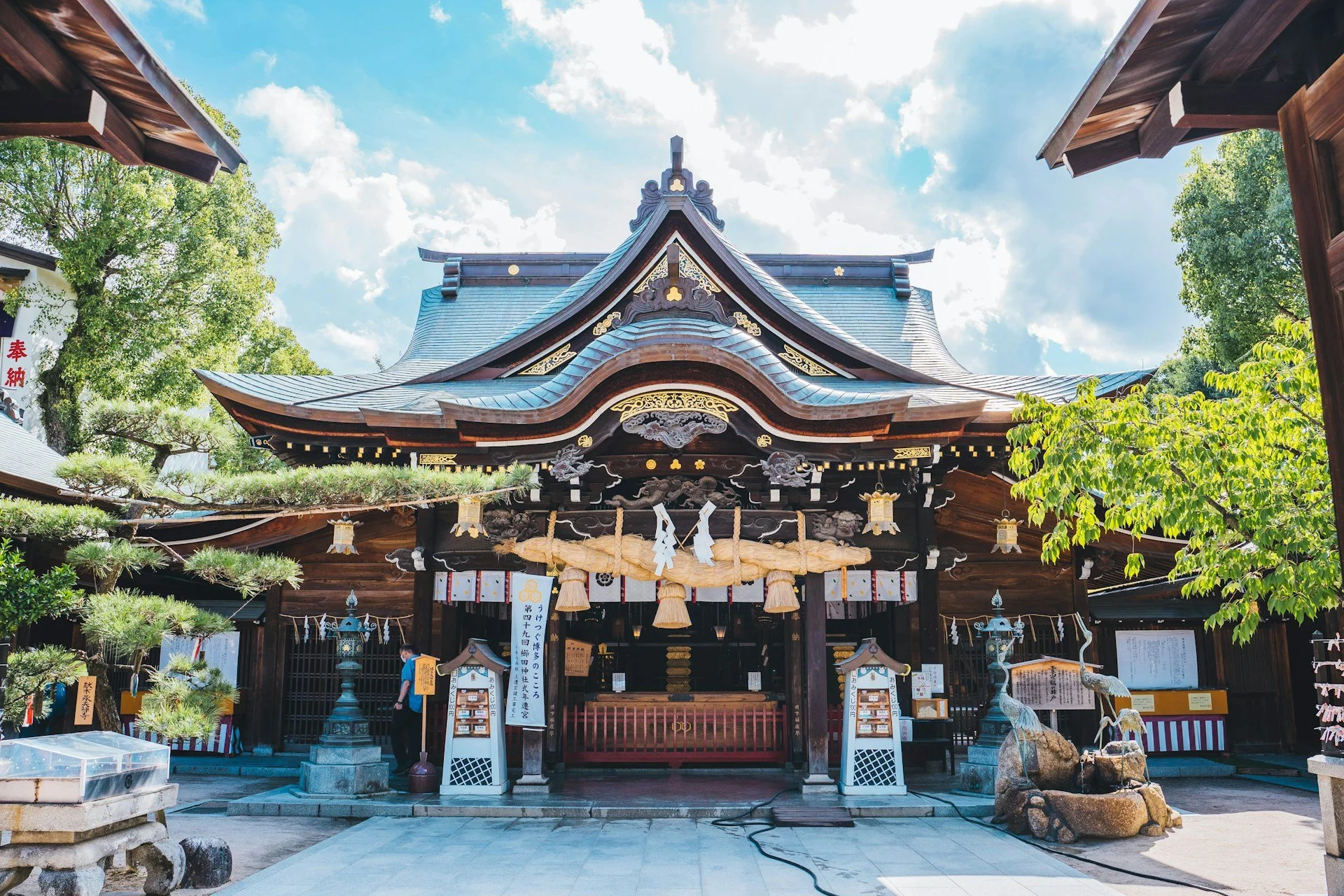
Kushida Shrine has been the guardian shrine of Hakata since 757 and is the spiritual centre of the old merchant district. Entry is free, the grounds are calm even when the city around them isn't, and inside there's a permanent display of a full-scale yamakasa festival float more than ten metres tall, decorated by the same doll-makers who build the floats for the July festival each year.
From the shrine it's an easy walk through what locals call Hakata Old Town, a cluster of temples that tends to get skipped in favour of more prominent sights elsewhere in the city. Shofukuji is Japan's oldest Zen temple, founded in 1195 by the monk Eisai, who also brought tea seeds back from China and grew them here, the first tea cultivated in Japan. A few minutes away, Jotenji is where a stone monument marks the spot where udon and soba were supposedly first made in Japan. Tochoji has the largest wooden seated Buddha in the country, ten metres tall, which you can walk around and behind.
Hakata Gion Yamakasa
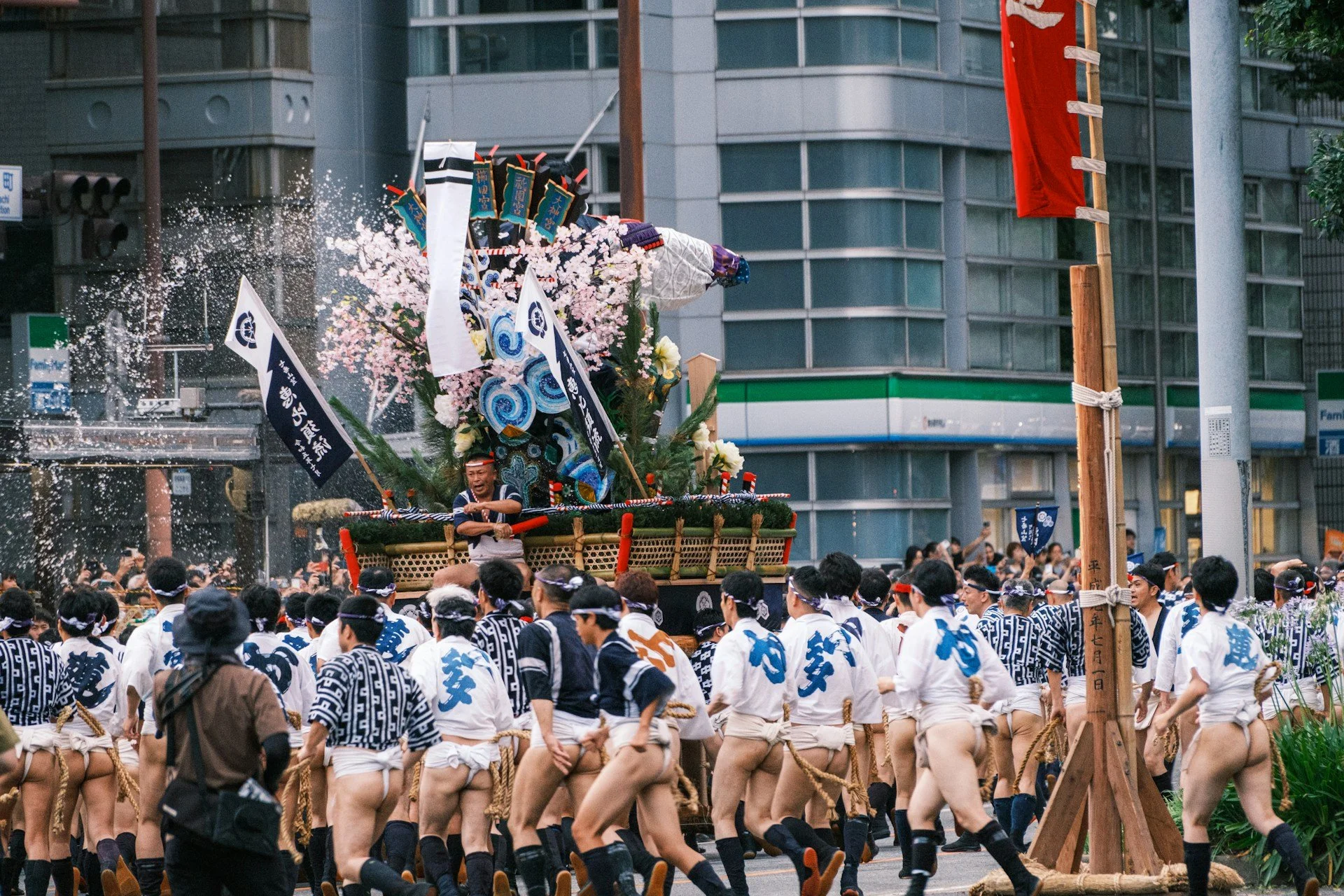
If you're in Fukuoka in July, plan around this. The Hakata Gion Yamakasa is one of Japan's great festivals, a UNESCO Intangible Cultural Heritage that has been running since 1241. Through the first two weeks of July, enormous decorative floats appear at points around Hakata, some reaching fifteen metres high, built fresh each year by neighbourhood teams who've been doing this for generations. The festival culminates on July 15th with the oiyama, a race in which teams of men in happi coats carry one-tonne portable floats through the streets of Hakata at a sprint, starting at exactly 4:59am. Even if you're not a morning person, it's worth setting an alarm.
Ohori Park
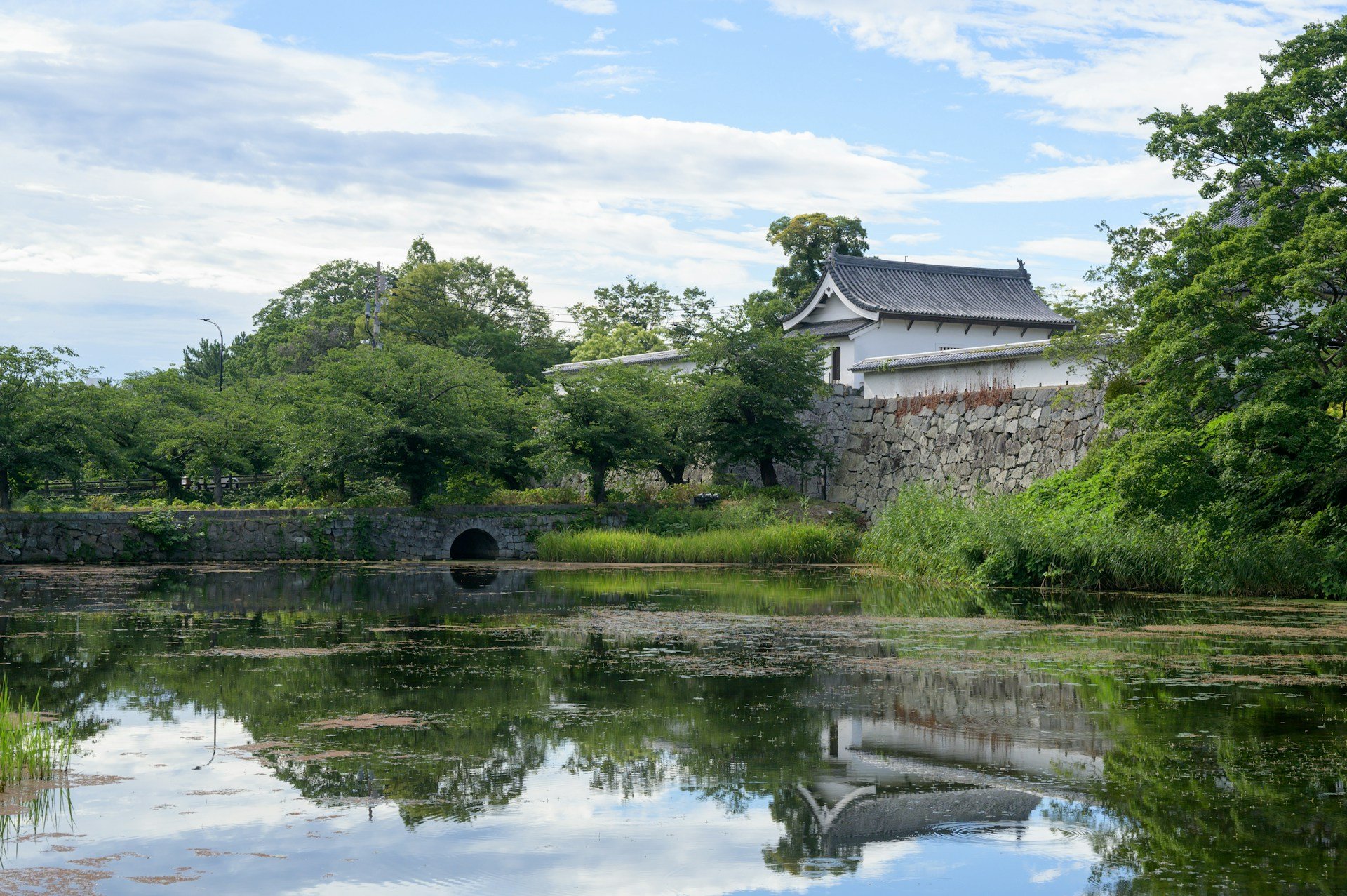
The city's central park, built around a large pond that was once the outer moat of Fukuoka Castle. The two-kilometre path around the water is where the city comes to decompress: joggers in the early morning, families on weekends, couples in the evening. Three small islands sit in the middle of the pond, connected by stone bridges. The adjacent castle ruins are worth a brief walk through for the views, and there's a small traditional Japanese garden on the park's edge that most people walk past without noticing. A good place to spend a morning before the restaurants open.
teamLab Forest Fukuoka
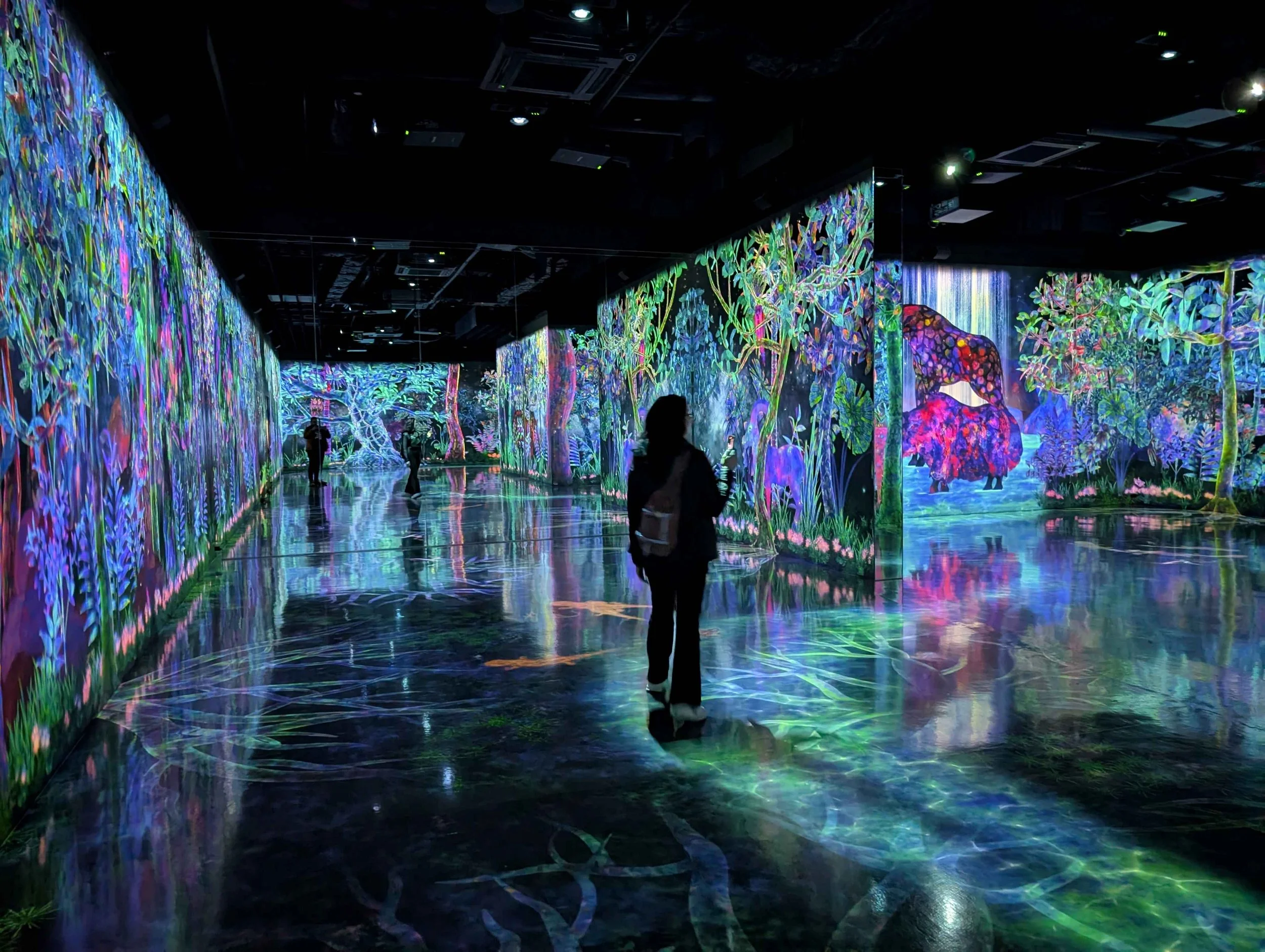
Most people know teamLab in Tokyo, but there are outposts spread across the country, including Fukuoka, which most people only learn about once it’s too late. All of teamLab’s installations provide a slightly different experience, and teamLab Forest is highly interactive, built around a "capture and collect" concept where visitors can manipulate digital creatures and environments. It’s also significantly less crowded than the Tokyo exhibits. Located in the BOSS E·ZO FUKUOKA complex next to PayPay Dome, it's an easy addition to an afternoon on that side of the city.
Day Trips
Fukuoka is great, but if you’re looking for an escape from the hustle and bustle, these places offer something a little quieter and are very easy to access from Fukuoka.
Dazaifu
Twenty-five minutes by Nishitetsu train, Dazaifu was the administrative capital of Kyushu for over 500 years and is now home to Dazaifu Tenman-gu, a shrine dedicated to Sugawara no Michizane, the Heian-era scholar and poet who became the Shinto god of learning after his death. The approach path is lined with plum trees and stalls selling umegaemochi, a grilled rice cake pressed with a plum blossom seal and filled with red bean paste. The Kyushu National Museum just behind the shrine is genuinely excellent. The permanent exhibition covers Japan's relationship with Asia across two thousand years of trade and cultural exchange.
Itoshima
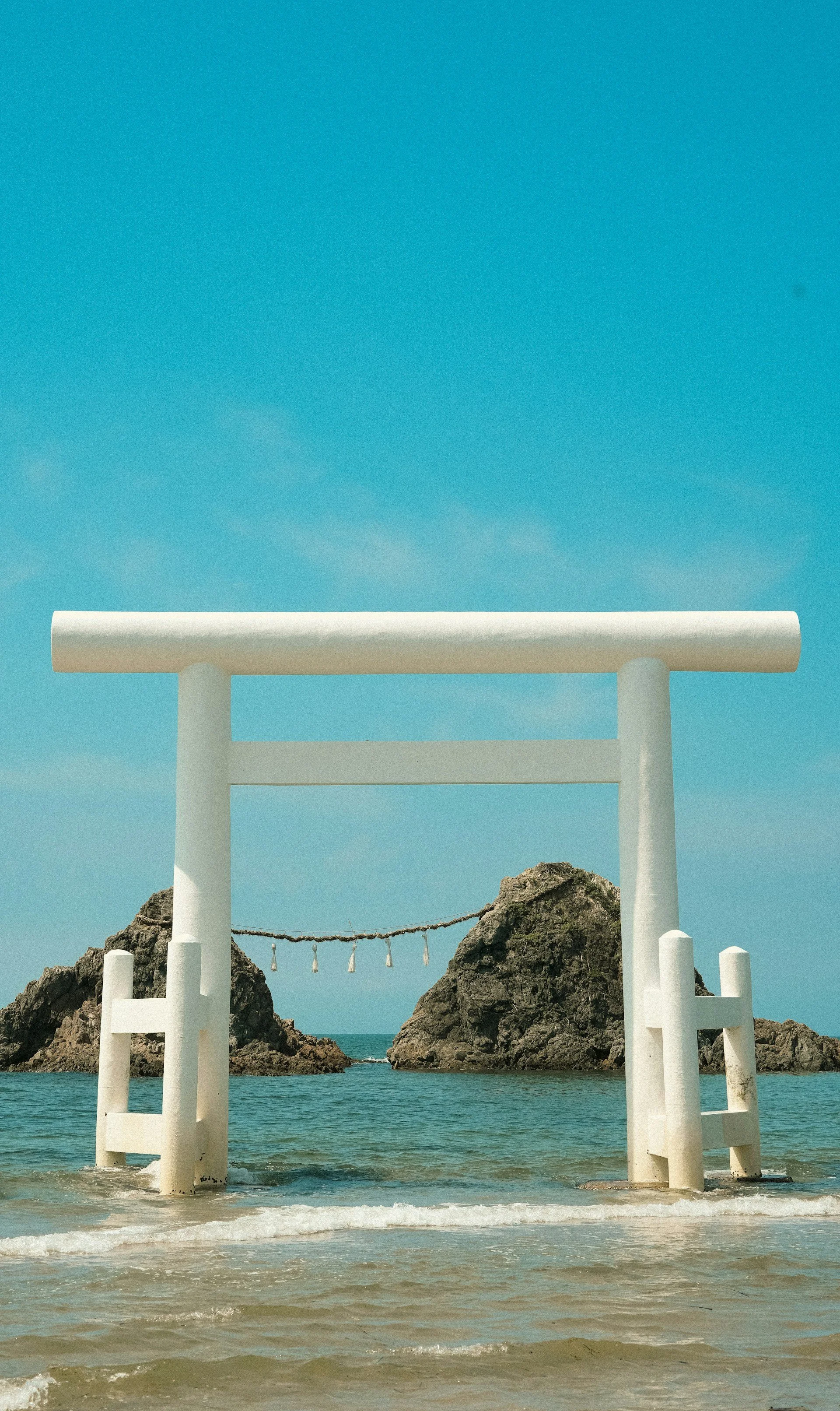
A coastal peninsula about forty minutes west of Fukuoka by train, Itoshima has become a destination in its own right for the city's creative class: craft farmers, ceramicists, small producers, and oyster shacks that open through the winter months and cook shellfish fresh over charcoal right at your table. The Sakurai Futamigaura shoreline has two large rocks rising from the sea connected by a shimenawa rope, framed by a torii gate standing in the water. If that image sounds familiar, it should. It's the same composition as Miyajima's famous floating torii, but without the crowds. A good reason to come here instead of, or as well as, making the trip to Hiroshima.
Nokonoshima Island
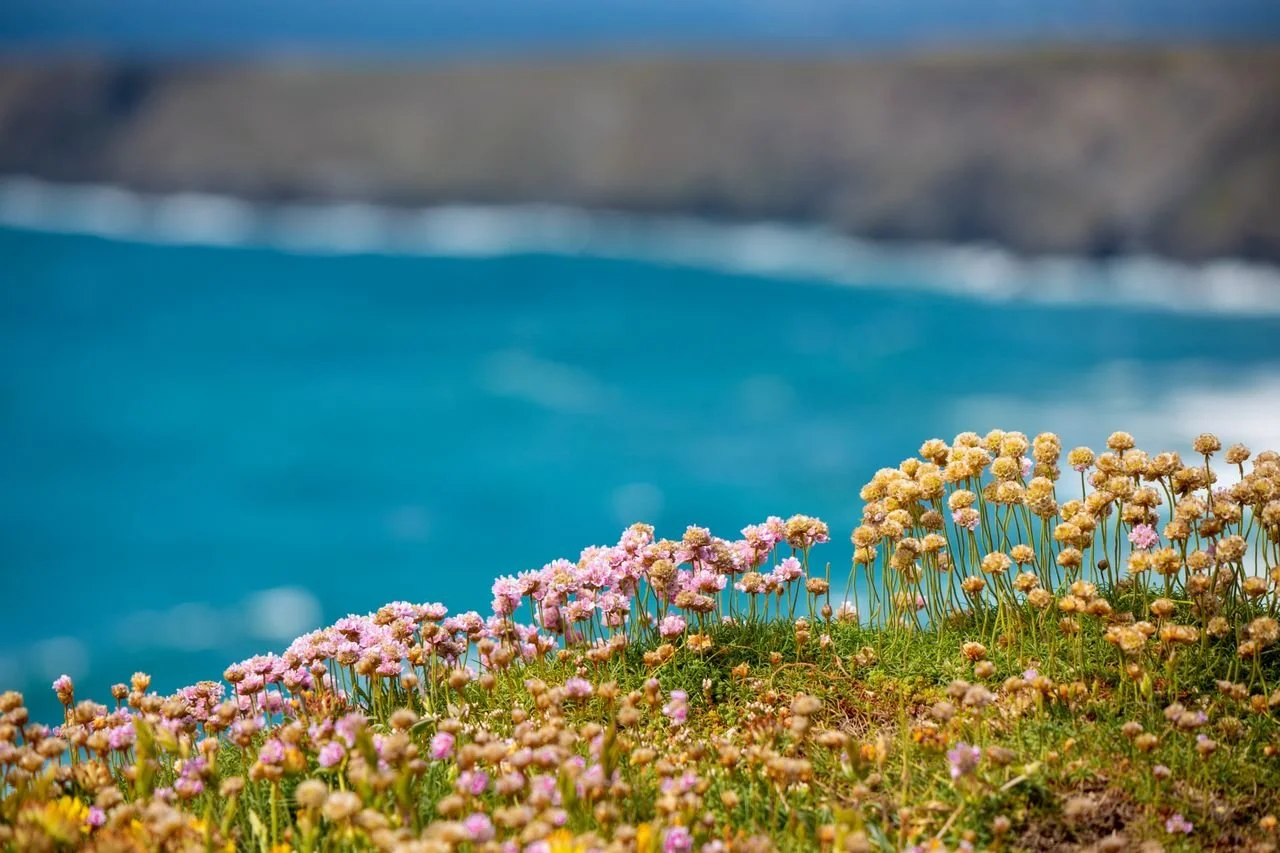
Ten minutes by ferry from Meinohama port, Nokonoshima Island sits in the middle of Hakata Bay and operates at a completely different pace from the city you just left. The population is around 700 people. There are flower fields that bloom through spring and autumn, a small fishing village at the port, and a park at the north end of the island with views back across the bay to Fukuoka's skyline. Rent a bike at the port and take your time. It's a half-day trip and a genuine change of pace.
Where to Shop
Fukuoka covers a lot of ground when it comes to shopping: a morning wet market, traditional craft arcades, one of the best vintage districts in western Japan, and a homegrown design brand that's quietly gone international.
Yanagibashi Rengo Market
Yanagibashi Rengo Market is a narrow covered market a short walk from Tenjin with around 50 vendors selling fresh fish, vegetables, meat, and local produce. It's been called the pantry of Hakata and the name is accurate. It's primarily a market for buying to cook at home rather than eating on site, though a few stalls sell ready-to-eat seafood bowls and fish cakes if you want a snack while you browse. Go in the morning when the fish is freshest. It's unglamorous and completely real, the kind of place that gives you a clearer picture of how the city actually eats than any restaurant guide can.
Kawabata Shopping Arcade
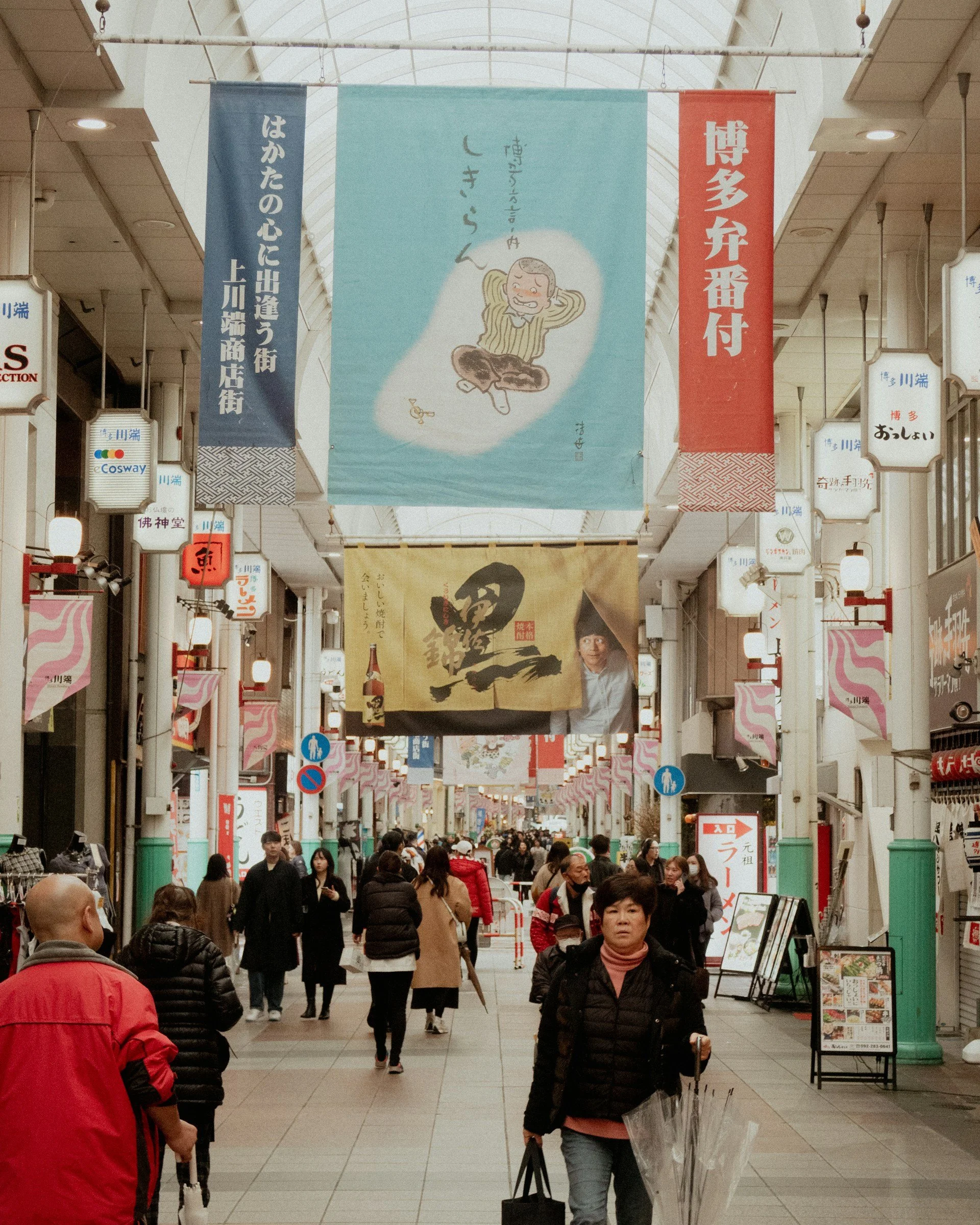
Kawabata is one of Japan's oldest covered shotengai, running 400 metres between Hakata and the waterfront and dating back over 130 years. This is where to find Hakata's traditional crafts: Hakata-ori silk textiles, now woven into wallets, bags, and phone straps as well as kimono fabric; Hakata ningyo, the handpainted clay dolls that are one of the city's most recognisable craft traditions; and wagashi sweets from old-school confectioners that have been in the same family for generations. The arcade connects directly to the entrance of Kushida Shrine at one end, so it fits naturally into a morning in the old town.
Mentaiko
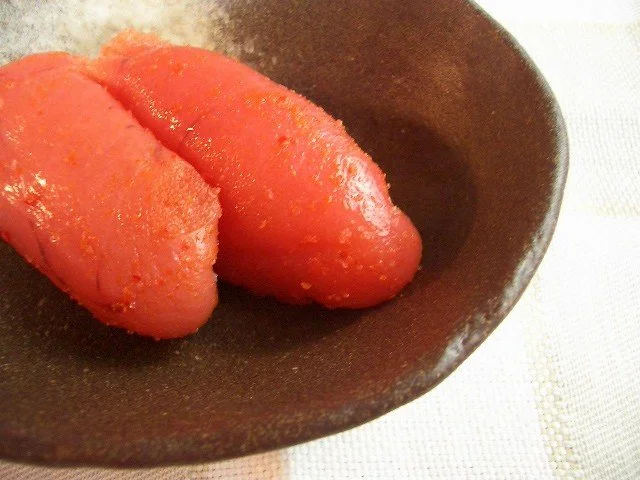
You've probably had mentaiko before — the spicy marinated pollock roe shows up on pasta menus and convenience store onigiri across Japan. What you might not know is that the Japanese version was born in Fukuoka. After World War II, a Korean-born man named Toshio Kawahara moved from Busan to Hakata and adapted the Korean salted roe tradition into the spiced, chilli-cured version Japan now calls mentaiko. The range and quality available here is on another level from what you'll find elsewhere in Japan. Hakata Station and Fukuoka Airport both have excellent food souvenir floors with every major producer represented and vacuum-packed options ready for travel.
Daimyo and Imazumi
The two adjoining neighbourhoods just west of Tenjin are where Fukuoka's vintage and independent boutique scene lives. It's been the centre of the city's creative retail culture for decades, and walking the streets is the activity: dozens of stores within a few blocks, ranging from American workwear specialists to carefully curated European fashion, alongside independent cafes, record shops, and small galleries. Hedy in Imazumi is one of the most well-regarded vintage stores in the city. Addiction Fukuoka in Daimyo has been running since 2005, stocking Japanese and Taiwanese independent designers.
Hightide Store
Hightide is a Fukuoka-born stationery and design brand that started here in 1994 and has since expanded to New York, Sapporo, and Tokyo. The flagship store near Yakuin is where the full range lives: notebooks, leather goods, travel accessories, and collaborations with other designers and craftspeople. One of the better places in the city to find something to bring home that isn't food.
Where to Play
Fukuoka drinks well and stays up late. The action is mostly concentrated in and around Daimyo and Tenjin, compact enough that you can move between venues on foot without much planning.
Stand Umineko yoca
Stand Umineko yoca is the Fukuoka outpost of Derailleur Brew Works, an Osaka brewery with an unusually good philosophy: around 30 taps, with roughly 90% of them dedicated to other small-batch Japanese breweries rather than their own. Plus it's a social enterprise, employing people recovering from addiction, homelessness, and disability. It's a standing bar, casual and lively, and the selection keeps rotating as kegs run out and new ones go on. You'll want to come back more than once.
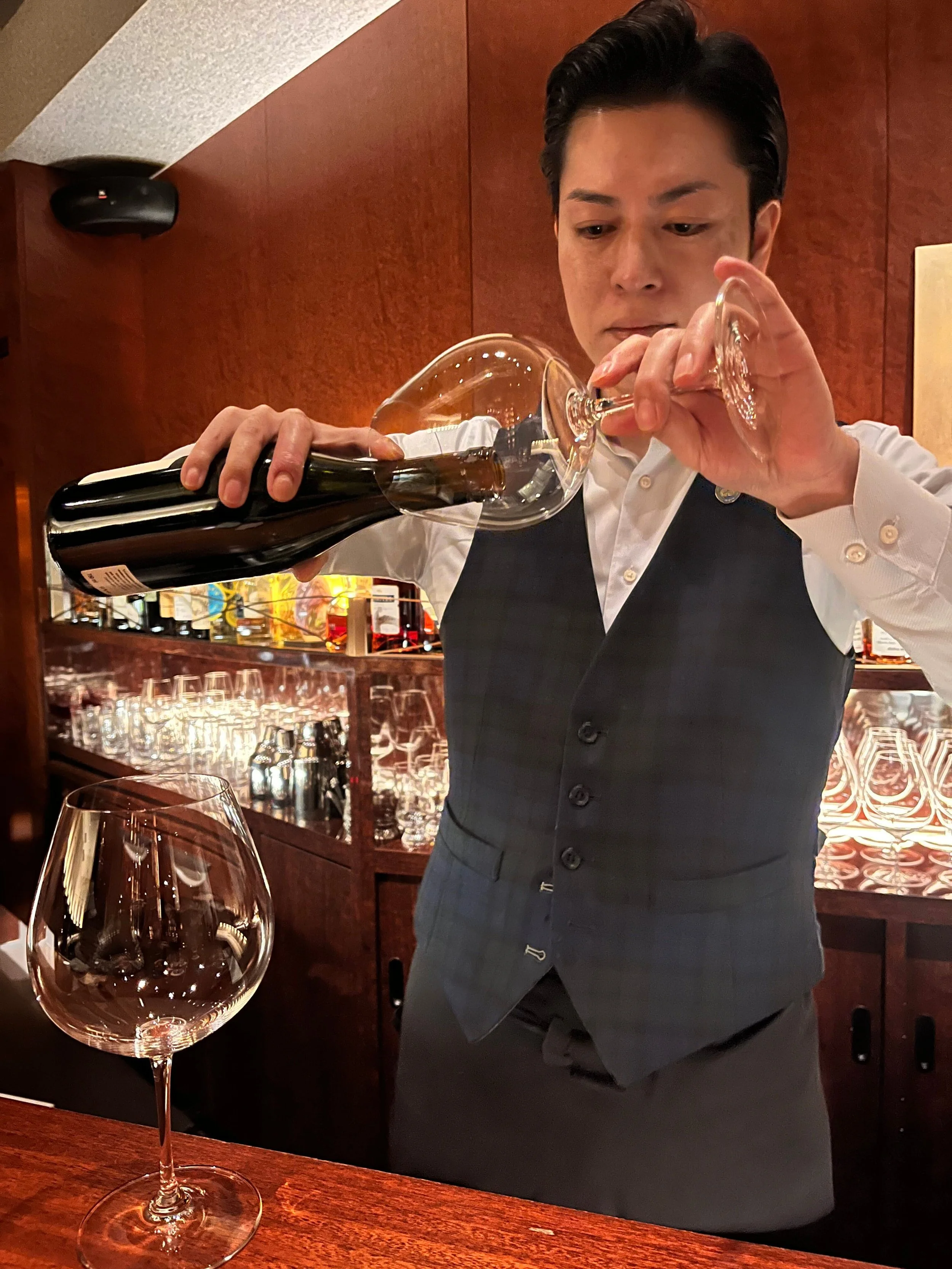
BarTetu
BarTetu in Nishitenma is a bar with a very specific philosophy about how you drink. The owner trained at Star Bar Ginza, one of Japan's most respected cocktail bars, before opening his own bar in Fukuoka. What he loves to do is pour the same drink into different glass shapes so you can taste for yourself how much the vessel changes the flavour, whether its wine or whisky. To him, this isn’t a gimmick, but a genuine lesson in what you're drinking and why the glassware matters. I was shocked at how much of a difference it made to the burgundy I had. He also makes excellent cocktails with seasonal fresh fruit and stocks rare vintage whisky and liqueurs. Reservations recommended.
Oyafuko-dori and the Daimyo District
Oyafuko-dori means "Disobedient Children Street", a nickname that stuck after decades of young people spending their money here instead of sending it home to their parents. That spirit hasn't changed much. By day the street and the blocks around it run on vinyl and coffee: record shops, independent cafes, small galleries, the odd bookshop. By night it shifts into live music venues, intimate bars, and clubs that stay open well past the point where you should probably be in bed. The Daimyo district as a whole is where Fukuoka's creative class spends time, and it's worth an afternoon as well as an evening.
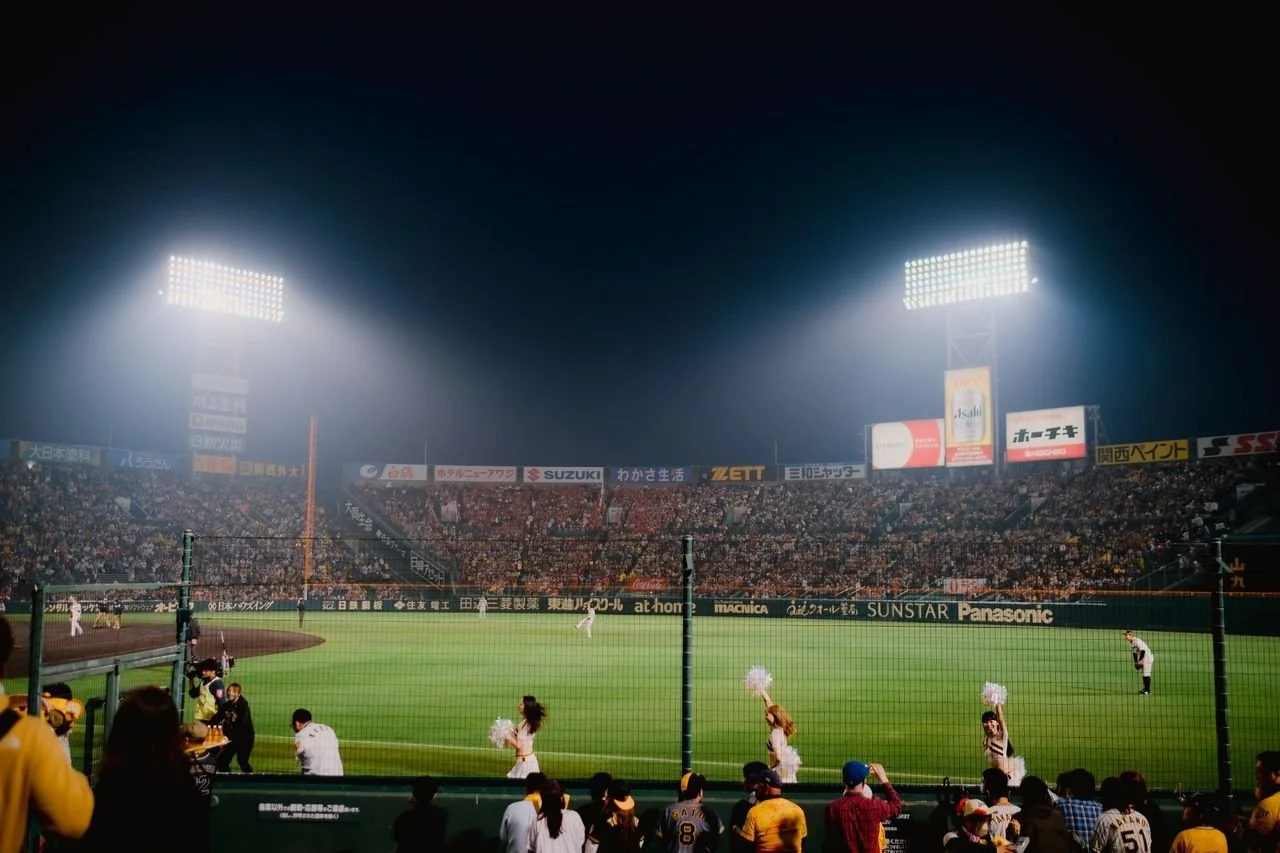
Fukuoka SoftBank Hawks at PayPay Dome
If there's a home game while you're in town, go. Even if, like me, you don't like baseball. Japanese stadium culture is something entirely unique, with its coordinated crowd chants, thundersticks, fireworks when the home team scores, and beer girls who walk the stands with kegs strapped to their backs so you never have to leave your seat. Check the schedule before you travel and book early for popular matches.
Kaku-uchi
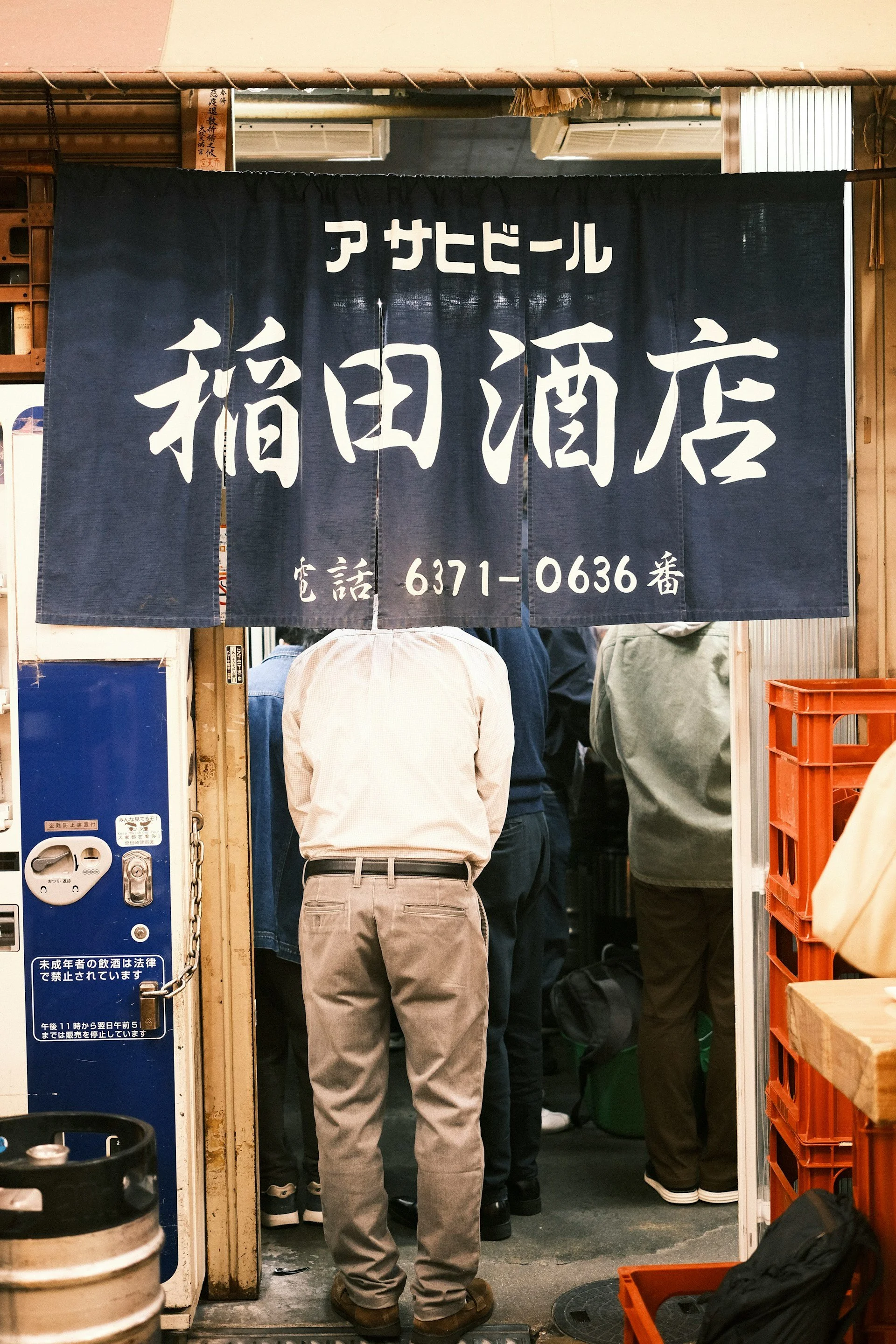
We became obsessed with kaku-uchi the moment we discovered them, which was actually in Osaka. A kaku-uchi is a bar where you’re drinking at the counter of a sake shop, from the retail stock, at shop prices. It turns out the format started here in Fukuoka, where factory workers would stop in for a standing drink on the way home, and the city still does it better than anywhere else in Japan.
Liquorshop Kotani (小谷酒舗) in Daimyo has been running since 1950, family-run across three generations, open from 10am, walls covered in handwritten price cards, proper small plates alongside the usual snacks. Koba Liquor Store (こば酒店) in Yakuin is older still, founded in 1930, entrance through the back of the building, 40+ snacks on the menu, and drinks from 300 yen. For natural wine specifically, I.N.U. wines in Imazumi starts serving from 2pm, pouring from their importer stock at retail prices.
Fukuoka is one of those cities that might start as a jumping off point when you’re visiting Kyushu, but if you stick around for a few days it earns its place on the itinerary fast. The food is serious, the drinking culture is boisterous, and the pace of it all feels easier than Tokyo or Osaka without being any less interesting. Give it a few days, eat more than you think you should, and if someone at a yatai or an oden counter scoots over to make room, take the seat.
Frequenly Asked Questions
-
Hakata ramen is a tonkotsu-style ramen originating in Fukuoka's Hakata district. It's made with a pork bone broth boiled at high heat for several hours until it turns white and creamy, served with thin, straight noodles. Diners can request kaedama, a fresh serving of noodles added to the remaining broth.
-
Fukuoka and Hakata were originally two separate cities on opposite banks of the Naka River: Fukuoka was the castle town of the ruling samurai class, and Hakata was the merchant and trading district. The two merged into a single city in 1889 under the name Fukuoka, but many landmarks, including the main railway station and the city's signature ramen, still carry the Hakata name.
-
Kaku-uchi is a Japanese drinking style where customers stand and drink at the counter of a liquor or sake shop, buying directly from the shop's retail stock at retail prices. The practice is widely credited as having originated in Fukuoka, where factory and dock workers would stop for a standing drink after their shifts.
-
Two to three full days allows time to cover Fukuoka's food scene, main historical sites, and at least one day trip to nearby Dazaifu or Itoshima. Travellers with more time can add a second day trip or explore the city's shopping and nightlife districts more thoroughly.
-
Spring (March to May) and autumn (October to November) offer the most comfortable weather for exploring Fukuoka, with mild temperatures and less humidity than summer. Early July is worth targeting specifically for the Hakata Gion Yamakasa festival, which culminates in a dawn race through the streets on July 15th. Summer is hot and humid, and winter is mild by Japanese standards but can be damp.
-
Fukuoka is accessible from Tokyo by direct flight, taking around two hours, or by Shinkansen bullet train via Hakata Station, the western terminus of the Tokaido-Sanyo line, which takes approximately five hours. Fukuoka Airport is also a short six-minute subway ride from central Hakata.
-
Fukuoka is best known for Hakata tonkotsu ramen, mentaiko (spicy marinated pollock roe), motsunabe (offal hot pot), and mizutaki (chicken hot pot). The city is also known for its yatai, open-air food stalls that serve a mix of these dishes each evening.
-
Yatai are open-air food stalls that set up each evening in Fukuoka, primarily around Nakasu and Tenjin, seating around eight to ten people at a shared counter. Fukuoka is the only major Japanese city where this street food culture has survived at a large scale, with around 100 stalls operating citywide.