
The best wine tour in China depends on how many days and how many regions you want. For a single day from Beijing, WildChina's Huailai tasting is the simplest option. For three to six days in one region, Lost Plate runs small-group tours in Ningxia and Yunnan, and WildChina runs a four-day Ningxia tour. For all three of China's main wine regions in one trip, Off the Eaten Track's China Wine Trail is the only tour we know of that covers Hebei, Ningxia and Yunnan.
Off the Eaten Track publishes this guide and runs the China Wine Trail, so it appears below. We describe it with the same criteria as every other tour and state its limits as plainly as the others. Each operator's details were checked against its own website in November 2026, and group tour dates and prices can change, so confirm with the operator before booking.
How we chose these wine tours
We looked at four things: which regions the tour covers, how much winery access it gets, who leads the tasting and how large the group is. The operators are grouped by purpose and are not ranked, because a six-hour tasting near Beijing and a 15-day expedition answer different questions.
China wine tours compared
| Operator | Best for | Where | Length | Group size | Price |
|---|---|---|---|---|---|
| WildChina (WildBeijing Experience) | One day from Beijing | Huailai, Hebei | About six hours | On request | On request |
| Lost Plate (Wine Taste Through Ningxia) | The most wineries in the fewest days | Ningxia | Three days, two nights | 4 to 10 | From USD 1,000 |
| WildChina (Ningxia Wine Tour) | Private, expert-led Ningxia | Ningxia | Four days | On request | On request |
| Lost Plate (Go Beyond Shangri-La) | Wine with Tibetan culture and mountains | Yunnan | Six days, five nights | 4 to 10 | From USD 1,235 |
| Off the Eaten Track (China's Wine Trail) | Three regions in one trip | Hebei, Ningxia, Yunnan | 14 nights, 15 days | 4 to 8 | Estimated AUD 11,000 to 12,000 |
Why visiting Chinese wine regions takes some help
Why are China's wine regions hard to combine?
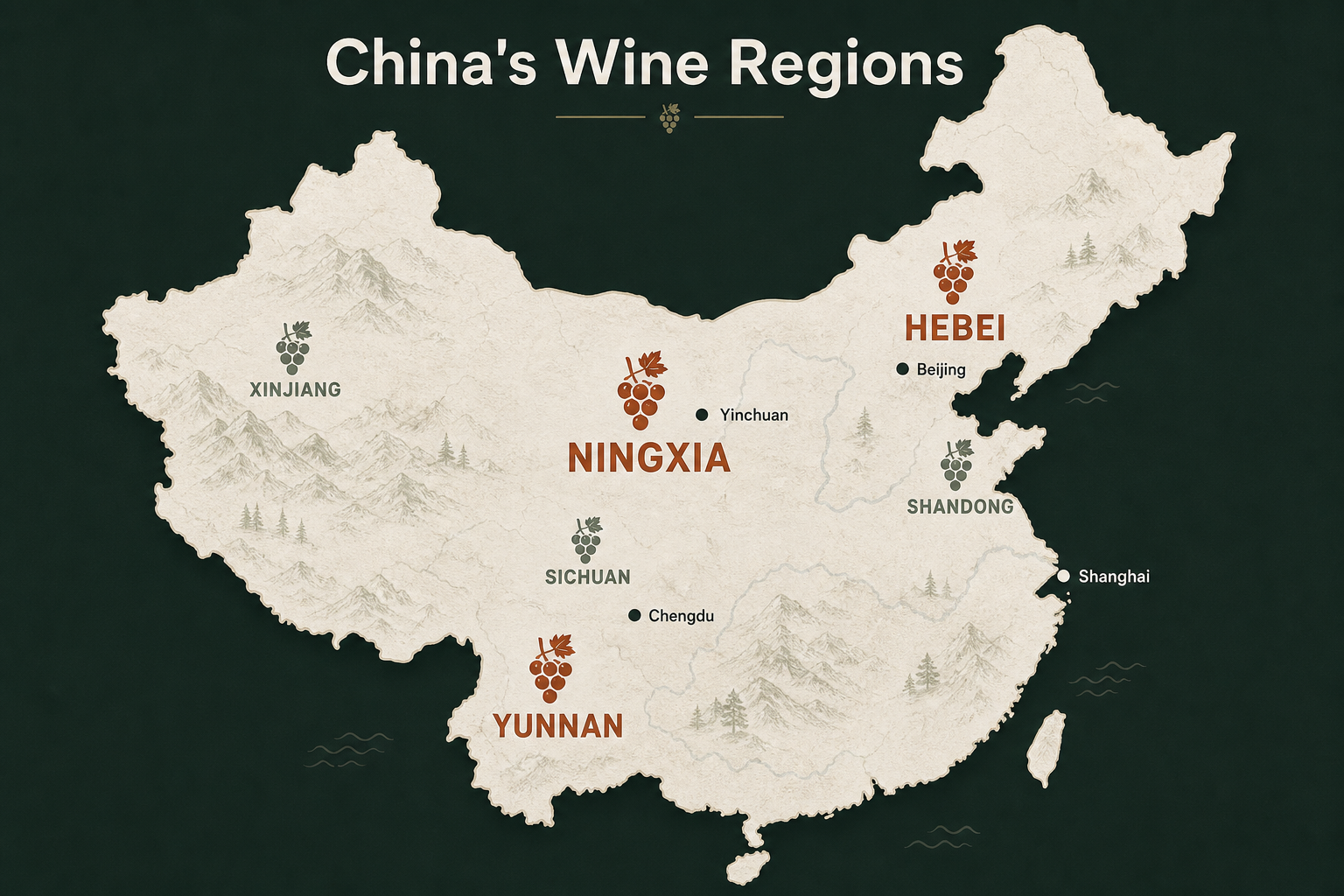
China's three main wine regions are far apart. Huailai is a day trip from Beijing, Ningxia's vineyards sit near Yinchuan in the north-west, and Yunnan's wine valleys lie on the edge of the Tibetan Plateau, so combining them means domestic flights.
Can you visit Chinese wineries without a tour?
Many of the producers are small, and Lost Plate says most of the Ningxia wineries on its tour are boutique estates that are not generally open to the public. Off the Eaten Track also visits small wineries where a single winemaker looks after everything from vineyard to bottle. English is uncommon at small estates, which makes a Mandarin-speaking guide useful. For other practical gaps, our guide to essential apps for China travel covers payments, maps and translation.
How does altitude shape China's wine regions?
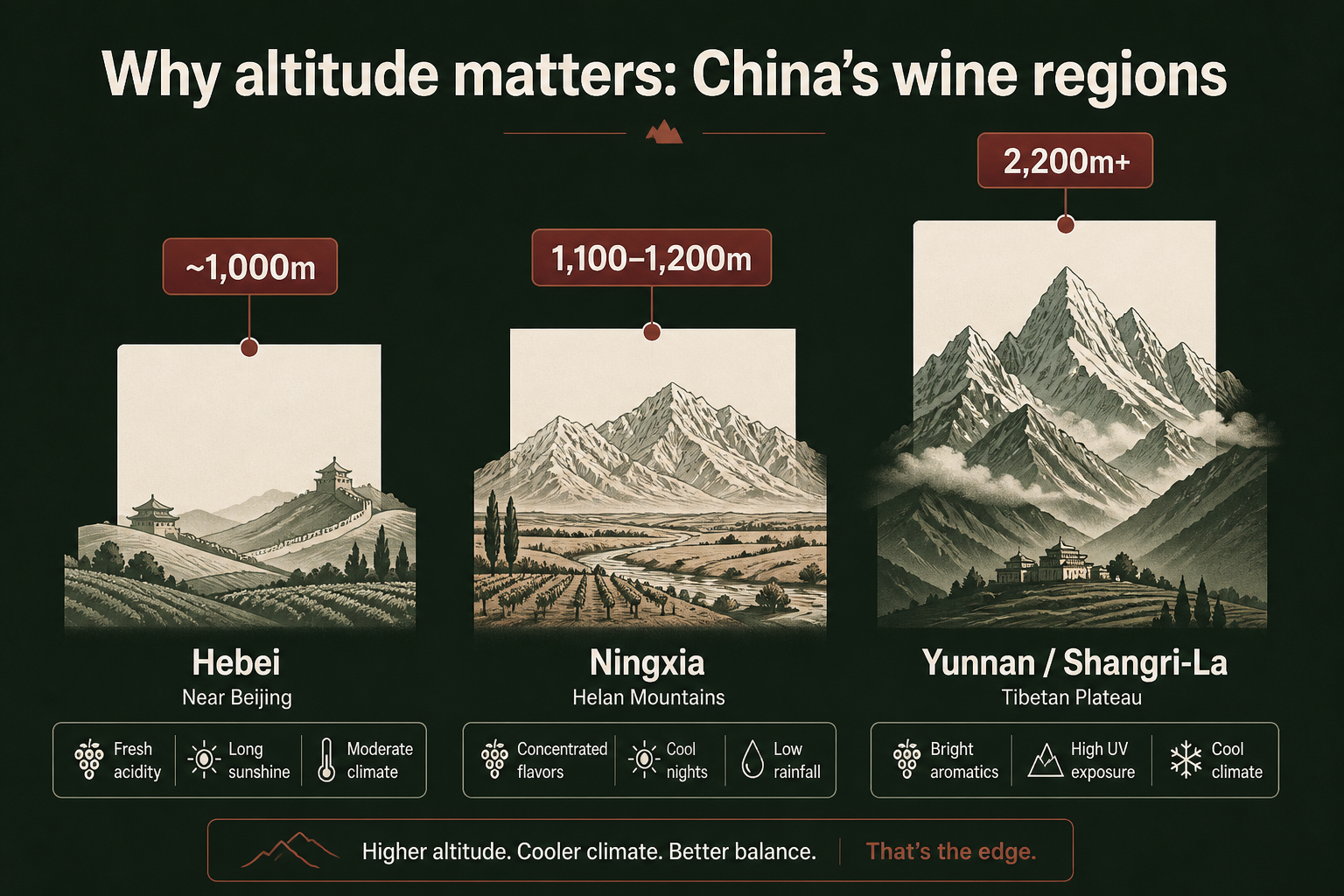
Altitude is the clearest difference between the three regions. Higher vineyards are cooler, which slows ripening and helps grapes keep acidity.
| Region | Vineyard altitude | Landscape |
|---|---|---|
| Hebei (Huailai) | About 490 metres at the core vineyards, rising to over 1,000 metres in the surrounding basin | Hills and Great Wall country near Beijing |
| Ningxia (Helan Mountain East) | About 1,100 to 1,200 metres | Gobi desert foothills below the Helan Mountains |
| Yunnan (Shangri-La and Cizhong) | About 2,200 to 2,600 metres | Canyons on the Tibetan Plateau below Meili Snow Mountain |
What are China's main wine regions?
Why is Ningxia the centre of Chinese wine tourism?
Ningxia's Helan Mountain East is where most Chinese wine tourism happens. The vineyards sit on the eastern slopes of the Helan Mountains, which shield them from Gobi sandstorms, with around 3,000 hours of sunshine a year, less than 200 millimetres of rain and cool nights. Growers bury their vines every winter to protect them from the cold.
What put Ningxia on the world wine map?
Ningxia's international profile grew through a few pioneering producers. Silver Heights, founded in 2007 by Emma Gao and her father Gao Lin, was among the first wineries to put the region on critics' radar, and Jancis Robinson has described Gao as the producer who first alerted her to Ningxia's potential. The turning point came in 2011, when Helan Qingxue's Jia Bei Lan 2009 won an International Trophy at the Decanter World Wine Awards, the first time a Chinese wine reached that level.
Where is Yunnan's wine country?
Yunnan's vineyards near Shangri-La sit on the upper Mekong at the foot of Meili Snow Mountain. LVMH's Ao Yun estate made its first vintage in 2013 and released it in 2016, and in 2022 the 2018 vintage became the first Chinese wine released through the Bordeaux négociant system.
What is Cizhong known for?
Cizhong is a village on the upper Mekong in Yunnan's Deqin County, where French Catholic missionaries planted grapevines in the 19th century. The missionaries were expelled in 1952, but the vines stayed, and nearly every household still makes wine. The village is best known for Rose Honey (玫瑰蜜), a grape Chinese agronomists identified in the 1980s as a French variety believed extinct in France, though its identity is still debated. A small plot grows beside the village's Catholic church, which is a national key cultural relic protection unit.
Why is Hebei a major wine region?
Hebei is one of the earliest provinces where modern winemaking was established in China. The country's first dry white wine was made in 1979 at Shacheng in Huailai, and its first dry red followed in 1983 at Changli. Decanter ranks Hebei second only to Shandong in production volume and sales value, and Huailai is the part of the province most visitors reach from Beijing.
What about Shandong and China's other wine regions?
Shandong, around Yantai on the east coast, is the other major wine region and is home to Changyu, China's oldest winery, founded in 1892. We have not found dedicated English-language guided wine tours for Xinjiang.
Best day wine tours in China
WildChina: Wine Tasting in Premier Vineyards (Huailai, Hebei)
Huailai is the wine region most easily reached from Beijing, and WildChina's WildBeijing Experience covers it in about six hours on any day of the week. The tasting visits Huailai wineries such as Canaan, and it is the shortest way to taste wine from the province where modern Chinese winemaking began. A five-hour private Changyu chateau tasting tour from Beijing is also listed on Viator.
What you get: a wine day from Beijing without an overnight stay, in a region with the longest history of modern winemaking in China.
What you don't get: an understanding of the variety of winemaking styles, terroir and methods across China, since the tour covers Hebei in a single day.
Best multi-day wine tours in China
Lost Plate and WildChina run multi-day tours in a single region, while Off the Eaten Track's China's Wine Trail crosses several regions.
Lost Plate: Wine Taste Through Ningxia (three days)
This three-day, two-night tour starts and ends in Yinchuan and runs for groups of four to 10, from USD 1,000 per person.
Which wineries does the Ningxia tour visit?
It visits seven wineries, including Silver Heights, Mountain Wave, Domaine Charme, Legacy Peak, Pu Shang and Xige Estate, tasting two to four wines at each. Pu Shang opens only for private tastings.
What is included on the Ningxia tour?
Evenings are built around Ningxia's lamb, from a roast lamb dinner to a hotpot with red wine in the broth. All meals and tastings are included, a single supplement of USD 150 applies, and the tour runs seasonally, generally from May to October.
What you get: the highest number of wineries in the shortest time, access to boutique estates that are not generally open to the public, and all meals and tastings included.
What you don't get: an understanding of the variety of winemaking styles, terroir and methods across China, since the tour is Ningxia only.
Lost Plate: Wine Taste Through Ningxia →
WildChina: Ningxia Wine Tour, Through the Vineyards (four days)
WildChina's four-day Ningxia tour is led by local wine expert Kiki and runs in spring, summer and autumn. It includes private tastings and visits to estates such as Xige Estate and Domaine Chandon, which was established in Ningxia in 2013.
What you get: a private, expert-led format with a local wine specialist.
What you don't get: a view of how winemaking differs across China's regions, since the tour is limited to Ningxia.
WildChina: Ningxia Wine Tour →
Lost Plate: Go Beyond Shangri-La for Wine and Tibetan Culture (six days)
This six-day, five-night tour starts and ends in Shangri-La and runs for groups of four to 10, from USD 1,235 per person. Lost Plate lists it at activity level three, compared with level one for its Ningxia tour.
What does the Yunnan tour cover?
The route covers Hada village, Tongle village and a wine tasting at the Catholic church in Cizhong on day three, then a jeep ride to Yubeng village with a view of Meili Snow Mountain on day four. It also includes Dukezong, the old town of Shangri-La, a tofu-making session and Songzanlin Monastery, the largest Tibetan monastery in Yunnan, built in 1679.
Why does the Yunnan tour stop at Cizhong?
Cizhong is where French missionaries planted the grapevines that began winemaking in the upper Mekong valley. The village's story, including the Rose Honey grape, is told in the Cizhong section above.
What you get: Yunnan's high-altitude wine alongside Tibetan villages, monasteries and mountain scenery, with meals, accommodation and private ground transport included.
What you don't get: Ningxia or Hebei, and the pace of an easy tour, since it carries a higher activity level than Lost Plate's Ningxia trip.
Lost Plate: Go Beyond Shangri-La →
Off the Eaten Track: China's Wine Trail (Hebei, Ningxia and Yunnan)
China's Wine Trail runs from 18 August to 1 September 2027, 14 nights and 15 days from Beijing to Lijiang, for four to eight guests.
What does China's Wine Trail cover?
The route goes from Beijing to Huailai in Hebei for wineries and the Great Wall, then by flight to Yinchuan in Ningxia, and on to Kunming in Yunnan with stops in Chuxiong and Lijiang. It includes at least two domestic flights. The 2027 trip adds one day to the 2026 route to allow more time in Shangri-La. The estimated price is AUD 11,000 to 12,000 per person, with the final price to be confirmed.
Who leads China's Wine Trail?
Michael Minsky leads the tour. He has travelled in China since 2005, lived there for almost a decade and speaks Mandarin. Camden Hauge of China Wine Club, one of Shanghai's foremost food personalities and an expert in Chinese wine, leads the wine programme, which covers winery visits and tastings in all three regions and time with winemakers where possible. No wine knowledge is needed.
What food and hotels are included?
Food is part of the trip throughout, from northern classics in Hebei and Beijing to Hui lamb dishes in Ningxia and the herb-forward cooking of Yunnan's Dai, Bai and Naxi communities. Hotels are a mix of four and five star, often Chinese chains such as Atour and Orange Hotel, with local guesthouses or boutique properties in remote areas. The group cap of eight allows access to workshops and restaurants that do not take larger groups.
What you get: the only tour we know of that covers Hebei, Ningxia and Yunnan in one trip, a sommelier-led wine programme, a small group and a leader who speaks Mandarin.
What you don't get: single-region depth, since the time is split across three regions. A published day-by-day itinerary, including named wineries, will be confirmed closer to departure.
How to choose a wine tour in China
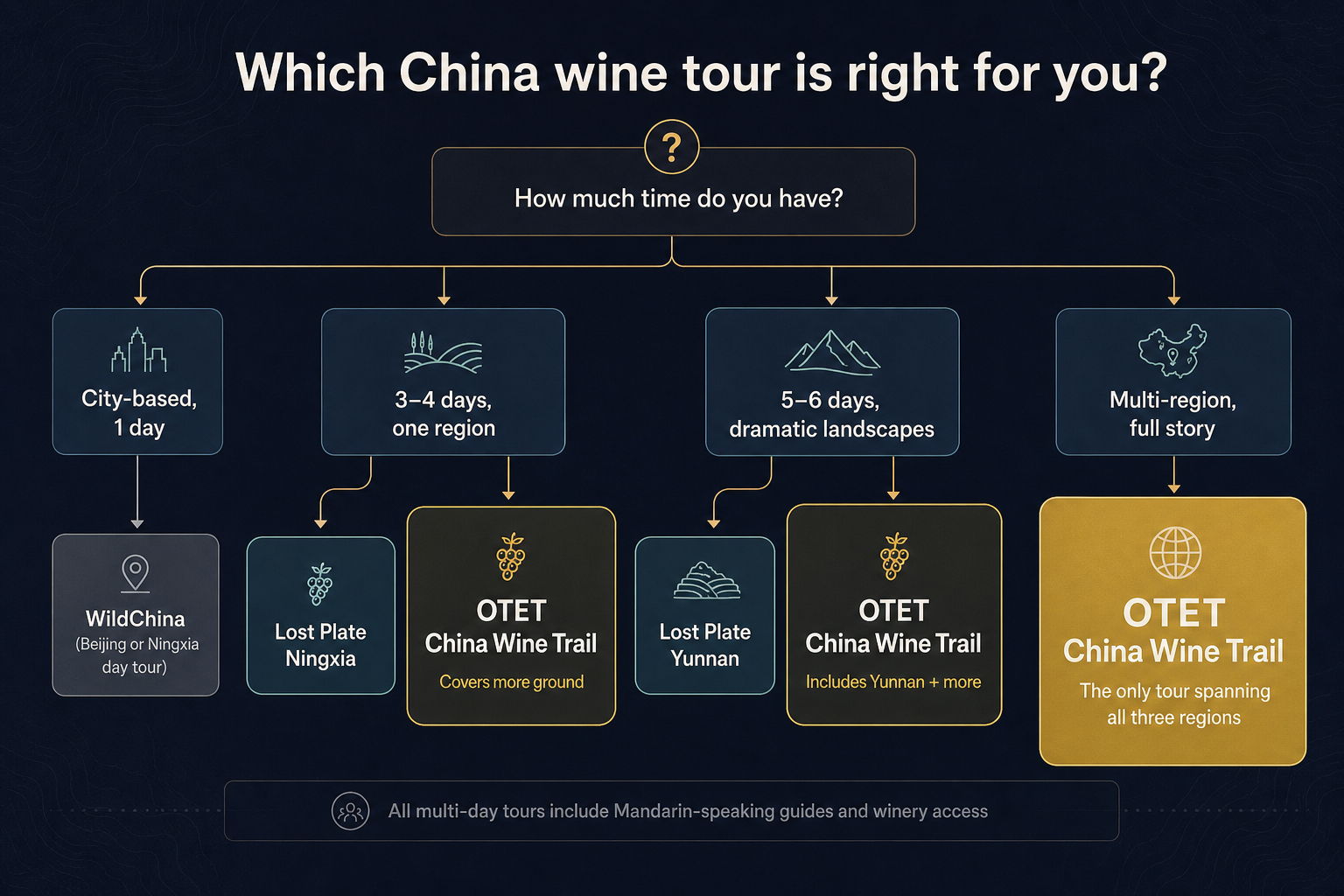
If you have one day and are already in Beijing, WildChina's Huailai tasting fits. If you want one region in three to four days, Lost Plate's Ningxia tour or WildChina's Ningxia tour suit, and Lost Plate's Ningxia trip is the one to pick for the most wineries. If you want dramatic landscapes and Tibetan culture over five to six days, Lost Plate's Yunnan tour fits. If you want the full story of Chinese wine in one trip, with Hebei as the origin, Ningxia as the proven region and Yunnan as the frontier, China's Wine Trail covers all three.
How do you get to China's wine regions?
| Region | Main gateway | Notes |
|---|---|---|
| Hebei (Huailai) | Beijing | A day trip by road from Beijing |
| Ningxia | Yinchuan | Reached by domestic flight, with the vineyards a short drive from the city |
| Yunnan (Shangri-La and Cizhong) | Kunming, Lijiang or Shangri-La | Reached by domestic flight, with higher altitude in Shangri-La |
Shangri-La sits above 3,000 metres, so arriving a day early helps with acclimatisation before a Yunnan tour.
When is the best time to visit China's wine regions?
Late September to mid-October is the best window for Ningxia, according to the China Vine regional guide, which places harvest from mid-September to mid-October and vine burial in late October and early November. June to August is the growing season, and Lost Plate's Ningxia tour runs from May to October. China's National Day Golden Week holiday in early October makes transport and hotels busier across the country.
Frequently asked questions
-
The best wine tour depends on trip length. WildChina's Huailai tasting is the best single-day option from Beijing, Lost Plate's three-day tour visits the most wineries in Ningxia, and Lost Plate's six-day tour is the best option for Yunnan. For three regions in one trip, Off the Eaten Track's China's Wine Trail is the only tour we know of covering Hebei, Ningxia and Yunnan.
-
Yes. In 2011, Helan Qingxue's Jia Bei Lan 2009 from Ningxia won an International Trophy at the Decanter World Wine Awards, the first Chinese wine to do so. In 2022, LVMH's Ao Yun 2018 from Yunnan became the first Chinese wine released through the Bordeaux négociant system. Quality varies by producer, and the wines differ in style from French and Californian wines because of altitude, dry climate and large day-to-night temperature swings.
-
Ningxia has the largest concentration of wineries open to visitors and the widest tasting range. Yunnan has high-altitude vineyards, Tibetan villages and the Cizhong church wine. Hebei is the easiest region to reach from Beijing and has the longest history of modern winemaking in China.
-
Late September to mid-October is the best window for Ningxia, covering harvest. June to August also suits Ningxia, and Lost Plate's Ningxia tour runs from May to October. Early October is the National Day Golden Week holiday, so book transport and hotels early if you travel then.
-
Australian passport holders can enter mainland China visa-free for up to 30 days for tourism and must complete an online arrival card before travel. The policy is currently confirmed until 31 December 2026, so check the latest rules before booking a 2027 trip. Rules differ by nationality, so check with the Chinese Ministry of Foreign Affairs or your nearest Chinese embassy.
-
Lost Plate's three-day Ningxia tour starts at USD 1,000 per person, and its six-day Yunnan tour starts at USD 1,235 per person. Off the Eaten Track's 15-day China's Wine Trail has an estimated price of AUD 11,000 to 12,000 per person, with the final price to be confirmed. WildChina sets prices on request for its Ningxia tour, Huailai tasting.
-
A wine tour of China's main regions takes anywhere from six hours to 15 days. Six hours covers a Huailai tasting from Beijing, three days covers Ningxia, six days covers Yunnan's Shangri-La and Cizhong area, and Hebei, Ningxia and Yunnan together take about two weeks.
-
No. Guides and sommeliers provide the context on the grapes, the regions and the wineries. On Off the Eaten Track's China's Wine Trail, the sommelier gives context throughout and no wine knowledge is needed.
-
Larger estates may accept visitors, but many boutique wineries are not generally open to the public. Lost Plate says most of the wineries on its Ningxia tour are boutique estates not open to the public, and one opens only for private tastings. Booking through an operator is the most reliable way to get access.
-
Lost Plate's tours run for four to 10 guests, and Off the Eaten Track's China's Wine Trail runs for four to eight. WildChina's group sizes are available on request.
About this guide
Michael Minsky is the founder of Off the Eaten Track and leads its China tours. He has travelled in China since 2005, lived there for almost a decade and speaks Mandarin. Tour details were checked against each operator's own pages in November 2026. Regional and historical facts come from the sources below. For more on food-led travel in China, see our guide to the best food tours in China, our guide to the lesser-known sections of the Great Wall, and our full range of China tours.