
The best off the beaten path regions in China are Henan, Yunnan beyond Lijiang and Dali, Guizhou, Fujian and Dongbei. All five are established domestic destinations for Chinese travellers, none needs a special permit, and each sees far fewer international visitors than the Beijing, Shanghai and Xi'an circuit.
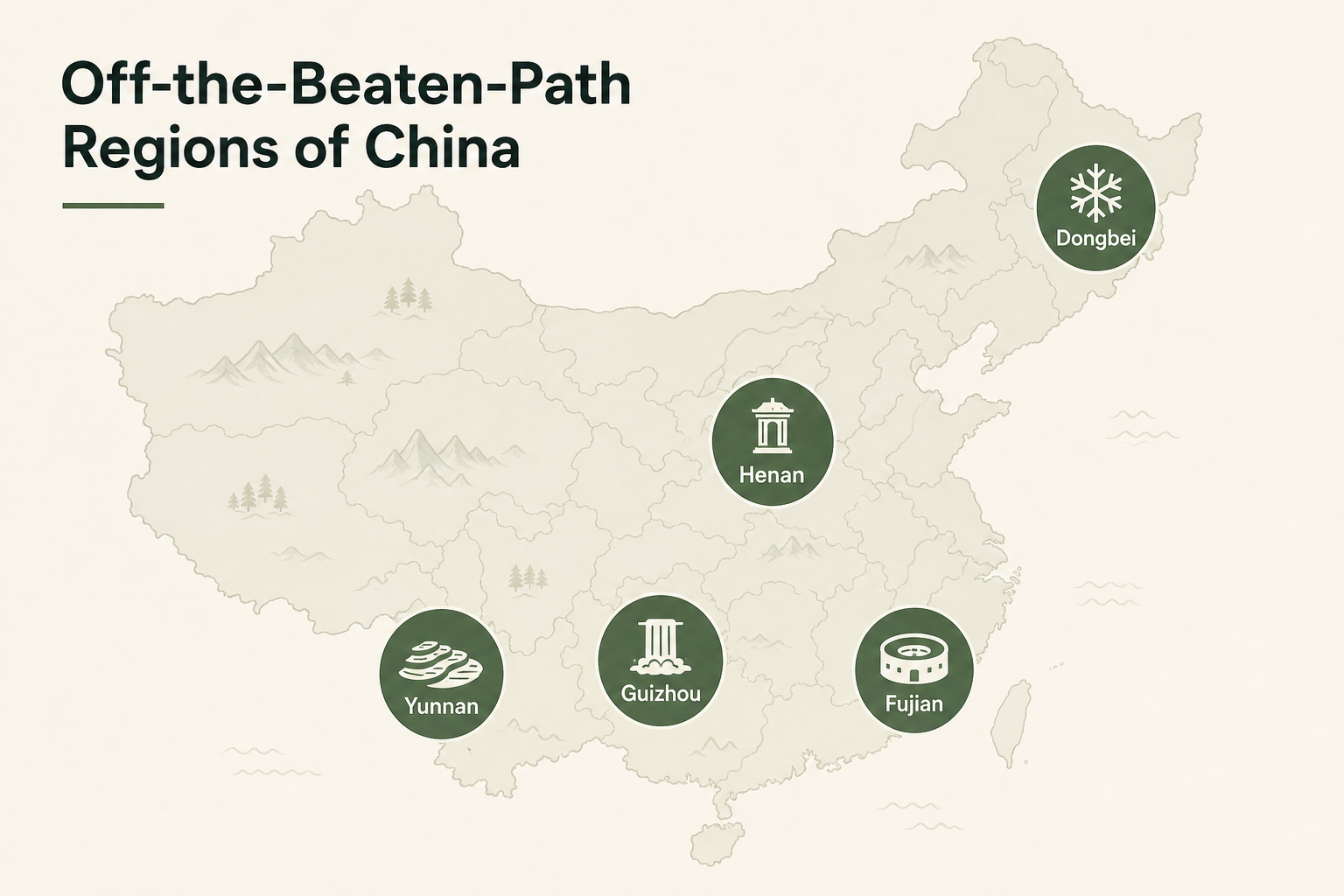
Which off the beaten path regions are worth visiting in China?
| Region | Known for | Best time to go | Main gateway |
|---|---|---|---|
| Henan | Longmen Grottoes, Shaolin Temple, Kaifeng's buried Song Dynasty streets | Apr to May, Sep to Oct | Zhengzhou |
| Yunnan | Yuanyang rice terraces, high-altitude Tibetan Plateau wine country | Mar to May, Sep to Nov | Kunming |
| Guizhou | Miao villages and festivals, Huangguoshu Waterfall, Moutai baijiu | Apr to May, Sep to Nov | Guiyang |
| Fujian | Gulangyu Island, Tulou earthen buildings, Wuyi oolong, Xiamen | Apr to May, Sep to Nov | Xiamen |
| Dongbei | Harbin Ice and Snow World, Jilin's rime ice, Hushan Great Wall | Dec to Feb | Harbin |
Why go beyond the standard circuit?
Most first-time itineraries run Beijing, Shanghai and Xi'an. That is a bit like visiting the United States and seeing only Washington DC, New York and Los Angeles: impressive, but a very small slice of the country.
The standard circuit shows imperial China, polished and well signposted. These five regions show other layers: the cradle of Chinese civilisation in Henan, minority communities in Yunnan and Guizhou who keep their languages and festival traditions, a coastline in Fujian shaped by centuries of maritime trade, and a northeast where winter itself becomes the attraction. The famous places are still worth seeing. China is simply large enough that sticking to three cities leaves most of the country, and most of its stories, on the table.
1. Henan: Longmen Grottoes, Shaolin Temple and Kaifeng's buried streets
Henan is worth visiting for the Longmen Grottoes, Shaolin Temple, Kaifeng's buried Song Dynasty streets and the Jun ware kilns at Shenhou. It is arguably China's most historically important province and one of the least visited by international travellers. Anyang's Yin Ruins, where the earliest Chinese writing was found on oracle bones, and Luoyang's White Horse Temple, founded in 68 CE and regarded as China's first Buddhist temple, both sit within the province.
What are the Longmen Grottoes and why are they significant?
The Longmen Grottoes near Luoyang are a UNESCO World Heritage Site with around 110,000 Buddhist statues carved into the Yi River gorge from 493 CE through the Song Dynasty. The centrepiece is a 17-metre Vairocana Buddha at Fengxian Temple, said to be modelled on Empress Wu Zetian. Further along is the Medicine Cave, where 140 ancient pharmaceutical prescriptions are carved into the rock walls, among the oldest preserved medical texts in China. The Kanjing Temple section reopened to the public on 1 April 2025, with 29 Tang Dynasty arhat reliefs on display, and most visitors never make it that far.
What is Shaolin Temple known for?
Shaolin Temple in Dengfeng is part of the UNESCO-listed Historic Monuments of Dengfeng, and is recognised as the birthplace of Chan Buddhism, better known abroad as Zen, and of Shaolin kung fu. According to tradition, the monk Bodhidharma sat facing a cave wall here for nine years, and that practice gave rise to both Chan Buddhism and the physical disciplines that became kung fu. The cave still exists, and you can stand in it. The kung fu demonstrations are genuinely impressive, but the real draw is the setting: the temple sits at the foot of Song Shan, one of China's sacred mountains, and the walk across its cliffs is the part I remember most.
The paths hang off the edge of the cliffs in many places, narrow and exposed, with the valley falling away beside you. It is stunning and slightly terrifying. I'm afraid of heights, so it was not the most relaxed walk of my life, but the views are extraordinary and I came off the mountain with a full sense of accomplishment.
What is there to see in Kaifeng?
Kaifeng is where xiaolongbao (soup dumplings) may have originated, as the descendant of guantangbao. These soup dumplings have a 1,000-year history, dating to the imperial kitchens of the Song Dynasty, and they're still served all over the city using the same ancient techniques. During the Northern Song Dynasty, Kaifeng's population passed a million while London's was around 15,000. The city had one of China's only local Jewish communities and one of its oldest mosques, both remnants of medieval China's cosmopolitan trading life, which Kaifeng was at the center of.
What is Jun ware ceramics at Shenhou?
Jun ware ceramics at Shenhou, in Yuzhou, is the unexpected highlight for many guests on our Henan tour. Yaobian, or kiln transformation, is what happens when copper oxide meets reduction firing. Purples bleed into reds and blues, and no two pieces are identical because the kiln decides the result. There is a 5,000-dealer antique market here, and workshops run by National Intangible Heritage inheritors where you can watch the full process from clay to finished piece. This is just one of the many ceramic traditions from around Henan, including Tang San Cai from Luoyang.
Our Henan Province tour (May 2027, dates to be confirmed, 12 nights and 13 days from Zhengzhou, maximum 12 guests) covers Kaifeng, Shenhou's Jun ware kilns, Shaolin, Luoyang and the imperial tombs at Gongyi.
What should you eat in Henan?
Henan takes soup seriously enough that it becomes part of local identity. In Luoyang, the local greeting is "Have you drunk your soup yet?", and it means beef bone broth, simmered overnight and eaten for breakfast. Hulatang, a thick, peppery breakfast broth with vermicelli and wood ear mushroom, turns up on street corners across the province. Hui mian, braised noodles with mutton in rich broth, is the quintessential Henan noodle dish.
The Luoyang Water Banquet is a 24-course feast in which every hot dish arrives in broth, and it is still served in century-old restaurants. My favourite is the most famous dish, peony yancai, a dish of shredded radish arranged to look like a flower at its centre. It is peppery and sour at once, and the mushroom, noodle and meat textures inside keep it beautifully balanced. The other dish I'd point you to is the wanzi, which looks like a bowl of meatballs but is made largely from vermicelli rather than meat. At the table, the fried balls are poured into hot soup and sizzle as they land, which makes a bit of theatre of the course. They stay crunchy outside and soft inside, and they hold that texture even as they sit in the broth.
2. Yunnan: rice terraces, borderlands and high-altitude wine
Yunnan is worth visiting for the Yuanyang rice terraces, the Myanmar borderland of Mangshi, the Confucian temple town of Jianshui and the canyons of Deqin, deep in the mountains of the Tibetan Plateau, where some of China's most exciting wine is made. Everyone who has been to Yunnan knows Lijiang and Dali, and both are genuinely good and genuinely crowded. The Yunnan worth going out of your way for lies beyond them.
What are the Yuanyang rice terraces?
The Yuanyang rice terraces, in Honghe prefecture, were carved by the Hani people over centuries of mountain agriculture. The fields fill with water from roughly late November to April, turning silver at dawn and gold at dusk. Through summer they turn green, and around September and October they ripen to gold.
What makes Mangshi worth visiting?
Mangshi, near the Myanmar border, is where Chinese and Southeast Asian culture blend as part of everyday life. Architecture, food, religious practice and the rhythm of daily life all reflect a borderland crossroads that existed for centuries before anyone thought to call it a destination.
What are Shaxi and the Nujiang Gorge?
Shaxi, a restored market town on the old Tea Horse Road near Dali, is a quiet alternative to the busier old towns. Further north-west, the Nujiang Gorge cuts a deep canyon through Yunnan's mountains and is home to Lisu communities. These are excellent alternatives to the more crowded Dali and Lijiang Old Towns, and Tiger Leaping Gorge.
Where is China's new wine country in Yunnan?
Meili Xueshan, known as Kawagarbo, rises to 6,740 metres near Deqin and is one of the most sacred mountains in Tibetan Buddhism. No one has ever reached the summit, and the local Tibetan communities have kept it that way. The canyons below, deep in the mountains of the Tibetan Plateau, are where some of China's most exciting new wine is being made, with vineyards above 2,000 metres, mineral-rich glacial soils and Cabernet Sauvignon developing in a direction the Western wine world has only recently started to notice.
What is Jianshui known for?
Jianshui, also in Honghe prefecture, has a 600-year-old Confucian temple that ranks among the largest in China, second only to the one in Qufu. It is also home to one of China's four famous clay pottery traditions, alongside Yixing, and to steamed chicken cooked in a purple clay pot, one of the province's most distinctive regional dishes.
China's Wine Trail (Aug 2027, dates to be confirmed, 14 nights and 15 days, maximum 8 guests) includes Yunnan's high-altitude Tibetan valleys as its third leg, tracing China's wine story from Hebei through Ningxia into Yunnan.
What should you eat in Yunnan?
Crossing-the-bridge rice noodles (过桥米线), from Kunming, are the best-known dish: a rich hot broth in which you cook thin slices of meat and vegetables at the table. In the south, Dai cuisine brings banana-leaf grilled fish, sticky rice and lemongrass-forward soups shaped by centuries of exchange with Thailand and Laos.
From June to September, wild mushrooms take over, and the best place to see them is Kunming's Mushuihua Wild Mushroom Trading Center, which lists more than 250 varieties and is one of the best and most unique markets I've ever visited to in China. Go early, around 7 or 8am, and be ready for fungi you never knew existed and would not recognise as mushrooms. You will almost certainly be the only foreigner there. Some varieties are extraordinary and some are toxic, which is why experienced local cooks are the ones to trust.
3. Guizhou: minority villages, waterfalls and baijiu
Guizhou is worth visiting for Xijiang Miao Village, Huangguoshu Waterfall, Maotai town and the sacred mountain of Fanjingshan. It is mountainous, landlocked and historically remote, and it is home to 18 ethnic minority groups, with the largest Miao population in China. The provincial government has prioritised an ecological civilisation approach that protects mountains and cultural traditions over maximum tourism development, so many villages that have softened elsewhere remain relatively intact here.
What is Xijiang Miao Village?
Xijiang Miao Village is the largest Miao village in China, with around 1,400 households and more than 5,000 residents, almost all of them Miao. Visitors are welcomed with the Twelve Welcome Drinks, twelve rounds of rice wine offered by villagers in traditional dress. The silver jewellery and embroidery here come from craft lineages that have run unbroken for centuries.
Xijiang is the best known of many Miao villages in the area, but there are plenty more quiet villages to explore. Langde Upper Miao Village is famous for its welcome ceremony and nail-free stilted houses, Qingman is regarded as the hometown of Miao embroidery, Xinqiao is known for its water granaries built on ponds, and Getou sits hidden in Leigong Mountain Forest Park. Biasha, much farther away in Congjiang County, is known as China's last gunslinger village.
How big is Huangguoshu Waterfall?
Huangguoshu Waterfall is the centrepiece of a cluster of 18 waterfalls and among the largest waterfalls in Asia, at 77.8 metres high and 101 metres wide. The Water-Curtain Cave runs 134 metres behind the falls, so you can walk inside the waterfall itself.
Why is Maotai town significant?
Maotai town, in Zunyi, is where Moutai baijiu is distilled from sorghum and aged using a fermentation process refined over centuries. Moutai is China's most prestigious spirit, poured at state dinners and major celebrations. Guizhou was also among the earliest provinces to adopt chillies, first as a salt substitute and now as a defining ingredient, and it is often cited as China's largest chilli-growing province.
What is Fanjingshan?
Fanjingshan is a sacred mountain and UNESCO World Heritage Site, and the only home of the endangered Guizhou snub-nosed monkey. It rises through fog to a pair of temples built on adjacent rock pillars at the summit.
Our Wild Southwest Guizhou tour (24 October to 5 November 2027, 12 nights and 13 days, maximum 12 guests) covers Miao New Year celebrations, Huangguoshu Falls, Fanjingshan and the Wanfenglin karst peaks.
What should you eat in Guizhou?
Sour fish soup (酸汤鱼) is the signature dish: a tangy, chilli-forward broth with whole freshwater fish, its sourness coming from fermented tomatoes and rice rather than vinegar. Miao-style roasted meats, spicy tofu dishes and smoked sausages round it out, and the smoked meat to look for is la rou (腊肉), cured and smoked pork. It is one of my favourite things in Guizhou, and Guizhou's version is the best in China. Centuries of preservation techniques developed in an isolated, mountainous region mean that fermented, pickled, smoked and spiced flavours run through everything.
4. Fujian: UNESCO coastline, oolong tea and Xiamen
Fujian is worth visiting for Gulangyu Island, the Tulou earthen buildings, the Wuyi Mountains tea region, the old trading port of Quanzhou and the city of Xiamen. It has four UNESCO World Heritage listings and one of China's most distinctive food traditions. It is probably my favourite province in China, and it is totally underrated and undervisited. That is odd when you consider that Xiamen is one of the main gateways into China, with a major global airline based there.
Why is Xiamen worth visiting?
Xiamen is my favourite city in China. It brings together excellent seafood, modernity, temples, high-rises and a young, artistic energy, and it is easy to enjoy on foot. Our Xiamen city guide covers where to eat, wander and stay.
What is Gulangyu Island?
Gulangyu Island is a car-free, UNESCO-listed island a five-minute ferry ride from central Xiamen. Its 19th and 20th century buildings come from a dozen different countries, and its tree-lined lanes hold piano museums. This is what happens when a city with a long maritime history spends a century as an international settlement.
What are the Tulou earthen buildings?
The Tulou earthen buildings, in Longyan and Zhangzhou prefectures, are UNESCO-listed Hakka fortress homes, circular or square, built from rammed earth, three to five storeys high and once housing entire clans. Chengqi Lou has 72 rooms on the outer ring alone. The setting in Fujian's interior valleys is beautiful.
What is the Wuyi Mountains tea region?
The Wuyi Mountains, in the northwest, are a UNESCO-listed scenic area and the source of Da Hong Pao (Big Red Robe) oolong. The mother plants grow in the cliffs and are officially classified as national relics. Tea culture here is serious in a way that rewards slowing down, with gongfu tea ceremonies, cliff-side picking and aged teas that collectors prize.
What is Quanzhou known for?
Quanzhou, on the south coast, was the great Song and Yuan Dynasty maritime trading hub, and it is also UNESCO-listed. Its temples reflect almost every religion that passed through the port, including an Islamic mosque, a Manichaean shrine and Catholic churches. Quanzhou's prefecture is also home to Dehua, famous for its creamy ivory-white porcelain, known in the West as blanc de Chine, which left China through Quanzhou's port for centuries. It has less tourists than Xiamen and more history per square metre.
What is Xiapu known for?
Xiapu, on Fujian's northeast coast, is known for its tidal mudflats, and it is one of the most photographed coastlines in China. Rows of bamboo poles set into the sand, hung with drying kelp and nori, form long graphic lines across the shore, while boats weave between them and fishing nets are strung out on the flats. At sunrise and sunset the light turns the mud gold against turquoise water and green hills, and in misty or rainy weather the whole scene looks like an ink painting. The shapes change with the tide, so the best shots come in the early morning or evening around the 1st and 15th of the lunar month.
What should you eat in Fujian?
Sha cha mian is my favourite noodle dish in China. The noodles come in a savoury broth built on sha cha sauce, a Fujian original that blends dried shrimp, fish, garlic and spices into something deeply umami. Think of it as the Chinese version of laksa, and it is little known outside the province.
Oyster omelette (海蛎煎), a crispy-edged pancake packed with fresh oysters, is the street food that gets it right every time. Fish balls, springy spheres of fish paste served in broth, are everywhere and excellent. Peanut soup, creamy, gingery and warm, is a dessert worth seeking out.
5. Dongbei: ice festivals and the Great Wall's eastern end
Dongbei is worth visiting for the Harbin Ice and Snow World, Jilin's rime ice, the Hushan Great Wall and the far north town of Mohe. Dongbei (东北, literally "northeast") covers three provinces, Liaoning, Jilin and Heilongjiang, bordering Russia, North Korea and Mongolia. Winters can drop to minus 30 degrees Celsius, and the food is generous and hearty in the way you'd expect from a place where January demands proper preparation.
What is the Harbin Ice and Snow World?
The Harbin Ice and Snow World opens around late December and runs into late February. Enormous sculptures are carved from Songhua River ice, some 20 metres tall and lit from inside with LEDs at night. In daylight you can see the detail: entire palace facades rendered in ice, bridges you can walk across and walls etched with narrative scenes. It is widely described as the world's largest ice and snow sculpture festival, and going at night is the right call.
Where is Mohe and can you see the northern lights there?
Mohe, in the far north of Heilongjiang, is China's northernmost town, at about 53°N. It is one of the few places in China where the northern lights are occasionally seen. Sightings depend on clear skies and solar activity and are never guaranteed, and local operators point to the weeks around the summer solstice as a reliable window, with autumn through early spring also possible on clear nights. Getting there means a short flight from Harbin or a much longer overland journey.
What is Jilin's rime ice?
Jilin's rime ice (吉林雾凇) is one of the most otherworldly winter landscapes in Asia and rarely appears on international itineraries. Supercooled droplets from the Songhua River freeze on contact with trees and structures and coat everything in thick white crystals. Peak viewing is December to February, in the early morning with sunrise coming through it. It works as a day trip from Harbin or Changchun.
What is the Hushan Great Wall?
The Hushan Great Wall, at Dandong, is regarded as the eastern starting point of the Ming Dynasty wall, where it meets the Yalu River at the North Korean border. From the summit you look across the river into North Korea. It is one of several sections worth travelling for beyond Beijing, and our guide to the lesser-known Great Wall sections covers it along with some others.
What should you eat in Dongbei?
Dumplings are bigger and meatier than their southern counterparts, usually pork and chive or cabbage and pork, and arrive in generous quantities. Suan cai (酸菜), fermented cabbage, appears beside almost everything, slightly sour and crunchy. Charcoal BBQ skewers, communal hotpot and unapologetic braised pork belly complete a winter cuisine built for people who spend their winters outdoors.
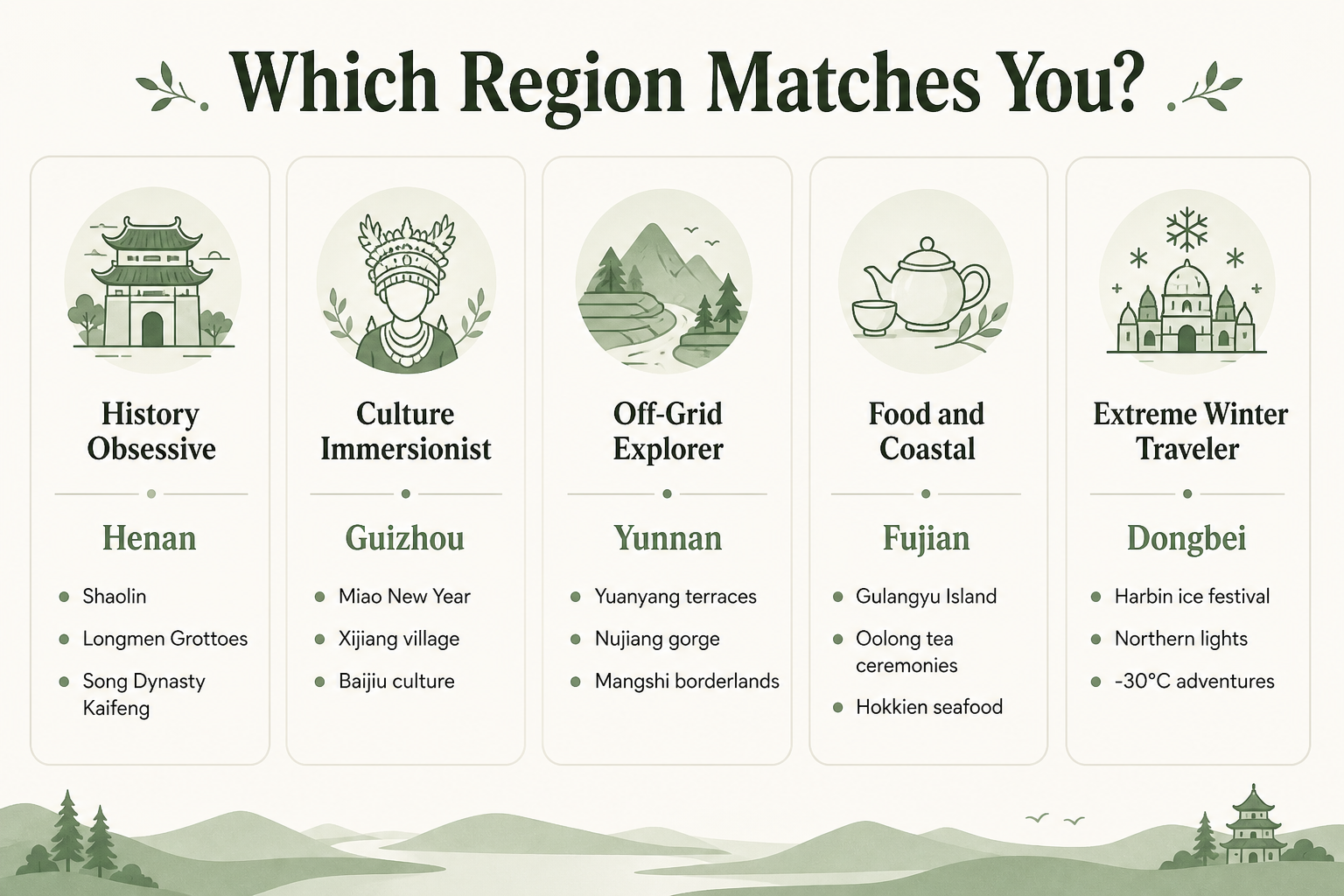
Which region is right for you?
Henan suits anyone who wants ancient history and Buddhism to plan a trip around, with the Longmen Grottoes, Shaolin Temple and Kaifeng's buried Song Dynasty streets. Yunnan is the pick for landscapes and wine, once you go beyond Lijiang and Dali, with the Yuanyang terraces and the Tibetan Plateau's high-altitude vineyards. Guizhou combines minority culture with dramatic scenery, adding Miao New Year, Huangguoshu Falls and baijiu country. Fujian offers a coastal city with UNESCO-calibre history and serious tea and seafood. Dongbei is the one for winter extremes, with the Harbin Ice and Snow World, Jilin's rime ice and the chance of the northern lights at Mohe.
How do you get to these regions?
High-speed rail and domestic flights connect all five regions to Beijing and Shanghai.
| Region | Main gateway | From Beijing | From Shanghai |
|---|---|---|---|
| Henan | Zhengzhou | 2.5 to 3.5 hrs (rail) | 5 to 6 hrs (rail) |
| Yunnan | Kunming | About 3.5 hrs (flight) | About 3.5 hrs (flight) |
| Guizhou | Guiyang | About 3 hrs (flight) | About 2.5 to 3 hrs (flight) |
| Fujian | Xiamen | About 3 hrs (flight) | About 2 hrs (flight), 5 to 6 hrs (rail) |
| Dongbei | Harbin | About 4.5 hrs (rail) | About 2.5 to 3 hrs (flight) |
Within each region, small-group tours make the biggest logistical difference, since the workshops, family-run restaurants and village access that define these experiences are not available to large groups. English is uncommon outside major cities, so a translation app is useful, and Dongbei's regional accent is notoriously difficult even for native Mandarin speakers.
When is the best time to visit off the beaten path China?
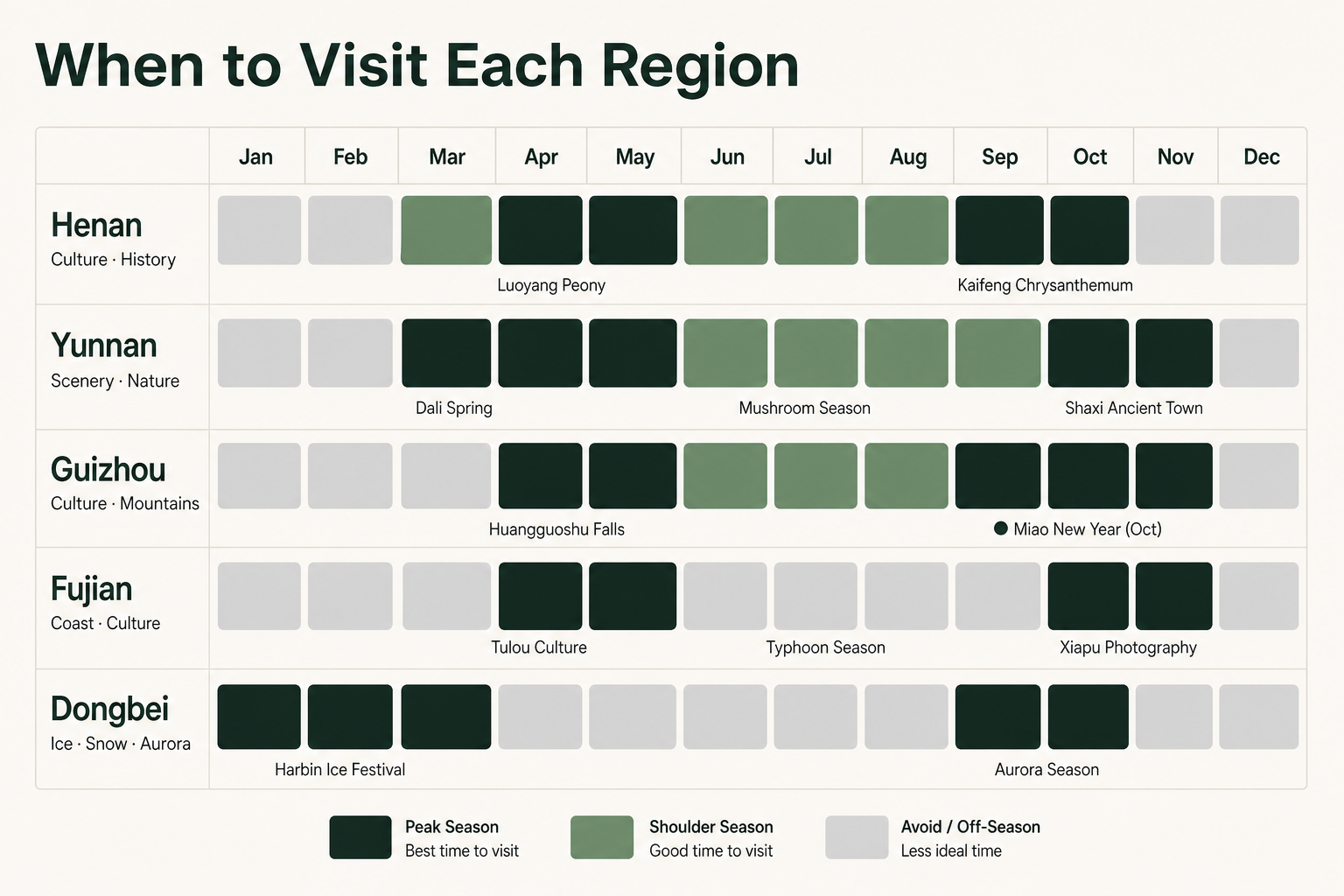
The best time to visit depends on the region, but spring and autumn suit four of the five. Henan is best from April to May and September to October, avoiding July and August when temperatures exceed 35 degrees Celsius. Yunnan suits March to May and September to November, with the Yuanyang terraces holding water from late November to April and wild mushrooms in season from June to September. Guizhou is at its best in April to May and September to November, and October and November bring Miao New Year. Fujian suits April to May and September to November, avoiding June to September, which is typhoon season. Dongbei is the exception and is best from December to February, when the Harbin Ice and Snow World and Jilin's rime ice are at their peak.
Which operators run tours to these regions?
Off the Eaten Track runs small-group food and culture tours of up to 12 guests (8 on the Wine Trail) in three of these five regions in 2027. The Henan Province tour runs from May 2027 (dates to be confirmed), 12 nights and 13 days from Zhengzhou, covering Kaifeng, Shenhou's Jun ware kilns, Shaolin, Luoyang and the imperial tombs at Gongyi. The Wild Southwest Guizhou tour runs from 24 October to 5 November 2027, 12 nights and 13 days, covering Miao New Year celebrations, Huangguoshu Falls, Fanjingshan and the Wanfenglin karst peaks. China's Wine Trail runs from August 2027 (dates to be confirmed), 14 nights and 15 days, tracing China's wine story from Hebei through Ningxia into Yunnan's high-altitude valleys. Private tours and custom itinerary planning are also available for Fujian and Dongbei.
Other operators cover parts of the same ground. Wild China covers broader adventure and culture travel across many regions, with strong community-based programmes in Yunnan and beyond. Shan China Tours specialises in private and small-group travel through Guizhou, Yunnan, Sichuan and Guilin, with custom itineraries built around the traveller rather than a fixed departure schedule.
Frequently asked questions
-
The best off the beaten path regions in China are Henan, Yunnan beyond Lijiang and Dali, Guizhou, Fujian and Dongbei. Henan suits history, Guizhou suits ethnic minority culture, Yunnan suits landscapes and wine, Fujian suits coastal city life and tea, and Dongbei suits winter travel. None requires special permits.
-
Yes. Henan, Yunnan, Guizhou, Fujian and Dongbei are all mainstream domestic tourist destinations with reliable transport and no particular safety concerns for international visitors. Off the beaten path here refers to how few international tourists visit, not to remoteness or risk. The main challenge is language, since English is uncommon outside major cities.
-
Australian passport holders can enter mainland China visa-free for up to 30 days for tourism, and must complete an online arrival card before travel. The policy is currently confirmed until 31 December 2026, so check the latest rules before booking a 2027 trip.
-
Henan is best from April to May and September to October, avoiding July and August when temperatures exceed 35 degrees Celsius. Yunnan suits March to May and September to November. Guizhou is at its best in April to May and September to November, especially October and November for Miao New Year. Fujian suits April to May and September to November, avoiding June to September, which is typhoon season. Dongbei is best from December to February, when the Harbin Ice and Snow World and Jilin's rime ice are at their peak.
-
A guide isn't required, but one makes a large difference outside major cities, where English is uncommon and many workshops, family-run restaurants and village visits depend on local relationships. Off the Eaten Track runs small-group tours in Henan, Guizhou and Yunnan (as part of China's Wine Trail) with Mandarin-speaking guides.
-
High-speed rail and domestic flights connect all five regions. Zhengzhou (Henan) is 2.5 to 3.5 hours from Beijing by high-speed rail. Kunming (Yunnan) and Guiyang (Guizhou) are about 3 hours by flight, Xiamen (Fujian) is about 3 hours by flight from Beijing, and Harbin (Dongbei) is 4 to 5 hours from Beijing by high-speed rail.
-
Guizhou suits travellers who want sour, spicy and fermented flavours. Fujian suits seafood, tea and light Hokkien cooking, and Henan suits wheat-based noodles and slow-simmered soups. Yunnan is the choice for wild mushrooms, rice noodles and Dai cuisine, and Dongbei for hearty dumplings, barbecue and pickled cabbage dishes.
-
Henan and Fujian are the easiest starting points. Both connect to Beijing, Shanghai and other major hubs by high-speed rail or short flights, and both have well-developed infrastructure at the main sights. Guizhou, Yunnan and Dongbei involve longer travel times within the region, so they suit second trips or guided travel.