
The best off the beaten path destinations in Japan for 2027 are Akita, Toyama, Tokushima, Tottori and Saga. Each has a major draw that most itineraries miss: Akita's Kanto Matsuri, Toyama's Alpine Route snow corridor, Tokushima's vine bridges and Awa Odori, Tottori's sand dunes and Saga's porcelain kilns.
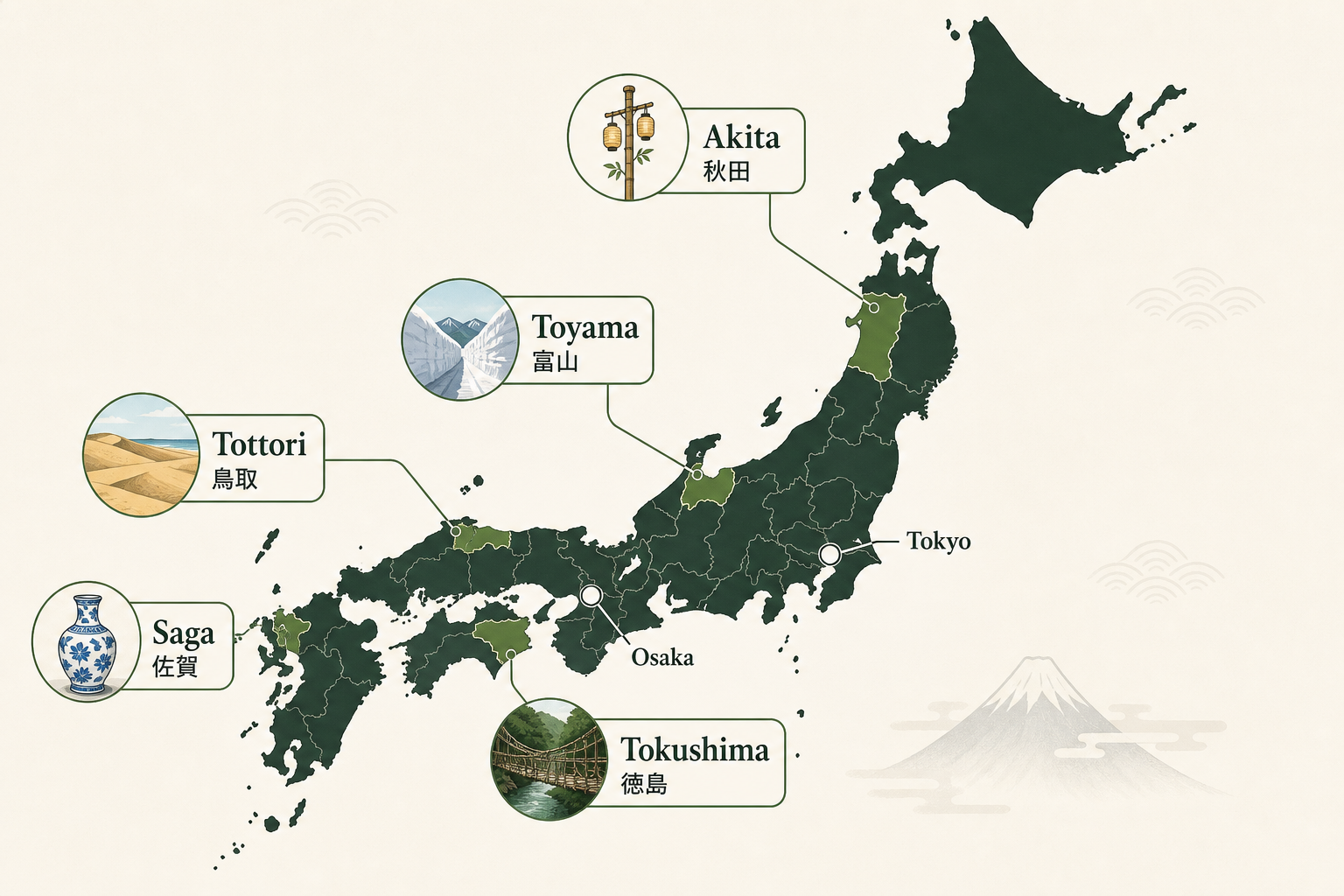
Which off the beaten path prefectures are worth visiting in Japan?
| Prefecture | Known for | Best time to go | Main gateway |
|---|---|---|---|
| Akita | Kanto Matsuri, Kakunodate samurai district, Nyuto Onsen | Early August, late April to early May | Akita Shinkansen |
| Toyama | Gokayama, Alpine Route, Takaoka and Inami crafts, firefly squid | Mid April to June, autumn, winter | Hokuriku Shinkansen |
| Tokushima | Iya Valley vine bridges, Awa Odori, Kamikatsu zero waste town, Awa indigo | Mid August, spring, autumn | Osaka by highway bus |
| Tottori | Sand dunes, yokai town, cliff hanging temple, winter crab | Spring to autumn, November to March | Super Hakuto from Osaka |
| Saga | Arita and Imari porcelain, Karatsu, live squid | Late April to early May, November | Hakata Station, Fukuoka |
Why go beyond Tokyo, Kyoto and Osaka?
Tokyo, Kyoto and Osaka are well worth seeing, but they also hold most of the crowds. Step one or two stops off the standard route and you find festivals where you can stand at the front, onsen towns with a handful of inns, and kilns that still fire pottery the way they did four centuries ago.
All five prefectures below are reachable by shinkansen, limited express, bus or a short flight. None needs a permit or unusual logistics. They reward a bit of planning around the right season, and in several cases around a single date in the calendar.
1. Akita: Kanto Matsuri, samurai streets and mountain onsen
Akita is worth visiting for the Kanto Matsuri each August, the samurai district of Kakunodate and the milky hot springs of Nyuto Onsen. It sits in northern Tohoku, roughly three hours from Tokyo to Kakunodate and just under four to Akita city on the Akita Shinkansen.
When is the Akita Kanto Matsuri and what happens?
The Kanto Matsuri runs from 3 to 6 August every year in Akita city. Performers balance bamboo poles more than 12 metres tall, weighing about 50 kilograms and hung with 46 paper lanterns, on their palms, foreheads, shoulders and hips. The lanterns are said to resemble ears of rice, and the performance is offered as a prayer for a good harvest. About 1.03 million people came in 2025.
Kanto is one of five major Tohoku festivals that overlap in the first week of August. Morioka's Sansa Odori usually runs 1 to 4 August, Aomori's Nebuta 2 to 7, Kanto 3 to 6, Yamagata's Hanagasa 5 to 7 and Sendai's Tanabata 6 to 8. A route through Morioka, Aomori and Akita can take in three of them in a single week.
This is one of my favourite festivals in Japan, and unlike anything else I've experienced. Watching the performers balance those poles looks impossible, and the crowd erupts when one almost comes crashing down (and sometimes one does). More than any other festival I have been to, Kanto feels like being at a big sports match, with the energy of the crowd creating an incredible atmosphere.
Our Tohoku Festival Circuit runs from 31 July to 11 August and is timed around Kanto, Nebuta and the other big August festivals.
What is there to see in Kakunodate and Nyuto Onsen?
Kakunodate's samurai district has preserved residences along a wide street lined with weeping cherry trees. The trees are designated a national natural monument and bloom from late April to early May, when the pink branches hang over the black wooden gates.
Nyuto Onsen is a cluster of seven hot spring inns in the mountains near Lake Tazawa, reached by bus from Tazawako Station. Tsurunoyu is the best known, with thatched-roof buildings and outdoor baths of cloudy white water. Lake Tazawa itself is Japan's deepest lake at 423.4 metres and does not freeze in winter.
What should you eat in Akita?
Start with kiritanpo nabe, a dish that began with charcoal makers and loggers in the Odate and Kazuno areas, who grilled leftover rice on skewers and simmered it with chicken and vegetables. The rice is mashed, wrapped around cedar sticks and toasted over charcoal until it is crisp outside and chewy within, then cut into pieces and dropped into a hot pot of hinai-jidori chicken, burdock, scallions and wild parsley. The original Hinai-dori breed was once protected and could not be eaten, so the crossbred hinai-jidori was developed to bring the dish back.
Akita is also known for inaniwa udon, thin hand-stretched noodles served cold in summer.
2. Toyama: Gokayama, Alpine Route snow walls and traditional crafts
Toyama is worth visiting for the quiet Gokayama thatched villages, the Tateyama Kurobe Alpine Route, centuries old metal and wood crafts and the seafood of Toyama Bay, including firefly squid and white shrimp. It is about two hours from Tokyo on the Hokuriku Shinkansen.
What is the Tateyama Kurobe Alpine Route?
The Tateyama Kurobe Alpine Route is a 37 kilometre crossing of the Northern Alps from Toyama to Nagano that links six forms of transport: a cable car, a highland bus, an electric bus through a tunnel, a ropeway, a second cable car and another electric bus. The route peaks at Murodo, 2,450 metres above sea level. The trolleybus that once ran through the mountain was replaced by electric buses. Along the way you cross Kurobe Dam, which at 186 metres is the tallest dam in Japan.
The highlight is the Yuki-no-Otani snow corridor near Murodo, where the road is cut through snow walls that reach close to 20 metres depending on the year. In 2026 the route opened on 15 April and closed on 30 November, with the snow walls open from mid April to late June. Check the operator's 2027 dates before booking.
Why visit Gokayama instead of Shirakawa-go?
Gokayama is the quieter alternative to Shirakawa-go. The two share a UNESCO World Heritage listing for their gassho-zukuri farmhouses, which have steeply pitched thatched roofs shaped like hands pressed together in prayer and built to shed heavy snow. On my last visit to the area, people were queueing for an hour just to park at Shirakawa-go. In Gokayama, 15 minutes up the road, we walked straight into the villages and were some of the only visitors there.
Ainokura, the larger of Gokayama's two villages alongside Suganuma, has plenty of homestays inside working gassho houses, and I have spent a night in one. It is also the place to get hands-on with the area's washi paper. The Gokayama Washi Paper-Making Experience Hall in the village lets you make your own sheet and press flowers or leaves into it, from 800 yen. It is closed on Tuesdays and in winter. The villages are especially striking under winter snow.
What crafts can you see in Toyama?
Toyama is one of Japan's craft heartlands. Takaoka has made cast copperware for more than 400 years and is Japan's leading production area for copper casting, with factory tours and hands-on workshops open to visitors. Inami, a short drive from Gokayama, is a woodcarving town where carvers work with about 200 different chisels and knives to create lifelike, three dimensional carvings, including the ornate openwork panels that decorate temples and homes.
Our Hokuriku Craft, Food and Culture Tour runs from 12 to 22 May and includes Takaoka bronze casting, Inami woodcarving and washi papermaking in Gokayama.
What should you eat in Toyama?
Toyama Bay drops steeply to more than 1,000 metres deep, which feeds a seafood scene unlike anywhere else in the country. Shiro-ebi, the translucent white shrimp, is eaten as sashimi, in kakiage tempura or over rice.
Firefly squid are fished from about March to late June, and the waters off Namerikawa where they gather are designated a Special Natural Monument. April is the most reliable month for the blue glow, seen from a pre-dawn boat tour or from the beach. The squid are usually served boiled with sumiso, a vinegar and miso dressing, or marinated. Raw squid carries a parasite risk, so marinated or frozen versions are the safer choice. The Hotaruika Museum in Namerikawa runs a light show from late March to the end of May.
Masu-no-sushi, trout pressed with rice and wrapped in bamboo leaves, is Toyama's best known station bento.
Toyama Black ramen is the dish to plan a meal around. It began in 1947, when Takahashi Seikan fed labourers rebuilding Toyama after the war from his stall, Taiki. He made the soup heavy with soy sauce and pepper so that a few mouthfuls would carry a bowl of plain rice, and the workers ate it as a side dish with the rice in their lunch boxes. The result is a jet black broth that is intensely salty and peppery, served with thick straight noodles, hand cut chashu and menma. Stir the toppings through the soup before you eat, and first timers can ask for a lighter broth. Nishicho Taiki in Toyama city is the original shop.
3. Tokushima: vine bridges, Awa Odori and the start of the pilgrimage
Tokushima is worth visiting for the Iya Valley vine bridges, the Awa Odori dance festival in mid August, Awa indigo dyeing, the zero waste town of Kamikatsu and the temples of the Shikoku pilgrimage. It is the first prefecture most travellers reach on Shikoku from Osaka, about two and a half hours away by highway bus.
What are the Iya Valley vine bridges made of?
The Kazurabashi in the Iya Valley are made from sarunashi, a hardy kiwi vine (Actinidia arguta). The vines grow wild in the cold mountains around the valley, and the bridge is rebuilt every three years. It spans 45 metres, is about 2 metres wide and hangs roughly 14 metres above the river, with gaps between the planks that let you see the water below. Local legend credits the monk Kukai or fleeing Heike warriors, who supposedly cut the vines to stop pursuers, though the true origin is uncertain. Entry is 550 yen for adults, and the bridge is closed during rebuilding.
If you are scared of heights, crossing it is a bit freaky, with the river showing through the gaps under your feet, but it is a totally unique experience. Even better is going deeper into the valley to the Oku-Iya Nijuu Kazurabashi, known as the husband and wife bridges, where you probably will not see anyone else. The longer husband bridge is 42 metres and hangs 12 metres above the water, and the wife bridge beside it is 22 metres long and 1.2 metres wide. Entry is 550 yen, and the bridges are open from April to November.
Our Shikoku Food and Culture Tour runs from 5 to 17 March and crosses the Iya Valley vine bridges.
What else is there to do in Tokushima?
The Naruto whirlpools form in the strait between Awaji Island and Tokushima and are strongest around the spring and autumn tides. You can see them from a boat or from the walkway under the Onaruto Bridge.
Ryozenji, temple number 1 of the 88-temple Shikoku pilgrimage, is in Naruto. The pilgrimage is a circuit of around 1,200 kilometres linked to the monk Kukai, and Tokushima holds the first 23 temples, so white-robed pilgrims are a regular sight on local roads.
Awa Odori runs from 12 to 15 August in Tokushima city, with dancing from 18:00 at venues and in the streets. Groups called ren perform their own choreography, and beginner groups let visitors join in. The festival's best known saying is that the dancing fool and the watching fool are both fools, so you may as well dance.
What is the zero waste town in Tokushima?
Kamikatsu, a mountain town in Tokushima, became the first town in Japan to declare a zero waste policy, in 2003. Residents sort their rubbish into 13 types and 45 subcategories and carry it to the Hidagaya Waste Station, where resident staff help them sort it. Anything still usable goes to the Kuru-Kuru Shop next door, a reuse shop where locals drop off goods and anyone can take them home. Around 15 tonnes of usable items pass through the shop each year.
Where can you try Awa indigo dyeing in Tokushima?
Tokushima is the home of Awa indigo, a dye with roots in the Heian period that became a major source of income for the Tokushima domain in the Edo period. Indigo merchants built townhouses topped with udatsu, raised fire walls, and many still stand in Mima. Aizumi, a town whose name carries the meaning of the place where indigo lives, is the centre of production, and you can dye your own handkerchief at Ai no Yakata, the Aizumi Town History Museum, from 1,000 yen, or at the Yano Factory by reservation.
What should you eat in Tokushima?
Sudachi is the flavour of Tokushima. The prefecture grows nearly all of Japan's sudachi, and the small green citrus is squeezed over soba, sashimi, grilled fish and drinks. Iya soba is made from 100 per cent local buckwheat flour and cut into thick, short noodles that break easily, a reflection of a valley where rice was hard to grow. Dekomawashi are skewers of potato, soba dumpling, stone-pressed tofu and konnyaku brushed with miso and grilled over a hearth that you can get from street-side vendors near the vine bridges.
4. Tottori: sand dunes, a yokai town and winter crab
Tottori is worth visiting for the Tottori Sand Dunes, the yokai statues of Sakaiminato, the cliff hanging temple of Nageiredo and matsuba crab in winter. It is Japan's least populous prefecture, and one of the least visited. The Super Hakuto limited express runs there from Osaka via Himeji.
How big are the Tottori Sand Dunes?
The dunes stretch about 16 kilometres east to west and 2.4 kilometres north to south along the Sea of Japan coast. The Umanose ridge rises about 47 metres above sea level, with slopes of around 30 degrees. Part of the dunes was designated a national natural monument in 1955, and the surrounding San'in Kaigan area joined the Global Geoparks Network in 2010. Camel rides, sandboarding and paragliding all operate here. The Sand Museum next door displays large sand sculptures by international artists, with a new theme each exhibition.
Why is Sakaiminato famous for yokai?
Sakaiminato is the home town of manga artist Shigeru Mizuki, creator of the extremely popular manga GeGeGe no Kitaro, which is all about Japanese spirits, or yokai. Mizuki Shigeru Road runs from the station to the Mizuki Shigeru Memorial Museum and is lined with 177 bronze yokai statues. Mizuki served in the war at Rabaul in New Britain, and his experiences there shaped his work.
What is Nageiredo, Tottori's cliff hanging temple?
Nageiredo is the inner sanctuary of Sanbutsuji temple on Mount Mitoku, a National Treasure of the Heian period tucked into a hollow in a cliff face. Legend says the monk En no Gyoja threw the hall into the rock, which is where the name comes from. The walk up takes about 40 minutes and climbs roughly 200 metres on an unpaved trail, with tree roots to scramble over and chains to hold on to along the rock faces. Climbers must go in groups of at least two, wear shoes without metal fittings and receive a ceremonial sash at the start. Straw sandals are sold at reception, which is open from 8:00 to 15:00. Entry is 800 yen for the mountain and 400 yen for the temple, and climbs are not allowed in rain or snow, which usually rules out December to about April. Mount Mitoku is around 10 minutes by car from Misasa Onsen.
When is the Tottori crab season?
Matsuba crab, the male snow crab, is in season from 6 November to 20 March in the sea area from Shimane to Toyama. Matsuba is a regional name for the male, with two theories behind it: the long legs look like pine needles, or fishermen grilled the crab over burning pine needles on the beach. Tottori's main landing ports are Sakaiminato, Tottori and Ajiro. Hyogo and Kyoto fishing ports use the name too. Female crab, called oyagani, are in season in November and December, and eastern Tottori turns them into a rich oyagani soup.
Tottori's other specialities include gyukotsu ramen, a beef bone broth ramen found only in this part of Japan, and the 20th Century pear, a crisp, juicy variety grown in the prefecture.
Is the Adachi Museum of Art in Tottori?
No, the Adachi Museum of Art is in Yasugi, Shimane, but it is an easy side trip from Yonago in western Tottori. The museum's garden has been ranked first in Japan for 23 consecutive years by the US magazine Journal of Japanese Gardening, with the latest ranking covering 2025.
5. Saga: Arita porcelain, Karatsu and live squid
Saga is worth visiting for Arita and Imari porcelain, Karatsu's castle and Kunchi festival, and live squid at Yobuko. It is about 40 minutes by limited express from Hakata Station in Fukuoka.
Why is Arita important to porcelain history?
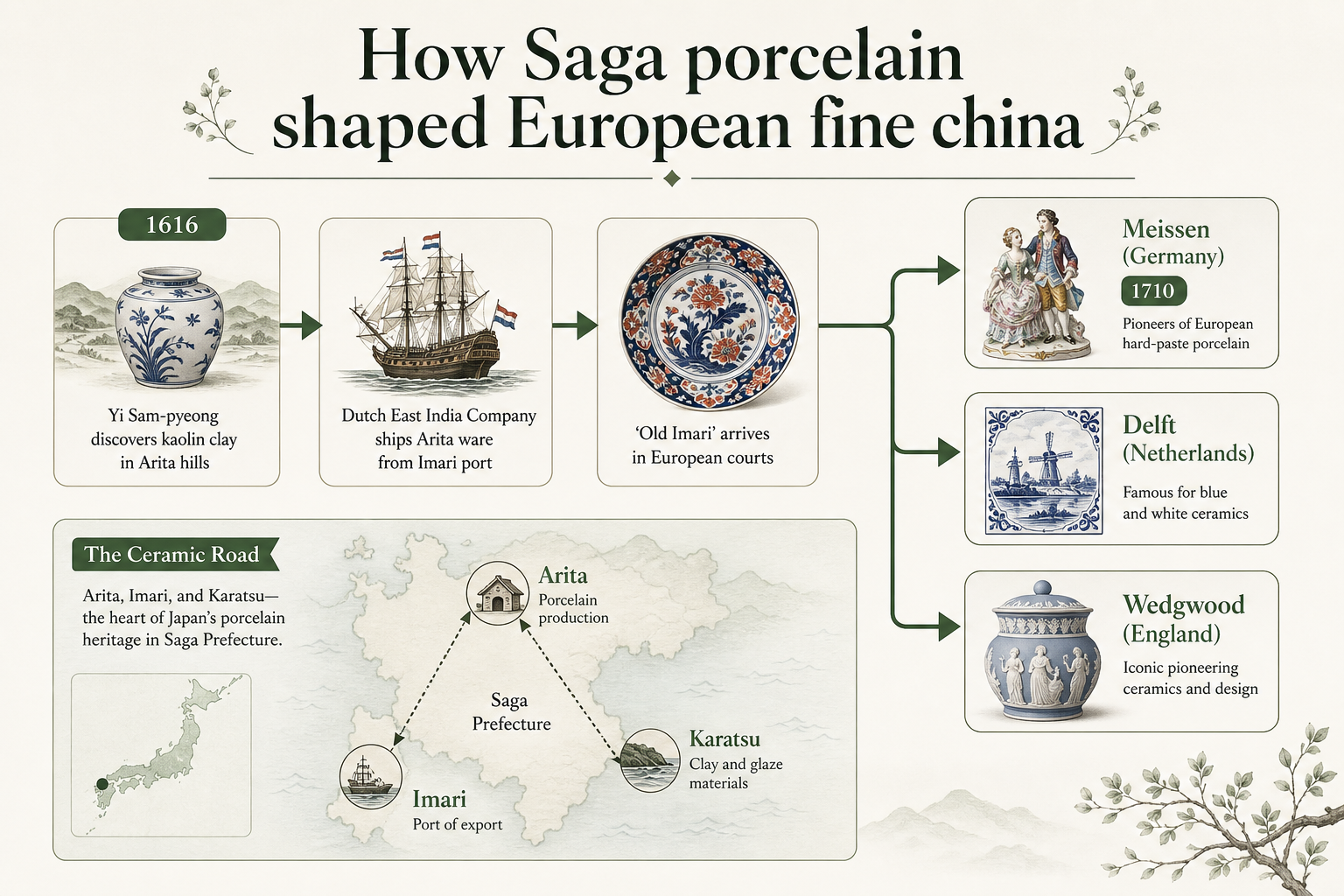
Arita is where Japanese porcelain began. The Korean potter Yi Sam-pyeong is credited with finding kaolin clay at Izumiyama near Arita in 1616, and the town's kilns went on to produce Japan's first porcelain. The Dutch East India Company shipped it to Europe from the nearby port of Imari. Kakiemon style ware was exported in large numbers in the late 17th century, and European makers such as Meissen and Chelsea imitated the style.
Arita Pottery Fair runs every year from 29 April to 5 May. In 2026 it drew about one million visitors to roughly 400 shops. Around 30 minutes away, the village of Okawachiyama in Imari was the home of Nabeshima ware, made for the shogunate and domain lords rather than the open market.
What else is there to see in Karatsu?
Karatsu Castle was built in 1608 on a headland above the sea. Karatsu Kunchi, held every year from 2 to 4 November, parades 14 hikiyama floats shaped like sea bream, lions, dragons and other creatures through the streets. Karatsu ware is the rough, earthy counterpart to Arita's refined porcelain and has long been prized by tea masters.
Yoshinogari Historical Park is a reconstructed Yayoi period settlement with an outer moat that encloses about 40 hectares. Some scholars link the site to Yamataikoku, the kingdom of Queen Himiko recorded in Chinese histories, but the identification remains debated.
What should you eat in Saga?
Yobuko is the place for ikezukuri, squid sashimi cut while the kensaki squid is still alive, so that the tentacles keep moving on the plate. The morning market in Yobuko is counted among Japan's three great morning markets, and restaurants in the market serve squid sets made with the day's catch. Nabeshima sake from Fukuchiyo has won awards at the International Wine Challenge. If regional beef is on your list, we have also written a guide to Japan's regional wagyu beyond Kobe.
Which prefecture is right for you?
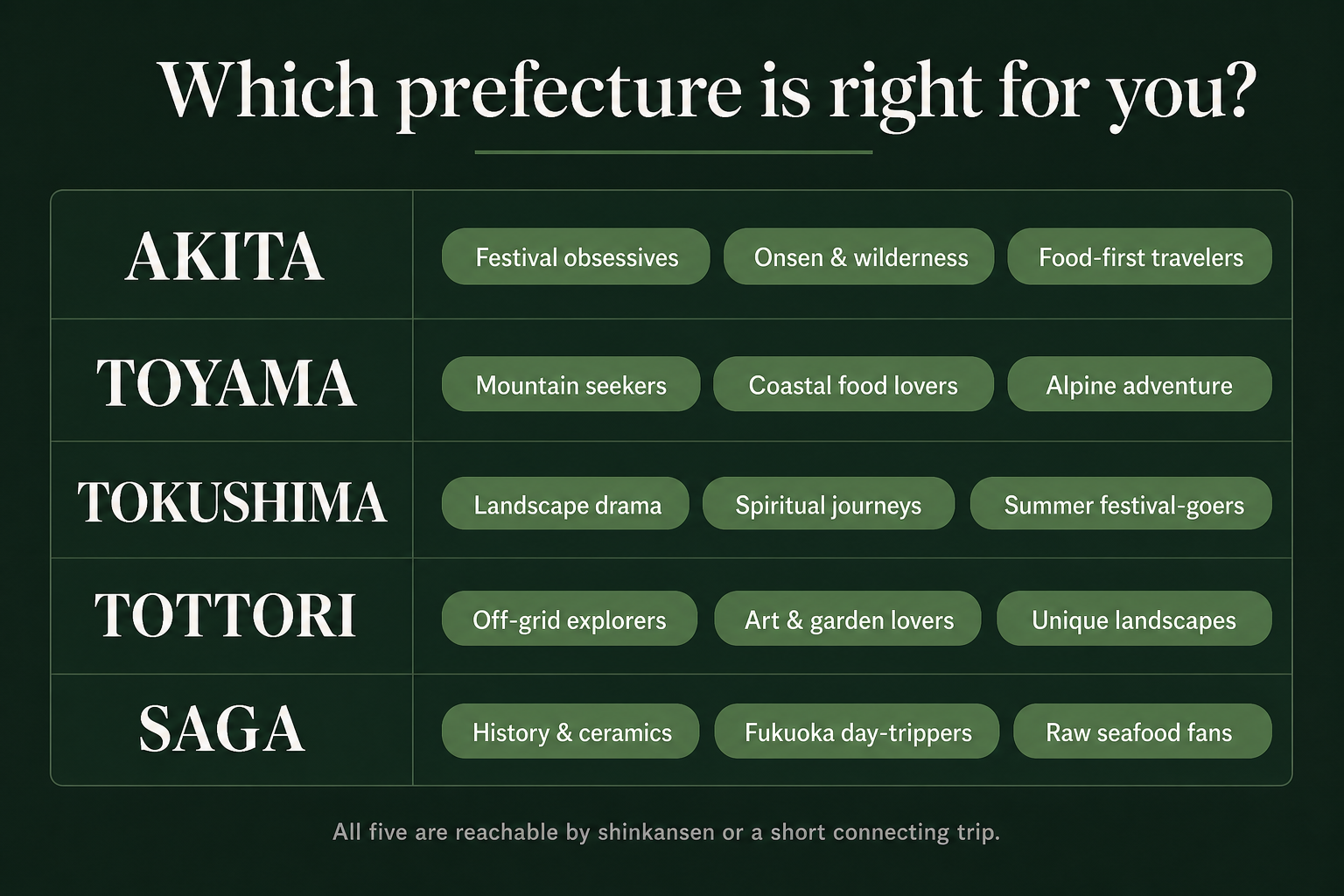
Akita suits anyone who wants a festival to plan a trip around, because the Kanto Matsuri runs from 3 to 6 August with Tohoku's other August festivals close by. Toyama is the pick for mountain scenery and seafood, with the Alpine Route snow walls, the quiet villages of Gokayama and the white shrimp and firefly squid of Toyama Bay. Tokushima combines dramatic landscapes with a summer dance festival, and adds vine bridges, the Naruto whirlpools and the pilgrimage temples. Tottori offers a landscape that does not look like Japan, with sand dunes, a cliff hanging temple and crab in winter. Saga is the one for craft and history, with Arita and Imari porcelain, Karatsu and the Yoshinogari settlement.
How do you get to these prefectures?
| Prefecture | From Tokyo | From Osaka or the nearest hub |
|---|---|---|
| Akita | Akita Shinkansen, about 3 hours to Kakunodate and just under 4 hours to Akita city | Fly Itami to Akita, or connect via Tokyo |
| Toyama | Hokuriku Shinkansen, about 2 hours | Thunderbird limited express to Tsuruga, then the Hokuriku Shinkansen |
| Tokushima | Fly to Tokushima Awaodori Airport | Highway bus from Osaka, about 2.5 hours. From Takamatsu, about 1 hour 10 minutes by train. From Okayama, about 2 hours by train |
| Tottori | Fly to Tottori, or shinkansen to Himeji then Super Hakuto | Super Hakuto from Osaka via Himeji. From Okayama, the Super Inaba limited express |
| Saga | Fly to Fukuoka | About 40 minutes by limited express from Hakata Station |
The Super Hakuto runs partly on a non-JR line, so check pass coverage before buying. Our guide to Japan's regional rail passes covers the options, and renting a car in Japan is worth considering for Iya Valley and Gokayama. English signage is good at shinkansen stations, but menus and local buses in all five prefectures are mostly in Japanese, so a translation app is useful.
When is the best time to visit?
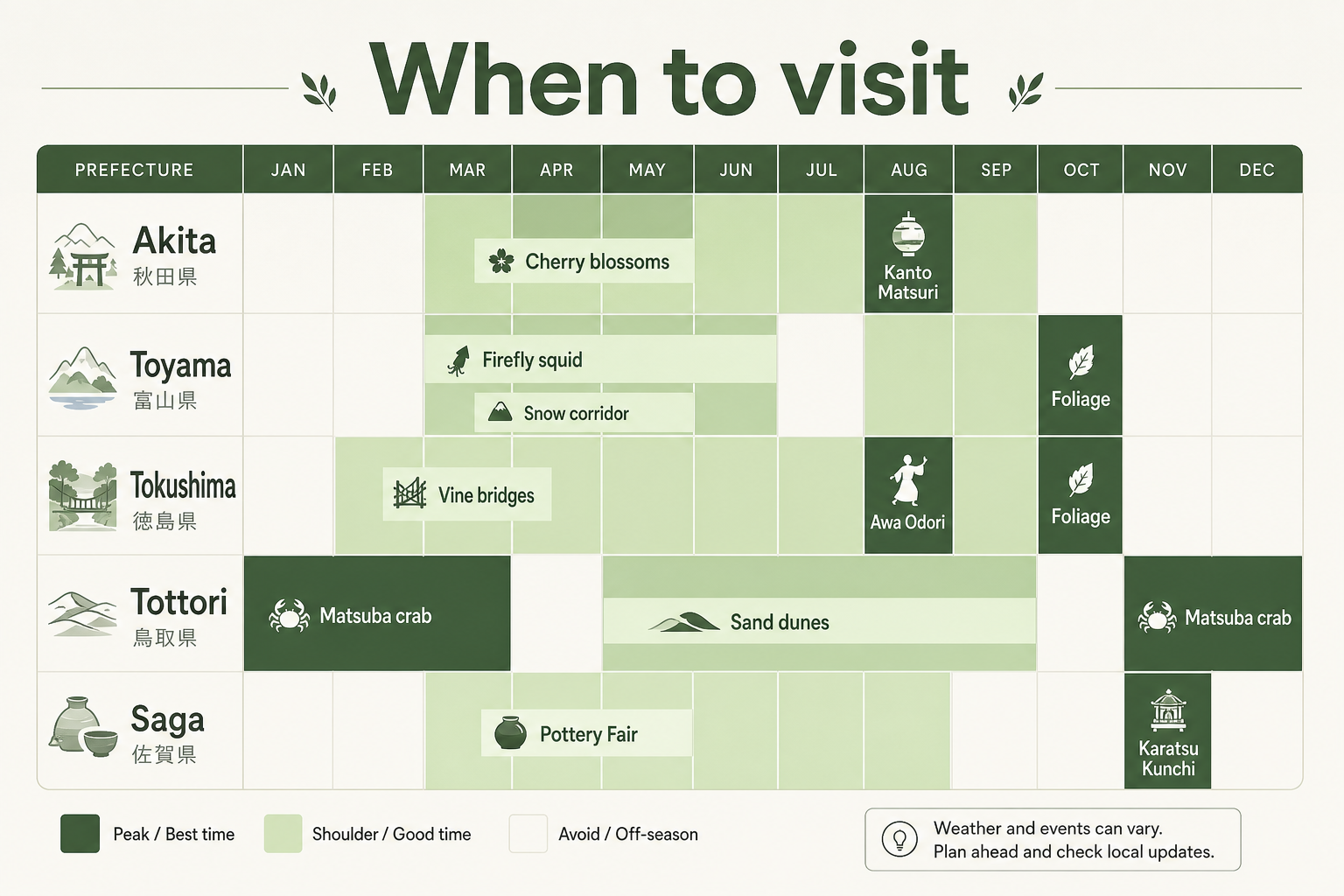
Akita is best from late April to early May, when the Kakunodate cherry blossoms bloom, and in early August for the Kanto Matsuri on 3 to 6 August. October and winter also suit it.
Toyama is at its best from mid April to June, when the Alpine Route snow walls are open and firefly squid are in season from March to late June. October to November and winter also work, and Gokayama is at its prettiest under snow.
Tokushima suits March to April, October and mid August, when Awa Odori runs from 12 to 15 August. The Naruto whirlpools are strongest around the spring and autumn tides.
Tottori works from spring to autumn for the sand dunes and from November to March for crab, with matsuba crab in season from 6 November to 20 March.
Saga is best from late April to early May, when the Arita Pottery Fair runs from 29 April to 5 May, and in November for Karatsu Kunchi on 2 to 4 November.
Which operators run tours to these regions?
Off the Eaten Track runs small group food and culture tours of up to eight guests in three of these regions in 2027. The Shikoku Food and Culture Tour runs from 5 to 17 March through Awaji, Tokushima, Kochi and Kagawa, with the Iya Valley vine bridges, Ryozenji and the Tosa no Okyaku festival in Kochi. The Hokuriku Craft, Food and Culture Tour runs from 12 to 22 May through Ishikawa, Toyama and Fukui and includes Takaoka bronze casting, Inami woodcarving, washi papermaking in Gokayama and the firefly squid museum. The Tohoku Festival Circuit runs from 31 July to 11 August through Iwate, Aomori, Akita and Fukushima, covering Sansa Odori, Kuroishi Neputa, Nebuta, Kanto and the Fukushima Waraji Festival.
Other operators cover parts of the same ground. Oku Japan offers a Temples and Trails of Shikoku itinerary, Walk Japan runs walking tours of Shikoku, 10Adventures runs guided e-bike tours of Shikoku for groups of up to eight, and Deeply Regional Japan runs tours in the Hokuriku region and the Japan Alps foothills. See all of our 2027 departures on the Japan tours page.
Frequently asked questions
-
No single place holds the title, but Tottori, Akita, Tokushima, Toyama and Saga all see far fewer visitors than the Tokyo, Kyoto and Osaka route. Tottori is Japan's least populous prefecture.
-
It is manageable. Shinkansen stations have English signage and staff, but local restaurants, rural inns and local buses often have little English. A translation app with a camera function handles most menus, and a guided small group tour removes the language barrier.
-
Late April to early June suits Toyama's Alpine Route snow walls, firefly squid and Kakunodate's cherry blossoms. Early August suits Tohoku's festivals, including Akita's Kanto Matsuri on 3 to 6 August. November to March suits Tottori's crab season.
-
The usual way is the highway bus, which takes about 2 hours 30 minutes. By train, travel via Okayama or Takamatsu, where limited express and local trains continue to Tokushima. The Uzushio limited express runs from Takamatsu to Tokushima, not from Osaka.
-
The Super Hakuto limited express runs from Osaka to Tottori via Himeji. From Okayama, the Super Inaba limited express runs to Tottori.
-
The Akita Kanto Matsuri runs from 3 to 6 August every year in Akita city.
-
The matsuba crab season runs from 6 November to 20 March in the sea area from Shimane to Toyama, which includes the ports of Tottori.