
Best Food Tours in Japan (2026)
Updated October 2026
The best food tours in Japan depend on trip length. For a single day, Ali Kosaka's Toyosu fish market tour, Taka's Osaka bar crawl, Arigato Travel and Shun Tours are the best places to start. For multi-day trips, Eat Japan and Eating Adventures go deep in Japan's major food cities, while Off the Eaten Track and Zenbu Travel build itineraries around regional Japan.
Off the Eaten Track is our company, and it appears in this guide. We've said plainly what each operator does and doesn't offer, ours included.
How we chose these food tours
We included operators that run English-language food tours in Japan, then looked at four things: how long they have been operating, how much local access their guides have, whether food shapes the itinerary or sits alongside other sights, and how large the groups are. We haven't ranked them from best to worst. Each is grouped by what it is built for.
Japan food tours compared
| Operator | Best for | Where | Length | Group size | Price |
|---|---|---|---|---|---|
| Ali Kosaka | A working fish market breakfast | Tokyo (Toyosu) | 2 hours | Variable | Variable |
| Taka's Osaka bar crawl | Standing bars and local izakayas | Osaka | 3 hours | Variable | ¥7,000 |
| Arigato Travel | Reliable group walking tours | Tokyo, Osaka, Kyoto, Hiroshima | 3 hours | Variable | ¥26,400 to ¥36,550 |
| Shun Tours | Private, customised food tours | Tokyo | 2.5 to 3.5 hours | Variable | From ¥49,800 |
| Journey to the East | Cultural journeys with food included | Kyushu, Hokkaido | 13 to 14 days | 8 to 10 | From AUD 11,000 |
| Oku Japan | Walking routes with regional cuisine | Nakasendo, Kumano Kodo, Shikoku 88 | 8 to 15 days | Max 13 | AUD 4,400 to 10,500 |
| Eat Japan | Founder-led food journeys, application only | Tokyo, Kyoto, Osaka, Nara | 11 days | Max 7 | USD 10,990 |
| Eating Adventures | Five-day Tokyo deep dive | Tokyo | 5 days | Max 8 | NZD 6,295 |
| Off the Eaten Track | Food-first tours in regional Japan | Shikoku, Hokuriku, Tohoku | 11 to 13 days | Max 8 | AUD 8,861 to 9,973 |
| Zenbu Travel | Luxury food access | Hokuriku, Kyoto, Kyushu | 12 to 16 days | Max 8 | Upon inquiry |
Why eating well in Japan takes some help
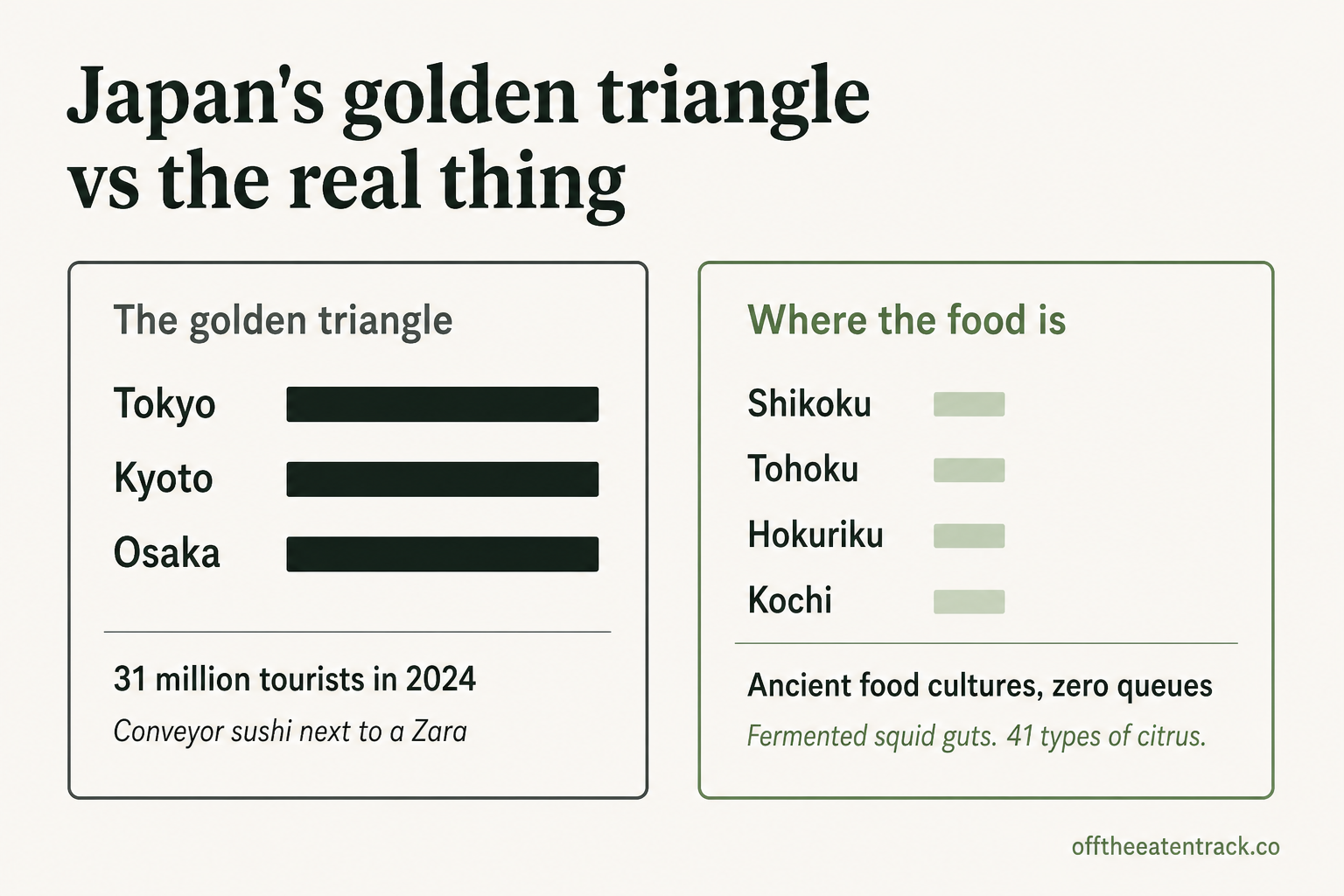
Japan welcomed a record 36.9 million international visitors in 2024, according to the Japan National Tourism Organisation, and Tokyo, Kyoto and Osaka are the stops on most first itineraries. The food in those cities has adapted to the volume, with high-throughput restaurants, English menus and queues built around the biggest names. The dirty Michelin spots still exist, including the unmarked lunch counters, standing sushi bars and ramen shops with handwritten signs, but they take more effort to find each year. Cities outside that circuit, Nagoya and Fukuoka especially, have more of that everyday food culture within easy reach, and our Nagoya travel guide is a good place to start.
Beyond the cities, regional Japan has its own dishes, ingredients and producers. Japan's Ministry of Agriculture, Forestry and Fisheries documents the origin, history and recipes of regional dishes prefecture by prefecture in its Regional Cuisines database, including regions like Tohoku, Shikoku and Hokuriku, or prefectures such as Toyama, Ishikawa and Fukui. A food tour is one way to reach those tables, producers and makers with someone who already knows them.
Best day food tours in Japan
Day tours suit travellers who are already in Japan and want one exceptional food experience without restructuring the whole trip. The best ones introduce you to someone who has been doing one thing well for a long time.
Best Tokyo fish market tour: Ali Kosaka
Ali Kosaka is a Tokyo guide who runs fish market tours through Airbnb Experiences, focused on Toyosu and the surrounding wholesale market area. Reviews describe a guide who knows every vendor, knows what is in season and turns a cold morning at the market into the meal people remember most from their trip.
The tour covers the working wholesale market that supplies Tokyo's seafood, rather than the outer market tourist corridor, and you eat at the market itself.
What you get: access to a working market, fresh fish and a guide who can explain what you're looking at and why it matters.
What you don't get: a broader look at Tokyo's food culture. It is a half-day at one market, done well.
Best Osaka bar crawl: Taka
Taka runs an Osaka bar crawl through standing bars and tiny Japanese pubs that often have no English menus and sometimes no menus at all. He speaks excellent English and grew up in the city. Osaka's food culture is summed up by the phrase eat until you drop (食い倒れ, kuidaore). Dotonbori, where most tourists go, is photogenic, but the food around it leans towards chains and long queues. Taka's evening goes somewhere different.
One stop is a standing bar inside a sake or liquor merchant's shop, called a kakuuchi, where the merchant sells directly from their own stock. It is Minsky’s favourite type of bar in Japan. They’re family run, with uncles and aunties make bar snacks from whatever they picked up at the market that morning. The evening leans towards drinks more than dinner, which is how Osaka people socialise.
The crawl runs through various booking platforms, and you can find Taka on Instagram to see what a night with him looks like.
What you get: an evening in a part of Osaka that standard itineraries skip, with someone who grew up here and still eats here.
What you don't get: a sit-down meal or a structured tasting menu. This is bar culture.
Arigato Travel: Tokyo, Osaka, Kyoto and Hiroshima
Arigato Travel is Japan's largest food tour operator, running more than 45 walking food tours in Tokyo, Osaka, Kyoto and Hiroshima. It has hosted over 100,000 guests and holds a 5/5 rating from more than 4,000 TripAdvisor reviews. Tours run three to four hours, in the daytime or evening, and cover a neighbourhood's food culture in a series of tastings.
What you get: a polished, well-organised food tour with an experienced guide, consistent quality and real insight into Japanese food culture.
What you don't get: the access that comes with a smaller operator. Arigato's scale is its strength, and the tours run for groups.
Shun Tours: private tours in Tokyo
Shun Tours is a private food tour company in Tokyo, created by @tokyofoodiesarah on Instagram. There are no group bookings and no shared tables. It's just you, whoever you're travelling with and a guide who has spent years mapping Tokyo's food culture from the inside.
Tours run around three hours, from ¥49,800, and Shun Tours holds a 4.9 rating. Private tours let you choose the neighbourhood, the pace and the dishes.
What you get: total flexibility, deep Tokyo food knowledge and an experience built around your interests.
What you don't get: the social energy of a group tour, or the breadth of a longer format.
Best multi-day food tours in Japan
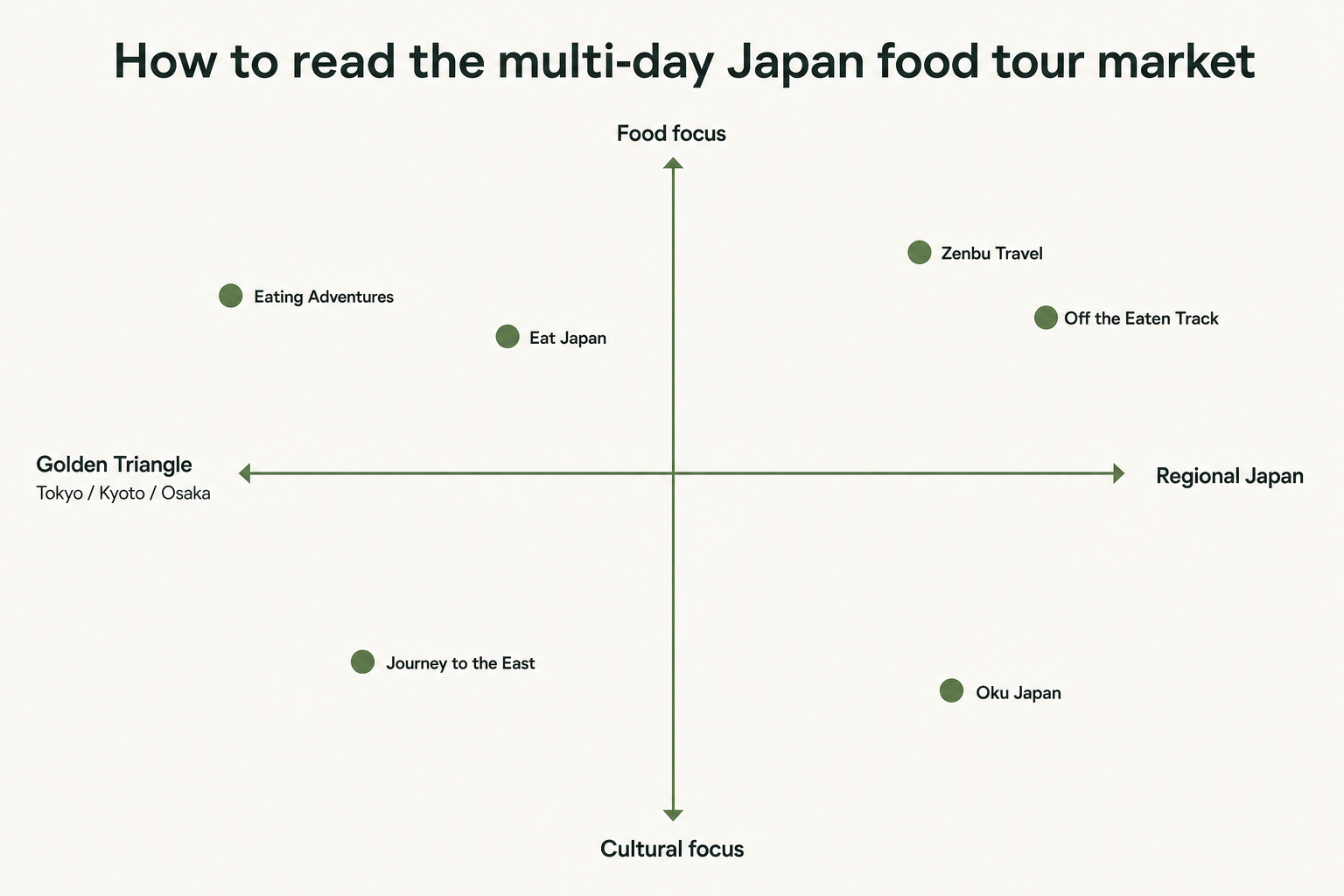
A multi-day food tour hands the logic of the journey to someone else's expertise: what gets eaten, where it comes from and what it means. Operators range from those who treat food as one thread among several to those who build every day around eating.
Multi-day Japan tours that pair food with culture
These operators take Japan's food seriously and eat well wherever they go. Food isn't the organising idea of the itinerary. It sits alongside history, architecture, craft and landscape.
Journey to the East: cultural immersion, food included
Journey to the East is an Australian-run small-group tour operator that has been running tours of Japan for more than 13 years. It is ATAS-accredited, recognised by Japan's National Tourism Organisation and holds a 4.9/5 rating across 472+ tours.
Tours run 13 to 14 days, with groups capped at eight to ten people. Food is present throughout, alongside history, architecture, craft and landscape, and the operator knows Japan well enough to eat well wherever it goes.
What you get: a thoughtful, well-run journey through Japan with a guide who understands the country deeply, with good food woven into a wider cultural itinerary.
What you don't get: days structured around the best bowl of noodles in a region, or visits to producers who grow a single variety of citrus for 50 people a year. If food is your primary reason for travelling, Journey to the East will feed you well, but the itinerary isn't built around it.
Oku Japan: walking through the landscape, eating through the region
Oku Japan is a walking tour operator that builds village-to-village walks along routes such as the Nakasendo, Kumano Kodo and Shikoku 88, with regional cuisine woven through each day. It offers both self-guided and small-group options, and its accommodation tends towards traditional inns and family-run guesthouses that serve food worth eating.
Food is inseparable from the landscape and the movement. You eat regional food because you are walking through the region.
What you get: a considered way to experience rural Japan, where what's on the table reflects what's in the fields outside, and the walking gives the food its context.
What you don't get: days structured around finding exceptional food. Food is context rather than subject, so Oku suits travellers who want Japan's landscape and culture with serious food alongside.
Multi-day Japan food tours built entirely around food
These operators treat food as the reason for being in Japan. Itineraries are built around what is in season, what is rare and what takes a relationship to reach. Some work in Japan's major food cities and others in regions such as Shikoku, Tohoku and Hokuriku, where local food cultures have developed over centuries.
Off the Eaten Track: food-first tours in regional Japan
Off the Eaten Track is a boutique tour company founded by Michael Minsky and Beth Brash, who met in Japan in 2007 and have spent nearly two decades building the relationships and regional knowledge behind their tours. It runs very small food-first groups through regions chosen for their food.
The 2027 calendar has a Shikoku circuit in March, a Hokuriku journey in May and a Tohoku festival circuit across July and August. Past tours have included making pickles with a fermentation expert in a temple kitchen, making buckwheat noodles (蕎麦, soba) with women in their seventies in the mountains of Shikoku who don't speak English and still grind and mix by hand the way they have all their lives, and eating sea urchin pulled from the ocean that morning by free-divers on Japan's northern coast. The access behind those days took years to build.
The pace is unhurried, and suppliers, farmers and chefs are part of each day. You eat with the people who made the food.
What you get: food-first travel in regions chosen for their food, in very small groups, with relationships with producers, farmers and chefs built over years.
What you don't get: a highlights tour of Tokyo, Kyoto and Osaka. Off the Eaten Track suits travellers who come to Japan for the food and want it to lead them somewhere new.
Eat Japan: founder-led, application only, maximum seven people
Eat Japan is a food tour company run by Scott Brills, with an application-based booking process and a maximum of seven participants. Tours typically run 10 to 11 days and usually depart in March, April or November. Scott curates each group through the application, so you travel with people who want the same things you do.
The itinerary covers Tokyo, Kyoto, Osaka and Nara, which is closer to the traditional circuit than Off the Eaten Track's regional focus, and the depth of the food experience is serious. Scott has eaten his way through Japan long enough to know where the good things are.
What you get: an intimate, founder-led food journey with a very small group and a guide who is personally invested in every meal.
What you don't get: access to Japan's more remote food cultures. Eat Japan works the major cities in depth, while Off the Eaten Track works the regions.
Eating Adventures: five-day Tokyo deep dive
Eating Adventures is a Tokyo-only food tour company run by Sue and Janice, offering five-day tours priced at NZ$6,295.
The format is intensive and built around one city: five days, a maximum of eight people and a focus on going deep into Tokyo's food culture rather than covering ground. Its March and April 2027 tours were mostly sold out at the time of writing.
What you get: a focused, immersive food experience in Tokyo with clear pricing, for people who want depth in one city rather than breadth across several.
What you don't get: regional Japan. If Tokyo is where you want to go deep, Eating Adventures is the right choice, and for Japan beyond Tokyo you'll need a different operator.
Zenbu Travel: luxury food tours with decades of access
Zenbu Travel is a luxury Japan tour company led by Jane Lawson, who has more than 40 years of Japan expertise. Its itineraries include a collaboration with chef Peter Gilmore of Quay in Sydney, and departures such as "11 Senses Kyoto" and "Winter Wonderland" have sold out. Tours to Shikoku run out of spots months before departure.
The luxury here is access: the relationships, the tables and the producers exist because Jane has spent decades building them.
What you get: the highest level of food access currently available on any Japan tour, for travellers who want the ceiling of what's possible and have the budget to reach it.
What you don't get: a wide departure calendar or easy availability. These tours fill quickly, run infrequently, and cost a lot.
How to choose a food tour in Japan
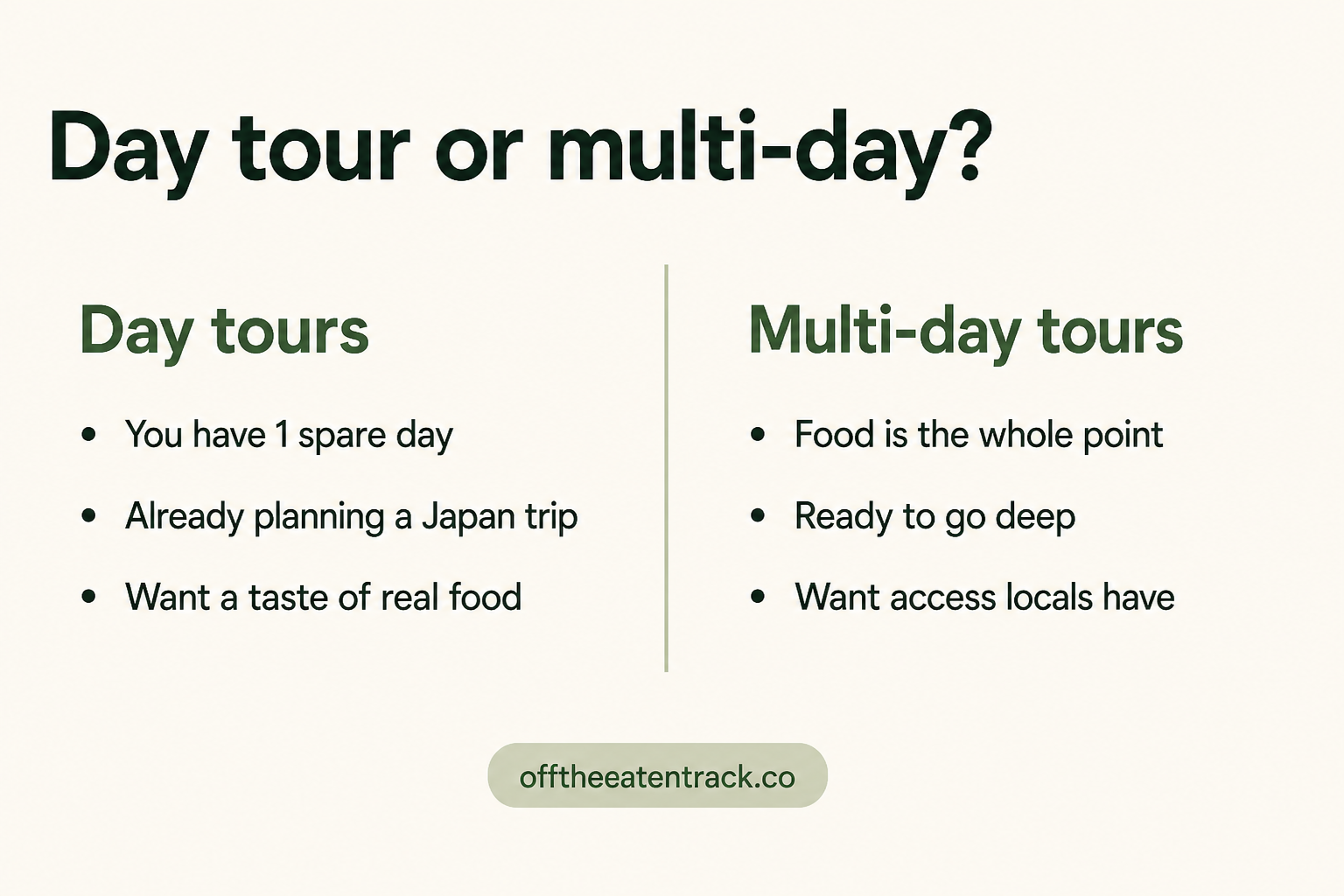
The choice comes down to one question: is food the reason for the trip, or something you want to do well on a trip that's about other things?
If you're already in Japan and want one great food day: Ali Kosaka's fish market tour in Tokyo, Taka's bar crawl in Osaka, Arigato Travel in Tokyo, Osaka, Kyoto or Hiroshima, or Shun Tours for a private Tokyo experience shaped around what you want to eat.
If you want a multi-day journey with food alongside culture: Journey to the East for cultural itineraries across Japan, or Oku Japan for walking routes with regional cuisine along the way.
If food is the reason you're going and you want Japan's major food cities: Eat Japan for Tokyo, Kyoto, Osaka and Nara, or Eating Adventures for a five-day Tokyo deep dive.
If food is the reason you're going and you want regional Japan: Off the Eaten Track for Shikoku, Hokuriku and Tohoku in very small groups at an unhurried pace, or Zenbu Travel at the luxury end, with access built over more than 40 years.
Off the Eaten Track's 2027 Japan tours
Off the Eaten Track has three Japan tours in 2027: Shikoku in March, Hokuriku in May, and a Tohoku festival circuit across July and August. Groups are very small and departures are limited, so spots fill months ahead. Current tours and availability are on the Japan tours page.
Frequently Asked Questions
-
Arigato Travel suits first-time visitors who want food alongside the major sights, with group walking tours of three to four hours in Tokyo, Osaka, Kyoto and Hiroshima. Travellers whose main reason for visiting is food can consider Eat Japan or Eating Adventures for the major cities, or Off the Eaten Track for regional itineraries in Shikoku, Hokuriku and Tohoku.
-
Day food tours in Tokyo and Osaka typically cost ¥5,000 - ¥35,000. Shun Tours' private Tokyo tours start from ¥49,800 per group. Multi-day food tour prices vary greatly, depending on length, region, group size, inclusions, and level of luxury
-
Tokyo and Osaka have the most established day food tours. Ali Kosaka, Shun Tours and Arigato Travel operate in Tokyo, while Taka's bar crawl and Arigato Travel operate in Osaka. Arigato Travel also runs tours in Kyoto and Hiroshima. Multi-day tours reach regions such as Shikoku, Hokuriku and Tohoku.
-
Day food tours typically run two to four hours. Multi-day food tours range from five days for Eating Adventures in Tokyo to 10 to 15 days for operators like Journey to the East and Off The Eaten Track.
-
Food tours are most useful for reaching small restaurants, markets and producers where a guide handles introductions, ordering and explanation. Travellers who are comfortable navigating independently may prefer a single half-day tour to a multi-day one.
-
Spring (March to May) and autumn (September to November) suit most of Japan, with mild temperatures and seasonal produce at its best. Spring coincides with cherry blossom season, which raises prices and crowds in Tokyo, Kyoto and Osaka, while regional Japan stays quieter. Golden Week, from late April to early May, is Japan's busiest domestic travel period. Late autumn is harvest season in Tohoku and Hokuriku.
-
No. Every operator in this guide provides English-speaking guides. Cashless payment is widely accepted, signage is often bilingual and translation apps handle most menus. A guide adds access to small restaurants, producers and makers that are hard to reach independently.
-
Multi-day tours often need booking months ahead. Zenbu Travel and Off the Eaten Track run limited departures with small groups, Eat Japan uses an application process, and Eating Adventures' March and April 2027 tours were mostly sold out at the time of writing. Day tours from Arigato Travel usually have more availability, though popular evening and private tours book up. The more specialist the operator, the more lead time you need.
-
They are all food-first multi-day operators that visit different places. Eat Japan (Scott Brills, maximum seven people, application-based) covers Tokyo, Kyoto, Osaka and Nara. Eating Adventures (Sue and Janice, five days) focuses only on Tokyo. Off the Eaten Track goes to regional Japan, including Shikoku, Tohoku and Hokuriku.
-
Most operators can accommodate common restrictions with advance notice. Vegetarian requests are usually manageable, though many Japanese dishes use fish stock (出汁, dashi), so vegan diets are harder. Shellfish and gluten restrictions should be confirmed directly with the operator before booking, particularly on regional tours where dishes depend on specific local ingredients.
-
Arigato Travel runs group tours in Tokyo, Osaka, Kyoto and Hiroshima with fixed departures and consistently high reviews, and suits travellers who want a reliable, well-organised tour with little lead time. Shun Tours is private only, Tokyo only and priced from ¥49,800 per group. The itinerary bends to what you want to see and eat. Choose Arigato for group energy and broader coverage, and Shun for privacy and customisation.